Wonderful Women Of The World
Posted by Michelle Moquin on 31st March 2012

Good morning!
Well, I don’t think that once since I have been blogging about wonderful women of the world, have I written about a woman that has already passed away. But, what can I say – there is always a first.
I was intrigued this morning when Dahlia posted about Shirley Chisholm. I had never heard of her. Then when Barbara chimed in I was inspired to do a little digging. I found several interesting writes about her. Chisholm is definitely a woman of mettle and no doubt had my blog been around when she was alive, and had my readers mentioned her, I would’ve named her a wonderful woman of the world.
Well…it’s never too late…The moment I started reading I knew that Chisholm would be the woman to blog under my title this morning. Thanks to Dahlia and Barbara for the introduction and the inspiration!
Who cannot love a woman with this tagline: “Unbought and Unbossed”.

Shirley Chisholm’s 1972 Presidential Campaign
by Jo Freeman
February 2005
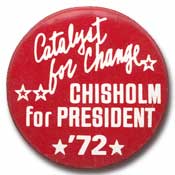 In July of 1971 Shirley Chisholm, Member of Congress from New York’s Twelfth District, began to explore the possibility of running for President. When she formally announced her candidacy the following January 25, she became the first woman and the first African-American to seek the nomination of the Democratic Party for the nation’s highest office. A few other women and other blacks had run on minor party tickets, and Sen. Margaret Chase Smith (R. Me) had campaigned for the Republican Party’s nomination in 1964, but Chisholm’s candidacy was a double first for the Democrats.
As soon as I heard that she might run, I knew that I had found my candidate. I quickly learned that Chisholm was running a grass roots campaign, in which it was up to the grass roots to figure out what needed to be done and to do it. What was needed in Illinois, where I lived while attending grad school at the University of Chicago, was to get her name on the ballot for the March primary.
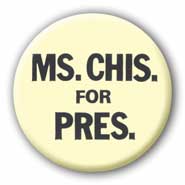
That was easier said than done. Not liking the Daley machine which ran the Democratic Party in Chicago, I had not been active in the local Democratic Party. I soon found out that Illinois would not have a Presidential preference primary in 1972; individuals would run for delegate to the Democratic Convention from each Congressional District, committed to a specific candidate or uncommitted. Only those Presidential candidates who had delegates running in a specific District committed to that candidate would appear on a District ballot. The Daley machine would run a complete slate of 59 in all of Chicago’s Congressional Districts that was officially uncommitted. Unofficially, the Daley delegates would vote the way Mayor Daley wanted them to; controlling a bloc of votes gave him a lot of power at Democratic Conventions.
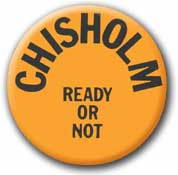
Shirley Chisholm had been breaking barriers and challenging conventions for many years. Born in Brooklyn, NY of West Indian parents, she was the first black woman to sit in Congress. Prior to her election in 1968 she had served in the New York Assembly for four years, following a professional career in child care and early childhood education. To be elected from her mostly black Brooklyn district, she had defied what was left of the Brooklyn Democratic machine. “Unbossed and unbought” was her slogan. On entering the House she had refused a place on the Forestry Subcommittee of the Agriculture Committee because she thought it was irrelevant to someone with her background from a poor, urban district. She was reassigned to Veterans Affairs; eventually she added a seat on her Committee of choice, Education and Labor. She deliberately hired a staff of young women, half of whom were black, for all of her office positions, not just the lower level ones usually occupied by women. Her first term she sponsored a bill to finance day care facilities; it passed Congress only to be vetoed by President Nixon.
It’s unusual for any Member of the House to run for President, especially after serving only three years, but Chisholm was used to doing the unusual. Of course, she didn’t run with the expectation of being nominated, or to increase her clout in Congress. She ran “to give a voice to the people the major candidates were ignoring.”
Although Chisholm made a point of saying that she was not the women’s candidate, she had always been a strong supporter of women’s rights. 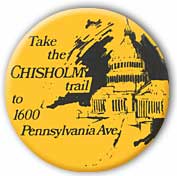 One of the four founders of the National Women’s Political Caucus in 1971, she often said that during her twenty years in local politics “I had met far more discrimination because I am a woman than because I am black.” Indeed Shirley Chisholm was so outspoken in favor of women’s rights that she was often criticized for not paying enough attention to black issues.
I encountered this negative attitude toward Chisholm by black leaders when I went to Operation PUSH, headed by Rev. Jesse Jackson, for help getting on the ballot. Its headquarters was in the First Congressional District, on the other side of the University of Chicago from where I lived. I found no support, just mild disdain.
Relying largely on my fellow grad students for help in petitioning, I was one of four people in the state of Illinois to get enough signatures to appear on the primary ballot committed to Shirley Chisholm, and the only one from a majority black district. When our campaign wrote her that she would be on the ballot in the First District of Illinois, she sent us 100 buttons, 20 bumper stickers and nine position papers on foreign affairs. Everything else we created ourselves. We used an initial $200 in contributions to buy 1,000 buttons, and the money from selling those to pay for ads and to print literature.
Florida was the first state where Chisholm actively campaigned, largely because it had “blacks, youth and a strong women’s movement” and there were a lot of people in Florida eager to organize for her. However, she didn’t have enough money to hire professionals and the volunteers often competed against each other rather than working together. Since she also had to attend to Congressional duties in Washington, Chisholm could only make two campaign tours in Florida before the March 14 primary. A Southern state, the big issue was busing “to correct racial imbalance” in the schools, an issue about which the candidate was ambivalent. Despite large and enthusiastic crowds wherever Chisholm spoke, she got only four percent of the vote.
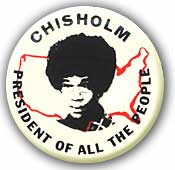 Chisholm continued her campaign wherever she could get on the ballot and had enough volunteers to set up speaking events. She campaigned in New York, New Jersey, California, Massachusetts, Minnesota, Michigan and North Carolina. There were some states in which Chisholm was on the ballot but never had time to visit (e.g. Wisconsin). And others in which she won delegates despite a single appearance (Minnesota). And still more in which she received write-in votes, or votes via delegate candidates (e.g. Illinois). Overall, people in fourteen states voted for Shirley Chisholm for President, in some fashion or other. After six months of campaigning in eleven primaries she had twenty-eight delegates committed to vote for her at the Democratic Convention.
California was a special case, because state law gave all of the delegates to the winner, despite national Democratic Party rules requiring that they be apportioned. McGovern won California; Chisholm came in third with a tenth of his votes— enough to entitle her to twelve of California’s 271 delegates under the national rules. The primacy of state law would be challenged at the convention.
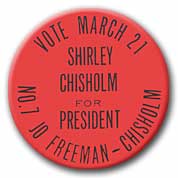
Chisholm made only one appearance in Chicago, where she spoke at Malcolm X Junior College on the west side of the city on March 6. Her two Chicago delegate candidates were running in districts on the north and south sides of the city, but no free venue could be found in either place. Jesse Jackson’s Operation PUSH, which owned its own building (a former synagogue) on the South Side, had declined to invite her to speak there, even though it regularly had some of the best speakers of a liberal persuasion (black and white) in the country.
The Illinois primary was one week after Florida’s. Of course I didn’t win; the Daley machine’s uncommitted candidates won all eight delegate slots in the First District. But in a field of 24 I came in ninth, beating people committed to Sens. George McGovern and Edward M. Kennedy. The next day I read about a challenge to the Daley delegation, which had made no attempt to comply with new Party guidelines requiring that delegations reflect the composition of their districts by race, sex and age. I immediately joined in.
Meeting in June, the Credentials Committee voted that national rules trumped state law in both California and Illinois; the challenge delegations would be seated. However, when the Committee report and recommendations went before the full convention on Monday night in July, the recommendation on California was reversed and all of the McGovern delegates were seated. That decision gave McGovern a lock on the nomination. All the candidate nominations and speeches after that were just window dressing.
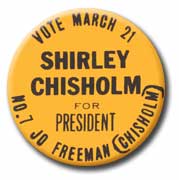
I was not a delegate at this convention, but an alternate. Since the election could not be held over again, the decision about who the Chicago challenge delegates should be was made at meetings of the people who had run for delegate in each District. When I arrived prepared to argue that Chisholm was entitled to at least one delegate because she had received more votes in the First District than anyone else, I found that a pre-meeting had been held and the delegates already agreed upon. Under the affirmative action rules only one of the eight First District delegates could be white, and that slot had been given to the head of the McGovern slate. Six of the seven blacks chosen had run committed to different candidates. One, Jesse Jackson, had not run at all. However, the three alternates had not been pre-selected, so I became the first alternate from the First District.
At the convention I lobbied the eight First District delegates to give one vote to Chisholm, but without success. All eight wanted to feel like they were part of the winning team, and a token vote for a losing candidate was not the way to do that. When the role call was held on Wednesday, Shirley Chisholm received 151.95 votes, including 4.5 from Illinois. None came from Illinois’ First District, even though she had received more votes in the primary from those voters than had McGovern, who got all eight delegate votes. Many of Chisholm’s 151.95 votes came from people who had come to the Democratic convention committed to other candidates, and become disenchanted when the race for the nomination ended on Monday. Ohio delegates gave her 23 votes, even though the Ohio voters hadn’t given her any.
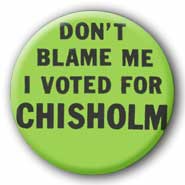
In the primaries and at the convention Chisholm received stronger support from grassroots feminists and blacks than she did from those identified as leaders. Reps. Ron Dellums (CA) and Parren Mitchell (MD) supported her. Betty Friedan and Gloria Steinem ran as Chisholm delegates in New York, but lost. Other Members of Congress and prominent people, both blacks and feminists, ignored her candidacy or opposed it. When Chisholm spoke at a National Black Political Convention in Gary, Indiana in March, she felt like she was treated like an intruder. However, at the Democratic Convention in July, the Chisholm meetings were full of feminists and the final meeting of the caucus of black delegates voted to support her. Most of those attending and voting were not delegates; those who were, were not bound by a caucus decision.
After it was over Chisholm said that if she had to do it over again, she would, but not the same way. Her campaign was under-organized, under-financed and unprepared. She calculated that she raised and spent only $300,000 between July 1971 when she first floated the idea of running, and July of 1972, when the last vote was counted at the Democratic Convention. That did not include the $2,000 that my campaign raised and spent on her behalf, and a lot more by other local campaigns.
By the next Presidential election Congress had passed the campaign finance acts, which required careful record keeping, certification and reporting, among other things. This effectively ended grass roots Presidential campaigns like those in 1972.
Chisholm quotes from her book on the campaign The Good Fight, Harper and Row, 1973.
PBS also aired a film about Chisholm called “Chisholm ’72: Unbought and Unbossed
Film Description
1972 was an extraordinary year. Richard Nixon was president, running for his second, ill-fated term. The voting age had just changed from 21 to 18, and millions of new voters were expected at the polls. The Vietnam War was in full swing, as were anti-war protests, a burgeoning women’s movement, and the rise of the Black Panther Party. Into the center of this maelstrom — shocking the conventional political wisdom — stepped Shirley Chisholm, a determined, rather prim and unapologetically liberal black woman with a powerful message: Exercise the full measure of your citizenship and vote.
 Announcing her candidacy for president on the evening news, Walter Cronkite quipped, “A new hat — rather a bonnet — was tossed into the presidential race today.” As revealed in Chisholm ’72 — Unbought & Unbossed, a new feature documentary having its world broadcast premiere on public television’s POV series, this first-ever run by a woman and person of color for presidential nomination was no laughing matter. Nor was it a polite exercise in symbolic electioneering. The New York Democratic congresswoman’s bid engendered strong, and sometimes bigoted opposition, setting off currents that affect American politics and social perceptions to this day. Shirley Chisholm died at the age of 80 on January 1, 2005, at her home in Florida.
Featuring stirring archival footage, period music, interviews with supporters, opponents and observers, and Chisholm’s own commentary — then and now —Chisholm ’72 is a remarkable recollection of a campaign that broke new ground in politics, and truly reached out to ‘the people.’ Among those interviewed are author/activist Amiri Baraka (then known as LeRoi Jones), Black Panther founder Bobby Seale, authors Susan Brownmiller and Octavia Butler, former Congressmen Reverend Walter Fauntroy and Ronald Dellums, and journalist/historian Paula Giddings.
 Chisholm championed the causes of the poor, the young, minorities, gays, women, and other marginalized Americans. In doing so, she prefigured Jesse Jackson’s Rainbow Coalition campaigns, not only in substance but in style. Chisholm saw the presidential race itself as an opportunity to draw people to politics who traditionally did not participate. In her words, “I ran for the presidency, despite hopeless odds, to demonstrate sheer will and refusal to accept the status quo.” In a race with 12 other candidates, Chisholm’s ultimate goal was to reach the Democratic National Convention in 1972 with a strong show of support.
At a time when Americans were just beginning to contemplate the possibility of a black man running for president, Chisholm was black and female. Chisholm ’72describes her formative years, from modest roots in Brooklyn’s Bedford-Stuyvesant neighborhood and a childhood in Barbados, to winning election to the New York State Assembly and then, in 1968, to become the first black woman ever elected to the U.S. Congress. Although she was no stranger to controversy, the documentary reveals the visceral opposition and blatant disregard to the Congresswoman’s candidacy that came from the establishment and the media.
Many reporters assumed she had no chance of winning and felt she was a spoiler. Feminists, who agreed entirely with Chisholm’s politics, preferred a different strategy, looking to Senator George McGovern as the realistic Democratic candidate. (McGovern eventually won the nomination.)
 All the while, Chisholm remained the “Unbought and Unbossed” candidate, poised and determined to direct the debate and news coverage of her candidacy to her stands on education, employment, health care, and the rights of minorities, women, and gays to full participation in American life. She won a Federal Court order to break the front-runners’ lock on televised debates, winning the chance to talk directly to a national television audience. Chisholm, in fact, struck a populist progressive chord with many Americans. Managing surprisingly strong showings in some state primaries, she carried 151 delegates at the severely divided 1972 Democratic Convention in Miami and won the right to speak from the main podium.
“I had something important to explain,” recalled Chisholm about her historic speech. “I ran because somebody had to do it first. I ran because most people thought the country was not ready for a black candidate, not ready for a woman candidate. Someday — it was time in 1972 to make that someday come.”
Chisholm ’72 recaptures the times and spirit of a watershed event in American politics, when a black woman dared to take an equal place on the presidential dais.
“Our goal was to make a documentary as passionate and powerful as Chisholm herself,” says director and co-producer Shola Lynch. “Her story is an important reminder of the power of a dedicated individual to make a difference.” It also reminds us that the country belongs to each of us only if we dare to claim our place in it.
******
Readers: What’s not to admire – Chisholm was an amazing woman. I wish she was still around inspiring women. But I have to say, just watching a few moments of the trailer, and listening to the strength, determination and commitment in her voice…I was certainly inspired and moved. If you’re intereted in seeing the entire film, you can purchase it on Amazon.
Peace & Love…
Lastly, greed over a great story is surfacing from my “loyal”(?) readers. With all this back and forth about who owns what, that appears on my blog, let me reiterate that all material posted on my blog becomes the sole property of my blog. If you want to reserve any proprietary rights don’t post it to my blog. I will prominently display this caveat on my blog from now on to remind those who may have forgotten this notice.
Gratefully your blog host,
michelle
Aka BABE: We all know what this means by now :)
If you love my blog and my writes, please make a donation via PayPal, credit card, or e-check, please click the “Donate” button below. (Please only donations from those readers within the United States. – International readers please see my “Donate” page)
Or if you would like to send a check via snail mail, please make checks payable to “Michelle Moquin”, and send to:
Michelle Moquin PO Box 29235 San Francisco, Ca. 94129
Thank you for your loyal support!
All content on this site are property of Michelle Moquin © copyright 2008-2012

“Though she be but little, she be fierce.” – William Shakespeare Midsummer Night’s Dream
" Politics, god, Life, News, Music, Family, Personal, Travel, Random, Photography, Religion, Aliens, Art, Entertainment, Food, Books, Thoughts, Media, Culture, Love, Sex, Poetry, Prose, Friends, Technology, Humor, Health, Writing, Events, Movies, Sports, Video, Christianity, Atheist, Blogging, History, Work, Education, Business, Fashion, Barack Obama, People, Internet, Relationships, Faith, Photos, Videos, Hillary Clinton, School, Reviews, God, TV, Philosophy, Fun, Science, Environment, Design, The Page, Rants, Pictures, Church, Blog, Nature, Marketing, Television, Democrats, Parenting, Miscellaneous, Current Events, Film, Spirituality, Obama, Musings, Home, Human Rights, Society, Comedy, Me, Random Thoughts, Research, Government, Election 2008, Baseball, Opinion, Recipes, Children, Iraq, Funny, Women, Economics, America, Misc, Commentary, John McCain, Reflections, All, Celebrities, Inspiration, Lifestyle, Theology, Linux, Kids, Games, World, India, Literature, China, Ramblings, Fitness, Money, Review, War, Articles, Economy, Journal, Quotes, NBA, Crime, Anime, Islam, 2008, Stories, Prayer, Diary, Jesus, Buddha, Muslim, Israel, Europe, Links, Marriage, Fiction, American Idol, Software, Leadership, Pop culture, Rants, Video Games, Republicans, Updates, Political, Football, Healing, Blogs, Shopping, USA, Class, Matrix, Course, Work, Web 2.0, My Life, Psychology, Gay, Happiness, Advertising, Field Hockey, Hip-hop, sex, fucking, ass, Soccer, sox"
Posted in Wonderful Women Of The World | 27 Comments »