For those of you interested in reading an Earthling Girl's Guide to a better Government, and a Greener world, check out the blog:
Contact Your Representatives and Senators Here!
To send letters to your representatives about any issue of interest, Click here
To send letters to your Senators about any issue of interest, Click here
Get involved - Write your letters today!
On The Issues
Don't be uninformed!
Click here to see how every political leader on every issue voted.
Don’t Believe The Lies – Get The Facts
FactCheck.org is a nonpartisan, nonprofit “consumer advocate” for voters that aims to reduce the level of deception and confusion in U.S. politics. They monitor the factual accuracy of what is said by major U.S. political players in the form of TV ads, debates, speeches, interviews and news releases. Their goal is to apply the best practices of both journalism and scholarship, and to increase public knowledge and understanding.
Pulitzer Prize Winner Politifact.com is another trusted site to get the facts. Click here to get the facts.
Who’s Paying Who?
On The Issues is a nonpartisan guide to money's influence on U.S. elections and public policy.
Blog Rules of Conduct
Rule #1: "The aliens can not reveal anything about anyone’s life that would not be known without the use of our technology. The exception being that if a reader has a question about his or her health and the assistance of alien technology would be necessary to answer that question.”
Rule #2: "Aliens will not threaten humans and Humans will not threaten aliens."
Rule #3:
Posting Comments:
When posting a comment in regards to any past or archived article, please reference the title and date of the article and post your comment on the present day to keep the conversation contemporary.
NOTE: You do not need to add your e-mail address when posting a comment. Your real name, an alias, a moniker, initials...whatever ...even simply "anonymous" is all you need to add in the fields in order to post a comment.
I DO NOT CENSOR COMMENTS POSTED TO THIS BLOG: Therefore this blog is not for the faint hearted, thin skinned, easily offended or the appointed people's moralist. If you feel that you may fit in any of those categories, please DO NOT read my blog or its comments. There are plenty of blogs that will fit your needs, find one. This warning also applies to those who post comments who would find it unpleasant or mentally injurious to receive an opposing opinion via a raw to vulgar delivery. I DO NOT censor comments posted here. If you post a comment, you are on notice that you may receive a comment in language or opinion that you will not approve of or that you feel is offensive. If that would bother you, DO NOT post on my blog.
27Mar2011
Medical Disclaimer:
I am not a doctor nor am I medically trained in any field. No one on this website is claiming to be a medical physician or claiming to be medically trained in any field.
However, anyone can blog information about health articles, folk remedies, possible cures, possible treatments, etc that they have heard of on my blog. Please see your physician or a health care professional before heeding or using any medical information given on this blog. It is not intended to replace any medical advice given to you by your licensed medical professional. This blog is simply providing a medium for discussion on all matters concerning life. All opinions given are the sole responsibility of the person giving them. This blog does not make any claim to their truthfulness, honesty, or factuality because of their presence on my blog.
Again, Please consult a health care professional before heeding any health information given here.
27Mar2011
Legal Disclaimer:
Michelle Moquin's "A Day In The Life Of..." publishes the opinions of expert authorities in many fields. But the use of these opinions is no substitute for legal, accounting, investment, medical and other professional services to suit your specific personal needs. Always consult a competent professional for answers to your specific questions.
27Mar2011
Fair Use Notice Disclaimer
This web site may contain copyrighted material the use of which has not always been specifically authorized by the copyright owner. We are making such material available in our efforts to advance the understanding of humanity's problems and hopefully to help find solutions for those problems.
We believe this constitutes a 'fair use' of any such copyrighted material as provided for in section 107 of the US Copyright Law. In accordance with Title 17 U.S.C. Section 107, the material on this site is distributed without profit to those who have expressed a prior interest in receiving the included information for research and educational purposes. A click on a hyperlink is a request for information.
However, if you wish to use copyrighted material from this site for purposes of your own that go beyond 'fair use', you must obtain permission from me.
You can read more about "fair use' and US Copyright Law"at the"Legal Information Institute of Cornell Law School." This notice was modified from a similar notice at "Common Dreams."
Archive for the 'Wonderful Women Of The World' Category
Social Butterfly: Thank you for sparking my interest in Aliaa Maghda Elmahdy, and her blog “A Rebel’s Diary“! I love and applaud Elmahdy’s boldness…her courageous stance in the face of being an Egyptian woman, and living in Egypt, a place of horrific extremism where women have no rights…where their men treat them as sexual objects, breeding machines…Elmahdy’s story is so inspiring, I could not help but post her today under the title heading. This gutsy girl certainly deserves it.
Here’s a write from an interview that Elmahdy did with CNN. Note: CNN didn’t post her fully naked picture but I decided to include it. I am sure those that oppose are going to be pissy that I’m not only featuring her today as a Wonderful Woman Of The World, but that I am posting her beautiful naked body. Fuck ‘em. Freedom of speech..freedom of press….as long as I am able.
Cairo, Egypt (CNN) – Egyptian blogger Aliaa Magda Elmahdy has become a household name in the Middle East and sparked a global uproar after a friend posted a photo of her naked on Twitter.
The photo, which the 20-year-old former student first posted on herblog, shows her naked apart from a pair of thigh-high stockings and some red patent leather shoes.
It was later posted on Twitter with the hashtag#nudephotorevolutionary. The tweet was viewed over a million times, while Elmahdy’s followers jumped from a few hundred to more than 14,000.
Her actions have received global media coverage and provoked outrage in Egypt, a conservative Muslim country where most women wear the veil. Many liberals fear that Elmahdy’s actions will hurt their prospects in the parliamentary election next week.
Elmahdy describes herself as an atheist. She has been living for the past five months with her boyfriend, bloggerKareem Amer, who, in 2006 was sentenced to four years in a maximum security prison for criticizing Islam and defaming former president Hosni Mubarak.
Here she talks exclusively to CNN in Cairo about why she posed nude.
CNN:Why did you post a photo of yourself nude photo on Twitter, and why the red high heels and black stockings?
Elmahdy: After my photo was removed from Facebook, a male friend of mine asked me if he may post it on Twitter. I accepted because I am not shy of being a woman in a society where women are nothing but sex objects harassed on a daily basis by men who know nothing about sex or the importance of a woman.
The photo is an expression of my being and I see the human body as the best artistic representation of that. I took the photo myself using a timer on my personal camera. The powerful colors black and red inspire me.
CNN:Who is Aliaa Elmahdy inside the body portrayed in the nude photo?
Elmahdy: I like being different. I love life, art, photography and expressing my thoughts through writing more than anything. That is why I studied media and hope to take it further to the TV world too so I can expose the truth behind the lies we endure everyday in this world. I don’t believe that we must have children only through marriage. It’s all about love.
CNN: How have your Egyptian Muslim parents reacted? How do they feel about you living with your boyfriend unmarried?
Elmahdy: I last spoke to them 24 days back. They want to support me and get closer, especially after the photo was released, but they accuse Kareem of manipulating me. He has been my support system and has passed along their text messages to me. I dropped out of AUC (The American University in Cairo where she was a media student) months back after (my parents) attempted to control my life by threatening not to pay the fees.
CNN:The press has labeled you a revolutionary but you were not in Tahrir Square during the 18 days of the revolution in February this year. Is there a political element to you posing nude?
Elmahdy: I was never into politics. I first joined the protests on May 27th because I felt the need to participate and decided I might be able to change the future of Egypt and refused to remain silent. I made it clear that I was not part of April 6th Movement (an Egyptian political group that came to prominence during the revolution) after the rumors were spread by remnants of Mubarak’s National Democratic Party who wanted to capitalize on the reaction to the photo.
What shocked me is April 6th’s statement clarifying that Aliaa Magda Elmahdy is not part of their organization and how they don’t accept “atheism.” Where is the democracy and liberalism they preach to the world? They only feed what the public wants to hear for their political ambitions.
CNN: What do you think about the forced virginity testsperformed by the Egyptian military on more than a dozen girls arrested in Tahrir Square?
Elmahdy: I consider this rape. Those men in the military who conducted these tests should be punished for allowing this to happen without the consent of the girls in the first place. Instead, the girls walk around feeling the shame and most of them are forced to remain silent.
CNN: Do you practice safe sex in your sexual revolution?
Elmahdy: Most Egyptians are secretive about sex because they are brought up thinking sex is something bad and dirty and there is no mention of it in schools. Sex to the majority is simply a man using a woman with no communication between them and children are just part of an equation. To me, sex is an expression of respect, a passion for love that culminates into sex to please both sides.
I do practice safe sex but I don’t take pills because I am against abortion. I enjoyed losing my virginity at the age of 18 with a man I loved who was 40 years older than me. Kareem Amer is the second man and the love of my life. The saying suits us: “Birds of the same feather flock together”
CNN: How do you see women in the “New Egypt” and will you leave the country if the ongoing revolution fails?
Elmahdy: I am not positive at all unless a social revolution erupts. Women under Islam will always be objects to use at home. The (sexism) against women in Egypt is unreal, but I am not going anywhere and will battle it ’til the end. Many women wear the veil just to escape the harassment and be able to walk the streets. I hate how society labels gays and lesbians as abnormal people. Different is not abnormal!
CNN: What are your future plans with Kareem and will you find it hard to deal with your new notoriety?
Elmahdy: I have discovered who my real friends are, and I have Kareem who loves me passionately. He works as a media monitor and I am currently looking for a job. I embrace the simple things in life and I am a vegetarian … I am a believer of every word I say and I am willing to live in danger under the many threats I receive in order to obtain the real freedom all Egyptian are fighting and dying for daily.
From Elmahdy’s blog with the caption that /SB posted:
…Elmahdy repeats her initial nude pose, this time covering her genitals, eyes and mouth with a yellow bar. “The yellow rectangles on my eyes, mouth and sex organ resemble the censoring of our knowledge, expression and sexuality,” she wrote.
*******
Readers: This girl Elmahdy is not just bold and gutsy but she’s got a brain too. I think she is just so intelligent. I am proud to be able to tout her in all of her glory. She is an inspiration to me and no doubt to so many more. I HOPE this is just the beginning of the greatness that we will surely see from her.
Thank you again Social Butterfly! And thank you for sharing how you were able to access my blog once you had trouble seeing it. It seems that was helpful to Dehlia. I HOPE it is helpful for others as well.
Lois: Your guess is as good as mine. Who knows! People are stupid or think that they’re going to be a part of that 1% some day. Romney is telling it like it is, blatantly, and some people will still vote for him. Inane isn’t it?
ZL, Christine, and all those that wanted to but couldn’t wish a wonderful Thanksgiving, thank you.
Howie: I like your words. In these times it can be challenging to see the glass half full, so thanks for the reminder…and the kudos.
Doug: Interesting comparison. It can be those same people who take more time planning their vacation, than planning their retirement. We need to do more than HOPE for our future; we need to be, in the words of Ellie Drake of BraveHeart Women, ”inspiration in action”. Just love that.
Peace out.
Lastly, greed over a great story is surfacing from my “loyal”(?) readers. With all this back and forth about who owns what, that appears on my blog, let me reiterate that all material posted on my blog becomes the sole property of my blog.If you want to reserve any proprietary rights don’t post it to my blog. I will prominently display this caveat on my blog from now on to remind those who may have forgotten this notice.
Gratefully your blog host,
michelle
Aka BABE: We all know what this means by now :)
If you love my blog and my writes, please make a donation via PayPal, credit card, or e-check, please click the “Donate” button below. (Please only donations from those readers within the United States. – International readers please see my “Donate” page)
Or if you would like to send a check via snail mail, please make checks payable to “Michelle Moquin”, and send to:
Michelle Moquin PO Box 29235 San Francisco, Ca. 94129
I don’t know about you, but when Michael Jackson first sang “Man In The Mirror”, I broke out in tears from his inspirational words. Little did I know then that he was not the writer of the song that so moved me every time I heard it. Don’t get me wrong, the fact that he didn’t write it doesn’t change my views of how he sings it…how he makes me feel when he belts out the words – I still thinks Michael sings it amazingly – his energy is like no other.
But…my new love is for the original writer. I had the pleasure of meeting her and witnessing her wonderfulness during an 11.11.11 transformational celebration that I attended during a BraveHeart Women’s conference last weekend. It was then that I learned who actually wrote this uplifting song. Her name? Siedah Garrett.
A triple threat singer, songwriter and performer, Siedah has written for a diverse selection of recording artists from Aretha Franklin to Al Jarreau, from The Korrs to Vanessa Williams, and from Barry White to Amy Grant. Siedah’s songs are featured on hit albums such as Quincy Jones’ Back On The Block and Paula Abdul’s Forever Your Girl. Siedah is probably best know for co-writing Michael Jackson’s worldwide hit, “Man In The Mirror.”
As a vocalist, she not only dueted with Jackson on the hit single “I Just Can’t Stop Loving You,” but she has also sung with a wide array of acts including Johnnie Mathis, Patti Austin, Quincy Jones, The Pointer Sisters, The Commodores, Kenny Loggins, Chaka Kahn and others.
As a member of London’s acclaimed neo-funk Brand New Heavies, Siedah co-wrote over half of the group’s album Shelter, which sold over a million copies in the United Kingdom.
From the start, Siedah’s new self titled album seemed to possess a life all its own. When the singer-songwriter decided to return to the recording studio, several of her highly regarded peers enthusiastically offered their services, just to be part of the project.
“I’m very proud of that fact that I cut the tracks live with the band, and what you hear is real and organic,” Siedah says. “Before I started recording, I put together a core band that would give consistency throughout the album, and allow me to perform my songs live.
“The result of this approach is an album that connects the dots between danceable rock ‘n’ roll, intelligent pop and pumped-up R&B.
Siedah relishes its rock-pop thrust, noting that “the general feel of this record is uplifting, truthful and revealing.” With its unforgettable songs, thought-provoking lyrics and earthy performances, this new album demonstrates Siedah’s gift for artistic reinvention. SIEDAH is the latest evolutionary step in a distinguished musical career.
I am posting a video of her tribute to Michael Jackson, where she sings “Man In The Mirror” backed by the Agape International Choir.
Michael, you are, and will forever be the thread of velvety voice, so intricately woven into the fabric of the soundtrack of my life. Your music, talent, heart and soul has touched every cell of my being. More than enough to last a lifetime. You are magic. And I will miss you. May your vibrant soul rest in eternal peace. You changed my life, and for that I will love you forever.
Siedah
AKA “Miss Gayree”
Readers: This girl deserves all the kudos one can give. She is truly talented, and her talent goes far beyond “The Man In The Mirror”. The concert that she performed for BraveHeart Women, was so uplifting, her passion so addictive, her moves and smile, so wide and intoxicating. And that is just her presence. I could go on and on – I just couldn’t get enough of her.
Please do peruse Garrett’s website where you can hear more of her music. Although I encourage you to watch her if you can, as she is truly amazing…she is inspiration in action.
Love her as much as I do? Blog me.
If you want to make the world a better place, take a look at yourself and make that change.
~Siedah Garrett
Peace & Love
Lastly, greed over a great story is surfacing from my “loyal”(?) readers. With all this back and forth about who owns what, that appears on my blog, let me reiterate that all material posted on my blog becomes the sole property of my blog.If you want to reserve any proprietary rights don’t post it to my blog. I will prominently display this caveat on my blog from now on to remind those who may have forgotten this notice.
Gratefully your blog host,
michelle
Aka BABE: We all know what this means by now :)
If you love my blog and my writes, please make a donation via PayPal, credit card, or e-check, please click the “Donate” button below. (Please only donations from those readers within the United States. – International readers please see my “Donate” page)
Or if you would like to send a check via snail mail, please make checks payable to “Michelle Moquin”, and send to:
Michelle Moquin PO Box 29235 San Francisco, Ca. 94129
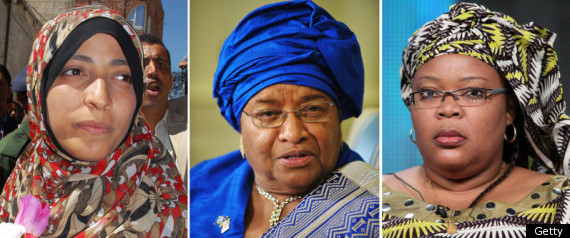
Liberian President Ellen Johnson Sirleaf, peace activist Leymah Gbowee, and human rights activist Tawakkul Karman have been awarded the Nobel Peace Prize. The Nobel Prize Committee lauded their non-violent struggle for the safety of women and women’s rights to fully participate in peace-building work. The three recipients were announced today in a ceremony in Oslo, Norway.
“It is the Norwegian Nobel Committee’s hope that the prize to Ellen Johnson Sirleaf, Leymah Gbowee and Tawakkul Karman will help to bring an end to the suppression of women that still occurs in many countries, and to realise the great potential for democracy and peace that women can represent.”
Karman, a 32-year-old mother who heads the human rights group Women Journalists without Chains, has been a leading figure in the protests against Yemeni President Ali Abdullah Saleh. “She is known among Yemenis as ‘the iron woman’ and the ‘mother of the revolution,’” the Associated Press writes. “A conservative woman fighting for change in a conservative Muslim and tribal society, Tawakkul Karman has been the face of the mass uprising against the authoritarian regime of President Ali Abdullah Saleh.”
“I am very very happy about this prize,” Karman told the news service from a protest tent in Sanaa. “This prize is not for Tawakkul, it is for the whole Yemeni people, for the martyrs, for the cause of standing up to (Saleh) and his gangs. Every tyrant and dictator is upset by this prize because it confronts injustice.”
“With two civil wars, an al-Qaida presence and 40% unemployment, what else is President Saleh waiting for? He should leave office now,” she told The Guardian.
Johnson Sirleaf, 72, is a Harvard-trained economist who became Africa’s first democratically elected female president in 2005.
Sirleaf was seen as a reformer and peacemaker when she took office in Liberia, a country ravaged by civil wars that is still struggling to maintain a fragile peace.
Sirleaf is running for re-election this month and opponents i have accused her of buying votes and using government funds to campaign. Sirleaf denies the charges.
The committee cited Johnson Sirleaf’s efforts to secure peace in her country, promote economic and social development and strengthen the position of women.
“We are dancing,” Bushuben Keita, a spokesman for Mrs. Johnson Sirleaf’s United Party told The New York Times. “This is the thing that we have been saying, progress has been made in Libera. We’ve come through 14 years of war and we have come to sustained peace. We’ve already started dancing.”
Gbowee, head of the Women Peace And Security Network, was honored by the Committee for for mobilizing women “across ethnic and religious dividing lines to bring an end to the long war in Liberia, and to ensure women’s participation in elections.” Gbowee brought together Christian and Muslim women against the power of Liberia’s warlords.
“I know Leymah to be a warrior daring to enter where others would not dare,” Gbowee’s assistant, Bertha Amanor, said to the AP. “So fair and straight, and a very nice person.”
The prize is awarded by a five-person committee chosen by the Norwegian parliament, lead this year by Thorbjoern Jagland. Speculation had swirled over who would receive the prize, with Jagland telling the Associated Press that the prize would be given to something “obvious” that he considered “the most positive development” in the world right now.
According the official Nobel Prize website, today’s presentation marks the 92nd time the Nobel Peace Prize has been awarded since 1901.
When Alfred Nobel died in 1895, part of his last will and testament requested the distribution of his fortune as prizes for “the person who shall have done the most or the best work for fraternity between nations, for the abolition or reduction of standing armies and for the holding and promotion of peace congresses.” Last year’s winner, Liu Xiaobo, received the award for his struggle for human rights in China. President Barack Obama received the Nobel Peace Prize the previous year for his efforts in international diplomacy.
How well do you know past Nobel Peace Prize winners? Click here to take the quiz and find out!
♥♥♥♥♥♥♥
Readers:Three Wonderful Women of the World! How delightful that the Nobel Peace Prize winners of 2011 are all women! I am not surprised, just simply thrilled. Can you imagine? We have three women that are so amazing that just one couldn’t be chosen as the winner, so this prestigious award was divided between the three of them!
It just goes to show you that women are doing wonderful things for this world…and for the lives of women now and in our future. They deserve the great recognition that they are receiving. And I take great pleasure in honoring them as Wonderful Women of the World.
I have more to say but Doug and Lucy are calling, so I’ll end my write and comment to the rest of you that I want to address tomorrow. Have a wonderful Saturday everyone!
Blog me. Peace out.
Lastly, greed over a great story is surfacing from my “loyal”(?) readers. With all this back and forth about who owns what, that appears on my blog, let me reiterate that all material posted on my blog becomes the sole property of my blog.If you want to reserve any proprietary rights don’t post it to my blog. I will prominently display this caveat on my blog from now on to remind those who may have forgotten this notice.
Gratefully your blog host,
michelle
Aka BABE: We all know what this means by now :)
If you love my blog and my writes, please make a donation via PayPal, credit card, or e-check, please click the “Donate” button below. (Please only donations from those readers within the United States. – International readers please see my “Donate” page)
Or if you would like to send a check via snail mail, please make checks payable to “Michelle Moquin”, and send to:
Michelle Moquin PO Box 29235 San Francisco, Ca. 94129
Just the fact alone that Elizabeth Warren is running against Scott Brown, and is in the lead for the Senate seat in Massachusetts, let me remind you, is reason enough to pin her with the badge of ”Wonderful Woman Of The World”.
Elizabeth Warren, Democratic Senate candidate in Massachusetts and former White House financial reform adviser, blasted Republicans at an appearance In Andover last month for accusing Democrats of engaging in “class warfare.”
“I hear all this, you know, ‘Well, this is class warfare, this is whatever,’” Warren said. “No. There is nobody in this country who got rich on his own — nobody.”
Republican lawmakers have criticized President Barack Obama in recent weeks for engaging in “class warfare.” House Majority Leader Eric Cantor (R-Va.) argued in an op-ed last month that the president was “anti-business, hyper-regulatory [and] pro-tax” and “fueled by efforts to incite class warfare.”
House Speaker John Boehner (R-Ohio) had a similarcriticism after Obama unveiled his new deficit reduction plan this month, which features a proposed tax on millionaires, saying “Class warfare isn’t leadership.”
In Andover, Warren went on to discuss the “social contract” and how it benefits everyone:
“You built a factory out there? Good for you. But I want to be clear: you moved your goods to market on the roads the rest of us paid for; you hired workers the rest of us paid to educate; you were safe in your factory because of police forces and fire forces that the rest of us paid for. You didn’t have to worry that marauding bands would come and seize everything at your factory, and hire someone to protect against this, because of the work the rest of us did.“Now look, you built a factory and it turned into something terrific, or a great idea? God bless. Keep a big hunk of it. But part of the underlying social contract is you take a hunk of that and pay forward for the next kid who comes along.”
Democrats have fought back against the “class warfare” charges by drawing attention to the dramatic cuts that Republicans have proposed to programs benefiting low- and middle-income Americans.
Obama disputed the claim during a speech on Monday, saying his newest plan “is not class warfare. It’s math.”
Warren — who formally entered the Senate race less than two weeks ago — currently has a slight edge over her competitor, Republican Scott Brown, according to a recent poll by the Democratic-affiliated firm Public Policy Polling.
Her comments were captured on video and posted to YouTube by an individual who claims not to be involved with Warren’s campaign, according to Talking Points Memo.
*********
Readers: That’s it for me this morning. Blog me and have a wonderful Saturday!
Lastly, greed over a great story is surfacing from my “loyal”(?) readers. With all this back and forth about who owns what, that appears on my blog, let me reiterate that all material posted on my blog becomes the sole property of my blog.If you want to reserve any proprietary rights don’t post it to my blog. I will prominently display this caveat on my blog from now on to remind those who may have forgotten this notice.
Gratefully your blog host,
michelle
Aka BABE: We all know what this means by now :)
If you love my blog and my writes, please make a donation via PayPal, credit card, or e-check, please click the “Donate” button below. (Please only donations from those readers within the United States. – International readers please see my “Donate” page)
We’ve all heard of the Vagina Monologues. And probably many of you have seen them performed. Eve Ensler, writer, is the author of the Vagina Monologues, translated into over 48 languages and performed in over 140 countries. Her monologues may be all talk but this girl isn’t. Ensler’s obsession with vaginas lead her to do something more…something bigger for women. Ensler is the founder of V-Day, a global activist movement to end violence against women and girls.
And in 2010 Ensler with UNICEF, and in partnership with Panzi Foundation opened the City Of Joy, a special facility for the survivors of sexual violence in Bukavu, Democratic Republic of Congo. I have written about the atrocities to women in Congo quite a few times here, and I can’t think of any other woman that would be better, and more suited to ending the violence against women and girls in Congo.
City of Joy
A goal of the STOP RAPING OUR GREATEST RESOURCE: Power To The Women And Girls Of The DRC campaign is to provide necessary resources and support for women to rebuild and transform their lives. A centerpiece of the campaign is to support community reintegration for survivors of rape, specifically those who face extreme challenges in returning home due to community rejection and trauma. V-Day and UNICEF in partnership with Panzi Foundation are currently building a special facility for the survivors of sexual violence.
Conceived, created and developed by the women on the ground, the City of Joy in Bukavu, Democratic Republic of Congo will support women survivors of sexual violence to heal and provide them with opportunities to develop their leadership through innovative programming. Through its groundbreaking model, the City of Joy will provide up to 180 women a year with an opportunity to benefit from: group therapy; storytelling; dance; theater; self-defense; comprehensive sexuality education (covering HIV/AIDS, family planning); ecology and horticulture; and economic empowerment.
The City of Joy will provide women a place to heal emotionally as they rebuild their lives, turn their pain to power, and return back into their communities to lead.
Eastern Congo is the rape capital of the world and the worst place on earth to be a woman. Katharine Viner reports on a radical new centre that promises its citizens a better future.
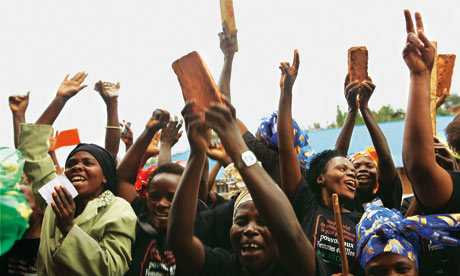
Women builders were part of the team that constructed City of Joy. At the opening ceremony they danced with bricks on their heads. Photograph: Paula Allen
Jeanne is 27, with a round face that makes her look younger, but she struggles on to the stage. She finds walking difficult, ever since she was tied to a tree and gang raped for many weeks, had surgery to repair the damage, went home and was raped again. She became pregnant during one of the attacks and was forced to give birth in the company of the militias; the baby died. Jeanne finally escaped to the Panzi hospital inBukavu, at the eastern edge of the Democratic Republic of the Congo. She has had repeated operations on her desecrated lower body. She looks small, shy, defeated.
But then this woman, a victim of the biggest horror story of modern times, in one of Africa‘s largest countries, steps up to the microphone and starts to speak.
“When you look at me, what do you see?” she asks, with the bold delivery of the born orator, the preacher, the leader. “Do you see me as an animal? Because you are letting animals treat me like one. You, the government, if it was your children, would you stop it? You, you white people: if this violence was happening in your country, would you end it?” She speaks with the kind of fury and focus rarely seen in western politics. Hundreds of other survivors of sexual violence in the audience cheer wildly.
Jeanne (who has requested her last name be withheld for her protection) is not the only speaker here at the opening of City of Joy, a centre for survivors of rape in Bukavu. There is the founder, the New York playwright, author of The Vagina Monologues and activist Eve Ensler. There is Obama’s ambassador for women and girls, a prominent congresswoman, someone from the UN. But it is Jeanne who steals the show. And this is the premise on which the centre is founded: that even the most traumatised and brutalised people need not be mere passive recipients of foreign aid, but can in fact become political leaders.
For more than a decade, eastern Congo has become infamous as the “rape capital of the world” and the “worst place on earth to be a woman”. The UN has confirmed these facts. Half a million women, perhaps many more, have been raped since 1998, and in particularly brutal ways. And one response has been the building of City of Joy, a haven where survivors of gender violence who have healed physically (not always straightforward) live for six months and are educated. It is the product of a shared vision that the women don’t just need help, they need power. “Eve asked us what we wanted,” says Jeanne, the orator. “And we said: shelter. A roof. A place where we can be safe. And a place where we can be powerful. That’s what we now have.” Jeanne, and women like her, hope to change Congo for good.
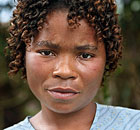
Jeanne, 27: ‘If this was happening in your country, would you end it?’ Photograph: Paula Allen
The grand opening of City Of Joy, in February, is a big party: survivors in celebration clothes dance and sing and bang drums. Some, very badly injured, are carried in. Women who helped construct City of Joy dance with bricks balanced on their heads. Local men taking a stand against sexual violence – the “V-men” (after Ensler’s feminist V-Day movement) – make themselves visible with special T-shirts. American donors join a conga line. Women from the stage speak not just of rape but about laws that discriminate against women, the lack of free HIV treatment, what happens to the children of rape. There’s a lot of hugging, but the atmosphere is fierce.
The centre’s story begins in 1999, when the gynaecologist Denis Mukwege, of Bukavu’s Panzi hospital, rang his friend Christine Schuler-Deschryver, a human rights worker in the town. He said he had started to see injuries he had never seen before – women who had been raped in terrible ways, whose reproductive organs had been wrecked, who were suffering from fistulas between the vagina and rectum inflicted not just by gang rape but also by attacks with sticks, guns, bottles. “I said to Christine, this is new,” he recalls. “Their vaginas are destroyed. I couldn’t understand what was going on.”
Everyone in Bukavu knows Christine – she is 6ft without heels (and she’s never without heels), mixed race (her father was from a family of Belgian colonisers, her mother a Congolese servant in the tea fields of his plantation), dramatic, demanding. “When Dr Mukwege told me about these injuries, we were very afraid,” she says. “And then, in 2000, I was in my office when a woman ran in with a baby girl, 18 months old, her legs both broken back – the baby had been raped. She died in my car on the way to Panzi hospital. I ran into the cathedral with the dead baby in my arms, shouting at God. And that was the day I became a radical fighter.”
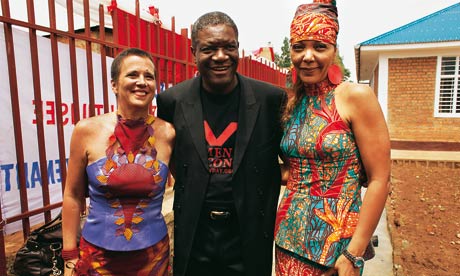
Left to right: City of Joy founders Eve Ensler, Denis Mukwege and Christine Schuler-Deschryver. Photograph: Paula Allen
Bukavu is a ragged, devastated town built on the banks of Lake Kivu in the east of Congo; at one time the Belgian colonisers tried to make it a lakeside retreat, so stunning is the setting. There are no roads, so when it rains the pathways turn to mud. Women (rarely men) stagger beneath gigantic sacks of cassava and charcoal; they sit on the ground with a single tomato to sell. Once a town of 50,000, it is now home to hundreds of thousands, most of whom have fled fighting in the bush to come to the comparative safety of the city.
Congo is the size of all of western Europe, with a very weak state. It is also the poorest country on earth, by GDP, and yet one of the richest in terms of resources – the fertile soil that produces such a lush landscape and juicy avocados brings with it gold, diamonds and precious minerals, with criminals, militia and kleptocrat politicians not far behind. Since colonialism, when King Leopold II of Belgium ran a notoriously genocidal regime in order to plunder Congo’s rubber, armies have tried to grab its wealth. President Mobutu, who renamed Congo Zaire and stole a personal fortune of billions, showed that it wasn’t only outsiders who could get in on the act. Today’s gold rush is over coltan – Congo has 80% of Africa’s reserves of the mineral, which is used in mobile phones, laptops, iPads; with the resource in such demand, there’s a direct link between the technology consumer boom and the fighting in Congo.
Rape is a feature of war, and is often seen as an inevitability – the second world war general George Patton wrote that “there would unquestionably be some raping”. But it is more widespread and more violent in some wars than others. According to Joanna Bourke, author of Rape: A History, its prevalence depends on how violent a society is already; the disparities between men and women in the culture; whether soldiers fear any kind of punishment for rape; and the extent to which the values that enable mass rape are shared by men on each side of the conflict. On every count, Congo rates disastrously. And there’s also a particular problem, what Jean-Claude Kibala, the deputy governor ofSouth Kivu, describes as a “bomb in the middle of society”: former child soldiers. “Nobody has a programme for how to deal with them,” he says. He tells of a bodyguard who kept falling asleep during the day. “The bodyguard explained, ‘When I was a child I was forced to bury a man who was still alive. This image is with me every night and I can’t sleep in darkness.’ There are people like that all through our society. Destruction and rape are destroying all humanity in the province.”
The particular brand of brutality that emerged in eastern Congo in the late 1990s has its roots in the Rwandan genocide of 1994, when 800,000 Tutsis and some Hutus were murdered in three months by Hutu gangs known as the interahamwe (what they call themselves) orgenocidaires (what their opponents call them). When the genocide was stopped by the arrival of the Tutsi exile-led Rwandan Patriotic Front, the interahamwe fled to eastern Congo where they established gigantic refugee camps in Goma, a town close to the Rwandan border. Notoriously, the global aid community responded to the refugee crisis with an efficiency that was missing from the response to the mass slaughter of the Tutsis: they fed, clothed and inoculated the genocidaires and their followers, while the few Tutsi survivors mourned their families and scrabbled around for food. The interahamwe who did not take up Rwandan president Paul Kagame‘s offer to return home disappeared into the Congolese bush.
The Rwandan genocide was, in the words of French writer Jean Hatzfeld, “enthusiastic processions of ordinary people who every day went singing off to work as killers”. Neighbours and friends went out “hunting” Tutsis with farming implements such as machetes and hoes. But it wasn’t straightforward murder. As interahamwe leader Adalbert Munzigura told Hatzfeld in A Time For Machetes: “They needed intoxication, like someone who calls louder and louder for a bottle. Animal death no longer gave them satisfaction, they felt frustrated when they simply struck down a Tutsi. They wanted seething excitement. They felt cheated when a Tutsi died without a word. Which is why they no longer struck at the mortal parts, wishing to savour the blows and relish the screams.”
It was these very interahamwe who imposed themselves on the Congolese people, later reinvented as a militia called the FDLR (Forces Démocratiques de Libération du Rwanda). And over more than a decade of violence, in which power passed from Laurent Kabila to his son Joseph, Rwanda invaded Congo, there was Africa’s “first world war”, which was played out in Congo (involving Uganda, Rwanda, Burundi, Zimbabwe, Angola, Chad, Namibia and Sudan, and leaving an estimated 5.4 million dead, according to the International Rescue Committee); through all of this, a multitude of new and primarily Congolese rebel militias were formed, and all of them raped women with extreme violence. Which is why Dr Mukwege started to see injuries he’d never seen before.
Rape, devastating everywhere, particularly undermines Congolese society. After being raped a woman is usually excluded by her family and so, when women have the babies and do all the cooking, farming, carrying, community is quickly undermined. Society breaks down. “If you destroy women, you destroy the Congo,” Ensler says. “Raping women is the cheapest and most effective way to instil fear in and humiliate a community. It doesn’t even cost a bullet.”
But is there something deeper at work? Has the epidemic mass rape in Congo got something to do with the country’s own history, the result of many years of subjugation, played back? Michela Wrong in her book In The Footsteps Of Mr Kurtz memorably describes Congo’s population as being “marinated in humiliation”. Says Ensler: “There is so much rape in men who’ve been colonised and enslaved. You have to wonder what it’s done to these men, to their collective psychological memory.” The Belgian colonists were famous for cutting off hands and feet, still a common rebel tactic – Jeanne was forced to watch as her uncle’s hands and feet were cut off before he was murdered. Says Ensler: “Centuries of colonialism, slavery and exploitation by the west have come together and are now being delivered on the bodies of the Congolese, most dramatically on the bodies of women.”
The particularly violent way of rape that has become current destroys the women’s reproductive organs. They can no longer have children (especially terrible in a society in which motherhood so defines being female that the word for “woman” is “mama”). As Mukwege, who has worked for more than two decades with women on the ground in eastern Congo, says, “This will be the destruction of the Congolese people. If you destroy enough wombs, there will be no children. So then you come right in and take the minerals.” Here in Congo, in the heart of Africa, home of the origin of man, the rapist wants to stop the human race for good. I was told of a woman being raped who asked the rapist why he was doing it. He replied, “Because I’m already dead.” Not for nothing does Ensler describe Congo as “ground zero”.
The raped women I spoke to have a straightforward request for how to solve the problem of rape in Congo: get the FDLR (the genocidaires and their descendants) out of the country. A common Congolese refrain is that “rape is not in our culture” – ie, foreign warlords brought it with them – and certainly, returning the FDLR to Rwanda would be a start, as would Rwanda taking responsibility for the other militias in the area it supports.
But it is now much more widespread: brutalised mass rape has become so endemic that the Congolese army, much more populous than the FDLR, reportedly commits most of the attacks. Rape has become normalised – and is only one, dramatic, dimension of a far wider violence taking place throughout the region. “Rape in Congo has tended to attract the headlines,” says Carina Tertsakian of Human Rights Watch. “There are also other serious abuses: killings of civilians, arbitrary arrests and widespread looting are all commonplace.”
But something is changing. In February, lieutenant colonel Kibibi Mutware and three other Congolese army officers were convicted of crimes against humanity for ordering rape and other crimes in Fizi town, South Kivu, on New Year’s Day this year. They were sentenced to 20 years in prison. This is truly a landmark – the first time a senior ranking Congolese army officer has been arrested, tried and convicted for rape crimes. But one case is hardly enough: there has been no action taken against other officers accused of similar crimes also committed that same day, the mass rape of 39 women and one girl in Bushani and Kalambiro villages in North Kivu. And, as Ensler asks: “Will they keep the lieutenant colonel in jail?” But it is, at least, something.
The women of Congo have been hopeful before. Since the late 90s, they have been intermittently fashionable as a global cause in the west; an activist wryly noted that every 18 months or so there’s a flurry of media interest, gruesome rape stories are related, each more terrible than the last, and then there’s silence. “They come and visit,” Schuler-Deschryver says bitterly, “and leave me with a pile of business cards.” Hillary Clinton, the US secretary of state, visited in 2009. “I made Hillary cry when she came, and it made me full of hope. But then – nothing.”
Melanne Verveer, who, in a new role created by Obama, is the US ambassador for women and girls, and who attended the opening of City of Joy, denies that the Clinton visit was followed by no extra money; her aides fluster around me proffering sheets of numbers, proclaiming cash provided ($42m over five years, they say). But Congo is clearly not a priority for international aid: when Ensler went to talk to Michelle Obama about the cause, she got inside the White House before an aide, high up in the Obama administration, informed her that “Congo was not going to be part of the Michelle brand”. It is notable that, despite the enormous hope raised in Africa when Obama was elected, both his predecessors, George W Bush and Bill Clinton, showed more interest in the continent.
Although the money for City of Joy is provided by Ensler’s movement V-Day (which raises cash through performances of The Vagina Monologues), plus Unicef and various foundations and donors, all are keen to emphasise that the project is owned and led by Congolese women. And their big idea is not aid, but empowerment. If we accept that rape is a violent expression of the power imbalance between men and women, then you prevent rape by helping women get more power. In other words, the City of Joy is all about a Congolese kind of feminism.
The programme will be run by Bahati Bachu, a strong-looking woman who carries an air of disbelief that this City of Joy is happening at all, and is a living, breathing rebuttal to those who imagine that feminism does not exist in developing countries. She is 58 (a good age in Congo, where life expectancy is 53) and a longtime women’s rights activist, a tough role to take in this harsh place. For international women’s day in 1999, she asked all the women in Bukavu to stay indoors; they did, and the entire town shut down. She was sacked from her role as regional women’s officer as a result. She once threatened to walk bare-breasted through the streets as a protest against women’s place in society. “When the rapes started to happen, I denounced it everywhere,” she says. “Germany, France. And nothing. I worked for so many years for Congolese women, but eventually I stopped because I was discouraged. But now, with City of Joy, I am seeing the fruit of my work, and others want to join. I will not die before we have a revolution.” She does not laugh at this.
Mama Bachu’s programme lasts six months. Survivors have “de-traumatisation” sessions; they learn about women’s rights (“Some are shocked to hear they have any rights at all,” Bachu says), literacy, the economy, accounting, farming, production, business, self-defence, the internet. (Google has donated a £100k technology centre.) Says Schuler-Deschryver, “Everything is Congolese, not American. So there’s no therapy, talking about your relationship with your father.” The women asked for small brick houses, arranged like a village, and a place for exercise, “so we can use up our energy and not row in the evenings”.
Sixty women will live here for six months, passed on from the gynaecology ward at Panzi hospital, after Dr Mukwege has saved their lives. They come from all over Congo. As the Congolese ambassador to the US, Faudi Mitfu, says, “City of Joy shows that even when a woman has been terribly tortured, she can still stand and build.” And, perhaps more hopefully: ”Today we build City of Joy. Tomorrow we build our country.”
It’s almost unbelievable that the poorest country on earth could give birth to a women’s movement, just like the incongruousness of the beautiful landscape with the horrific past and present; the terrible damaged lives with the singing and dancing. It’s got to have a chance. As Schuler-Deschryver says, “There’s something you need to know about Congolese women. When we can’t walk, we run.”
• Read Katharine Viner’s books blog on this story.
*********
I can’t say or post enough about Ensler and her efforts to end the violence against women and girls. This is the latest – Her talk at TedWomen:
Lastly, greed over a great story is surfacing from my “loyal”(?) readers. With all this back and forth about who owns what, that appears on my blog, let me reiterate that all material posted on my blog becomes the sole property of my blog.If you want to reserve any proprietary rights don’t post it to my blog. I will prominently display this caveat on my blog from now on to remind those who may have forgotten this notice.
Gratefully your blog host,
michelle
Aka BABE: We all know what this means by now :)
If you love my blog and my writes, please make a donation via PayPal, credit card, or e-check, please click the “Donate” button below. (Please only donations from those readers within the United States. – International readers please see my “Donate” page)
Or if you would like to send a check via snail mail, please make checks payable to “Michelle Moquin”, and send to:
Michelle Moquin PO Box 29235 San Francisco, Ca. 94129