


Wonderful Women Of The World
Posted by Michelle Moquin on September 17th, 2011

Good morning!
We’ve all heard of the Vagina Monologues. And probably many of you have seen them performed. Eve Ensler, writer, is the author of the Vagina Monologues, translated into over 48 languages and performed in over 140 countries. Her monologues may be all talk but this girl isn’t. Ensler’s obsession with vaginas lead her to do something more…something bigger for women. Ensler is the founder of V-Day, a global activist movement to end violence against women and girls.
And in 2010 Ensler with UNICEF, and in partnership with Panzi Foundation opened the City Of Joy, a special facility for the survivors of sexual violence in Bukavu, Democratic Republic of Congo. I have written about the atrocities to women in Congo quite a few times here, and I can’t think of any other woman that would be better, and more suited to ending the violence against women and girls in Congo.
City of Joy
A goal of the STOP RAPING OUR GREATEST RESOURCE: Power To The Women And Girls Of The DRC campaign is to provide necessary resources and support for women to rebuild and transform their lives. A centerpiece of the campaign is to support community reintegration for survivors of rape, specifically those who face extreme challenges in returning home due to community rejection and trauma. V-Day and UNICEF in partnership with Panzi Foundation are currently building a special facility for the survivors of sexual violence.
Conceived, created and developed by the women on the ground, the City of Joy in Bukavu, Democratic Republic of Congo will support women survivors of sexual violence to heal and provide them with opportunities to develop their leadership through innovative programming. Through its groundbreaking model, the City of Joy will provide up to 180 women a year with an opportunity to benefit from: group therapy; storytelling; dance; theater; self-defense; comprehensive sexuality education (covering HIV/AIDS, family planning); ecology and horticulture; and economic empowerment.
The City of Joy will provide women a place to heal emotionally as they rebuild their lives, turn their pain to power, and return back into their communities to lead.
City of Joy: New hope for Congo’s brutalised women
Eastern Congo is the rape capital of the world and the worst place on earth to be a woman. Katharine Viner reports on a radical new centre that promises its citizens a better future.
Jeanne is 27, with a round face that makes her look younger, but she struggles on to the stage. She finds walking difficult, ever since she was tied to a tree and gang raped for many weeks, had surgery to repair the damage, went home and was raped again. She became pregnant during one of the attacks and was forced to give birth in the company of the militias; the baby died. Jeanne finally escaped to the Panzi hospital inBukavu, at the eastern edge of the Democratic Republic of the Congo. She has had repeated operations on her desecrated lower body. She looks small, shy, defeated.
But then this woman, a victim of the biggest horror story of modern times, in one of Africa‘s largest countries, steps up to the microphone and starts to speak.
“When you look at me, what do you see?” she asks, with the bold delivery of the born orator, the preacher, the leader. “Do you see me as an animal? Because you are letting animals treat me like one. You, the government, if it was your children, would you stop it? You, you white people: if this violence was happening in your country, would you end it?” She speaks with the kind of fury and focus rarely seen in western politics. Hundreds of other survivors of sexual violence in the audience cheer wildly.
Jeanne (who has requested her last name be withheld for her protection) is not the only speaker here at the opening of City of Joy, a centre for survivors of rape in Bukavu. There is the founder, the New York playwright, author of The Vagina Monologues and activist Eve Ensler. There is Obama’s ambassador for women and girls, a prominent congresswoman, someone from the UN. But it is Jeanne who steals the show. And this is the premise on which the centre is founded: that even the most traumatised and brutalised people need not be mere passive recipients of foreign aid, but can in fact become political leaders.
For more than a decade, eastern Congo has become infamous as the “rape capital of the world” and the “worst place on earth to be a woman”. The UN has confirmed these facts. Half a million women, perhaps many more, have been raped since 1998, and in particularly brutal ways. And one response has been the building of City of Joy, a haven where survivors of gender violence who have healed physically (not always straightforward) live for six months and are educated. It is the product of a shared vision that the women don’t just need help, they need power. “Eve asked us what we wanted,” says Jeanne, the orator. “And we said: shelter. A roof. A place where we can be safe. And a place where we can be powerful. That’s what we now have.” Jeanne, and women like her, hope to change Congo for good.
Jeanne, 27: ‘If this was happening in your country, would you end it?’ Photograph: Paula Allen
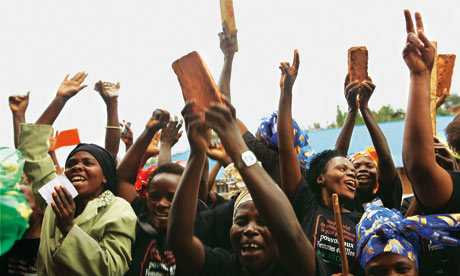
The grand opening of City Of Joy, in February, is a big party: survivors in celebration clothes dance and sing and bang drums. Some, very badly injured, are carried in. Women who helped construct City of Joy dance with bricks balanced on their heads. Local men taking a stand against sexual violence – the “V-men” (after Ensler’s feminist V-Day movement) – make themselves visible with special T-shirts. American donors join a conga line. Women from the stage speak not just of rape but about laws that discriminate against women, the lack of free HIV treatment, what happens to the children of rape. There’s a lot of hugging, but the atmosphere is fierce.
The centre’s story begins in 1999, when the gynaecologist Denis Mukwege, of Bukavu’s Panzi hospital, rang his friend Christine Schuler-Deschryver, a human rights worker in the town. He said he had started to see injuries he had never seen before – women who had been raped in terrible ways, whose reproductive organs had been wrecked, who were suffering from fistulas between the vagina and rectum inflicted not just by gang rape but also by attacks with sticks, guns, bottles. “I said to Christine, this is new,” he recalls. “Their vaginas are destroyed. I couldn’t understand what was going on.”
Everyone in Bukavu knows Christine – she is 6ft without heels (and she’s never without heels), mixed race (her father was from a family of Belgian colonisers, her mother a Congolese servant in the tea fields of his plantation), dramatic, demanding. “When Dr Mukwege told me about these injuries, we were very afraid,” she says. “And then, in 2000, I was in my office when a woman ran in with a baby girl, 18 months old, her legs both broken back – the baby had been raped. She died in my car on the way to Panzi hospital. I ran into the cathedral with the dead baby in my arms, shouting at God. And that was the day I became a radical fighter.”
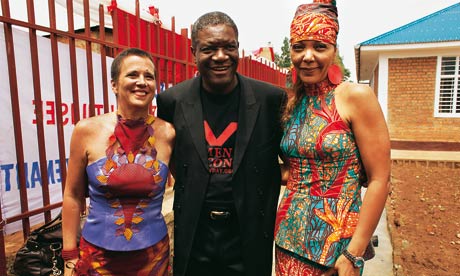
Left to right: City of Joy founders Eve Ensler, Denis Mukwege and Christine Schuler-Deschryver. Photograph: Paula Allen
Bukavu is a ragged, devastated town built on the banks of Lake Kivu in the east of Congo; at one time the Belgian colonisers tried to make it a lakeside retreat, so stunning is the setting. There are no roads, so when it rains the pathways turn to mud. Women (rarely men) stagger beneath gigantic sacks of cassava and charcoal; they sit on the ground with a single tomato to sell. Once a town of 50,000, it is now home to hundreds of thousands, most of whom have fled fighting in the bush to come to the comparative safety of the city.
Congo is the size of all of western Europe, with a very weak state. It is also the poorest country on earth, by GDP, and yet one of the richest in terms of resources – the fertile soil that produces such a lush landscape and juicy avocados brings with it gold, diamonds and precious minerals, with criminals, militia and kleptocrat politicians not far behind. Since colonialism, when King Leopold II of Belgium ran a notoriously genocidal regime in order to plunder Congo’s rubber, armies have tried to grab its wealth. President Mobutu, who renamed Congo Zaire and stole a personal fortune of billions, showed that it wasn’t only outsiders who could get in on the act. Today’s gold rush is over coltan – Congo has 80% of Africa’s reserves of the mineral, which is used in mobile phones, laptops, iPads; with the resource in such demand, there’s a direct link between the technology consumer boom and the fighting in Congo.
Rape is a feature of war, and is often seen as an inevitability – the second world war general George Patton wrote that “there would unquestionably be some raping”. But it is more widespread and more violent in some wars than others. According to Joanna Bourke, author of Rape: A History, its prevalence depends on how violent a society is already; the disparities between men and women in the culture; whether soldiers fear any kind of punishment for rape; and the extent to which the values that enable mass rape are shared by men on each side of the conflict. On every count, Congo rates disastrously. And there’s also a particular problem, what Jean-Claude Kibala, the deputy governor ofSouth Kivu, describes as a “bomb in the middle of society”: former child soldiers. “Nobody has a programme for how to deal with them,” he says. He tells of a bodyguard who kept falling asleep during the day. “The bodyguard explained, ‘When I was a child I was forced to bury a man who was still alive. This image is with me every night and I can’t sleep in darkness.’ There are people like that all through our society. Destruction and rape are destroying all humanity in the province.”
The particular brand of brutality that emerged in eastern Congo in the late 1990s has its roots in the Rwandan genocide of 1994, when 800,000 Tutsis and some Hutus were murdered in three months by Hutu gangs known as the interahamwe (what they call themselves) orgenocidaires (what their opponents call them). When the genocide was stopped by the arrival of the Tutsi exile-led Rwandan Patriotic Front, the interahamwe fled to eastern Congo where they established gigantic refugee camps in Goma, a town close to the Rwandan border. Notoriously, the global aid community responded to the refugee crisis with an efficiency that was missing from the response to the mass slaughter of the Tutsis: they fed, clothed and inoculated the genocidaires and their followers, while the few Tutsi survivors mourned their families and scrabbled around for food. The interahamwe who did not take up Rwandan president Paul Kagame‘s offer to return home disappeared into the Congolese bush.
The Rwandan genocide was, in the words of French writer Jean Hatzfeld, “enthusiastic processions of ordinary people who every day went singing off to work as killers”. Neighbours and friends went out “hunting” Tutsis with farming implements such as machetes and hoes. But it wasn’t straightforward murder. As interahamwe leader Adalbert Munzigura told Hatzfeld in A Time For Machetes: “They needed intoxication, like someone who calls louder and louder for a bottle. Animal death no longer gave them satisfaction, they felt frustrated when they simply struck down a Tutsi. They wanted seething excitement. They felt cheated when a Tutsi died without a word. Which is why they no longer struck at the mortal parts, wishing to savour the blows and relish the screams.”
It was these very interahamwe who imposed themselves on the Congolese people, later reinvented as a militia called the FDLR (Forces Démocratiques de Libération du Rwanda). And over more than a decade of violence, in which power passed from Laurent Kabila to his son Joseph, Rwanda invaded Congo, there was Africa’s “first world war”, which was played out in Congo (involving Uganda, Rwanda, Burundi, Zimbabwe, Angola, Chad, Namibia and Sudan, and leaving an estimated 5.4 million dead, according to the International Rescue Committee); through all of this, a multitude of new and primarily Congolese rebel militias were formed, and all of them raped women with extreme violence. Which is why Dr Mukwege started to see injuries he’d never seen before.
Rape, devastating everywhere, particularly undermines Congolese society. After being raped a woman is usually excluded by her family and so, when women have the babies and do all the cooking, farming, carrying, community is quickly undermined. Society breaks down. “If you destroy women, you destroy the Congo,” Ensler says. “Raping women is the cheapest and most effective way to instil fear in and humiliate a community. It doesn’t even cost a bullet.”
But is there something deeper at work? Has the epidemic mass rape in Congo got something to do with the country’s own history, the result of many years of subjugation, played back? Michela Wrong in her book In The Footsteps Of Mr Kurtz memorably describes Congo’s population as being “marinated in humiliation”. Says Ensler: “There is so much rape in men who’ve been colonised and enslaved. You have to wonder what it’s done to these men, to their collective psychological memory.” The Belgian colonists were famous for cutting off hands and feet, still a common rebel tactic – Jeanne was forced to watch as her uncle’s hands and feet were cut off before he was murdered. Says Ensler: “Centuries of colonialism, slavery and exploitation by the west have come together and are now being delivered on the bodies of the Congolese, most dramatically on the bodies of women.”
The particularly violent way of rape that has become current destroys the women’s reproductive organs. They can no longer have children (especially terrible in a society in which motherhood so defines being female that the word for “woman” is “mama”). As Mukwege, who has worked for more than two decades with women on the ground in eastern Congo, says, “This will be the destruction of the Congolese people. If you destroy enough wombs, there will be no children. So then you come right in and take the minerals.” Here in Congo, in the heart of Africa, home of the origin of man, the rapist wants to stop the human race for good. I was told of a woman being raped who asked the rapist why he was doing it. He replied, “Because I’m already dead.” Not for nothing does Ensler describe Congo as “ground zero”.
The raped women I spoke to have a straightforward request for how to solve the problem of rape in Congo: get the FDLR (the genocidaires and their descendants) out of the country. A common Congolese refrain is that “rape is not in our culture” – ie, foreign warlords brought it with them – and certainly, returning the FDLR to Rwanda would be a start, as would Rwanda taking responsibility for the other militias in the area it supports.
But it is now much more widespread: brutalised mass rape has become so endemic that the Congolese army, much more populous than the FDLR, reportedly commits most of the attacks. Rape has become normalised – and is only one, dramatic, dimension of a far wider violence taking place throughout the region. “Rape in Congo has tended to attract the headlines,” says Carina Tertsakian of Human Rights Watch. “There are also other serious abuses: killings of civilians, arbitrary arrests and widespread looting are all commonplace.”
But something is changing. In February, lieutenant colonel Kibibi Mutware and three other Congolese army officers were convicted of crimes against humanity for ordering rape and other crimes in Fizi town, South Kivu, on New Year’s Day this year. They were sentenced to 20 years in prison. This is truly a landmark – the first time a senior ranking Congolese army officer has been arrested, tried and convicted for rape crimes. But one case is hardly enough: there has been no action taken against other officers accused of similar crimes also committed that same day, the mass rape of 39 women and one girl in Bushani and Kalambiro villages in North Kivu. And, as Ensler asks: “Will they keep the lieutenant colonel in jail?” But it is, at least, something.
The women of Congo have been hopeful before. Since the late 90s, they have been intermittently fashionable as a global cause in the west; an activist wryly noted that every 18 months or so there’s a flurry of media interest, gruesome rape stories are related, each more terrible than the last, and then there’s silence. “They come and visit,” Schuler-Deschryver says bitterly, “and leave me with a pile of business cards.” Hillary Clinton, the US secretary of state, visited in 2009. “I made Hillary cry when she came, and it made me full of hope. But then – nothing.”
Melanne Verveer, who, in a new role created by Obama, is the US ambassador for women and girls, and who attended the opening of City of Joy, denies that the Clinton visit was followed by no extra money; her aides fluster around me proffering sheets of numbers, proclaiming cash provided ($42m over five years, they say). But Congo is clearly not a priority for international aid: when Ensler went to talk to Michelle Obama about the cause, she got inside the White House before an aide, high up in the Obama administration, informed her that “Congo was not going to be part of the Michelle brand”. It is notable that, despite the enormous hope raised in Africa when Obama was elected, both his predecessors, George W Bush and Bill Clinton, showed more interest in the continent.
Although the money for City of Joy is provided by Ensler’s movement V-Day (which raises cash through performances of The Vagina Monologues), plus Unicef and various foundations and donors, all are keen to emphasise that the project is owned and led by Congolese women. And their big idea is not aid, but empowerment. If we accept that rape is a violent expression of the power imbalance between men and women, then you prevent rape by helping women get more power. In other words, the City of Joy is all about a Congolese kind of feminism.
The programme will be run by Bahati Bachu, a strong-looking woman who carries an air of disbelief that this City of Joy is happening at all, and is a living, breathing rebuttal to those who imagine that feminism does not exist in developing countries. She is 58 (a good age in Congo, where life expectancy is 53) and a longtime women’s rights activist, a tough role to take in this harsh place. For international women’s day in 1999, she asked all the women in Bukavu to stay indoors; they did, and the entire town shut down. She was sacked from her role as regional women’s officer as a result. She once threatened to walk bare-breasted through the streets as a protest against women’s place in society. “When the rapes started to happen, I denounced it everywhere,” she says. “Germany, France. And nothing. I worked for so many years for Congolese women, but eventually I stopped because I was discouraged. But now, with City of Joy, I am seeing the fruit of my work, and others want to join. I will not die before we have a revolution.” She does not laugh at this.
Mama Bachu’s programme lasts six months. Survivors have “de-traumatisation” sessions; they learn about women’s rights (“Some are shocked to hear they have any rights at all,” Bachu says), literacy, the economy, accounting, farming, production, business, self-defence, the internet. (Google has donated a £100k technology centre.) Says Schuler-Deschryver, “Everything is Congolese, not American. So there’s no therapy, talking about your relationship with your father.” The women asked for small brick houses, arranged like a village, and a place for exercise, “so we can use up our energy and not row in the evenings”.
Sixty women will live here for six months, passed on from the gynaecology ward at Panzi hospital, after Dr Mukwege has saved their lives. They come from all over Congo. As the Congolese ambassador to the US, Faudi Mitfu, says, “City of Joy shows that even when a woman has been terribly tortured, she can still stand and build.” And, perhaps more hopefully: ”Today we build City of Joy. Tomorrow we build our country.”
It’s almost unbelievable that the poorest country on earth could give birth to a women’s movement, just like the incongruousness of the beautiful landscape with the horrific past and present; the terrible damaged lives with the singing and dancing. It’s got to have a chance. As Schuler-Deschryver says, “There’s something you need to know about Congolese women. When we can’t walk, we run.”
• Read Katharine Viner’s books blog on this story.
*********
I can’t say or post enough about Ensler and her efforts to end the violence against women and girls. This is the latest – Her talk at TedWomen:
Readers: If you want to learn more about this amazing Wonderful Woman of The World, Eve Ensler, click here. Living in the Bay Area? Ensler will be at Grace Cathedral, September 27th.
What are you doing for women today?
Peace out.
Lastly, greed over a great story is surfacing from my “loyal”(?) readers. With all this back and forth about who owns what, that appears on my blog, let me reiterate that all material posted on my blog becomes the sole property of my blog. If you want to reserve any proprietary rights don’t post it to my blog. I will prominently display this caveat on my blog from now on to remind those who may have forgotten this notice.
Gratefully your blog host,
michelle
Aka BABE: We all know what this means by now :)
If you love my blog and my writes, please make a donation via PayPal, credit card, or e-check, please click the “Donate” button below. (Please only donations from those readers within the United States. – International readers please see my “Donate” page)
Or if you would like to send a check via snail mail, please make checks payable to “Michelle Moquin”, and send to:
Michelle Moquin PO Box 29235 San Francisco, Ca. 94129
Thank you for your loyal support!
All content on this site are property of Michelle Moquin © copyright 2008-2011
 “ Politics, god, Life, News, Music, Family, Personal, Travel, Random, Photography, Religion, Aliens, Art, Entertainment, Food, Books, Thoughts, Media, Culture, Love, Sex, Poetry, Prose, Friends, Technology, Humor, Health, Writing, Events, Movies, Sports, Video, Christianity, Atheist, Blogging, History, Work, Education, Business, Fashion, Barack Obama, People, Internet, Relationships, Faith, Photos, Videos, Hillary Clinton, School, Reviews, God, TV, Philosophy, Fun, Science, Environment, Design, The Page, Rants, Pictures, Church, Blog, Nature, Marketing, Television, Democrats, Parenting, Miscellaneous, Current Events, Film, Spirituality, Obama, Musings, Home, Human Rights, Society, Comedy, Me, Random Thoughts, Research, Government, Election 2008, Baseball, Opinion, Recipes, Children, Iraq, Funny, Women, Economics, America, Misc, Commentary, John McCain, Reflections, All, Celebrities, Inspiration, Lifestyle, Theology, Linux, Kids, Games, World, India, Literature, China, Ramblings, Fitness, Money, Review, War, Articles, Economy, Journal, Quotes, NBA, Crime, Anime, Islam, 2008, Stories, Prayer, Diary, Jesus, Buddha, Muslim, Israel, Europe, Links, Marriage, Fiction, American Idol, Software, Leadership, Pop culture, Rants, Video Games, Republicans, Updates, Political, Football, Healing, Blogs, Shopping, USA, Class, Matrix, Course, Work, Web 2.0, My Life, Psychology, Gay, Happiness, Advertising, Field Hockey, Hip-hop, sex, fucking, ass, Soccer, sox“
September 18th, 2011 at 9:16 am
I tried to get in yesterday to say my sister Nancy is my Hero. She made me who I am today.
David
September 18th, 2011 at 9:20 am
Thank you Michelle for featuring my country. Everything is true.
Men are ruining out lives here also.
September 18th, 2011 at 9:22 am
Michelle, I am from China but I now live in the Congo. It is a beautiful place, but honestly I don’t believe that these people deserve this place.
Zea
September 18th, 2011 at 9:32 am
260
No. 260 of 365
Praise the marvelous “inclusivity” and “diversity” of the United Nations Human Rights Council,
whose membership includes such bastions of free speech, fair play, and democracy as Cuba, Saudi Arabia, China, and Burkina Faso.
Praise also the great sense of humor the organization has demonstrated in the past, like the time in 2002 when—under its old name the United Nations Human Rights Commission—forty of its members (including Zimbabwe and Sudan) passed a resolution affirming the “right” of the Palestinians to fight Israel by “all available means including armed struggle.”
September 18th, 2011 at 9:35 am
Like your article Michelle. I wanted to put this notice in, but I couldn’t get in. Hope I’m not to late.
——————————-
In June 2011, The Women’s Wilderness Institute, a nonprofit organization focused on developing confidence in girls and women, began a program that targeted America’s female veterans. Known as Women Veterans Retreats, the program, which is funded by the U.S. Department of Veterans Affairs, helps women adjust to life after war and teaches them ways to let their voices be heard.
“We are so honored because it is such a needed service that aligns with our mission so well,” says Laura Tyson, director of veterans’ programs at TWWI. “Women veterans have faced all of the challenges of military service, with all of the additional challenges involved of being a minority in a primarily male institution.”
This year, Women Veterans Retreats will help 72 women, with an additional 72 next year, Tyson says. Quinene and Torres were the first female veterans from Guam to attend a retreat.
The retreats, which take place at outdoor resorts across the country, use nature to help rebuild the women’s inner strength. The program is completely free.
By removing the financial burden from the veterans, they are able to focus on themselves and their rehabilitation. The next retreat will begin next week in Washington for a new set of female veterans hoping for relief.
September 18th, 2011 at 9:39 am
Zen Lill, I’m trying to be like you. I’m the change my family hates me to be. I quit that shitty party they are so proud of.
The Tea party is all about stupid people being told they are special because they are white. I have grown up. That does’t work for me anymore.
I want to support candidates that can beat that nigger. So far all I see is closet bigots that are all about the money.
Holly
September 18th, 2011 at 9:56 am
FALSE CLAIMS IN MOISTURIZER ADS
What a smart business move it was for cosmetic and skin-care companies to formulate facial moisturizers that also contain broad-spectrum sunscreen (meaning that they provide UV-A and UV-B protection) to save our vulnerable faces from the sun’s damaging UV rays —
the ones that not only cause premature aging of the skin, leaving you with brown spots, lines and wrinkles, but also melanoma, the deadly skin cancer.
Trusting that these products actually will protect you turns out not to be such a smart move, however!
A new study tested 29 facial moisturizers that promised to offer broad-spectrum UV protection, ranging in sun protection factor (SPF) from 15 to 50, and found that only a few of these products really did the trick. Shame on the marketers!
I talked to Steven Q. Wang, MD, a dermatologist with Memorial Sloan Kettering Cancer Center and one of the study’s authors, about how this could be so, and he explained the problem:
Most of the moisturizers protect you from UV-B waves — in fact, the SPF number on the label refers only to UV-B — but they don’t protect you from UV-A waves.
UV-A RAYS — DANGEROUS AND INESCAPABLE
This distinction is important because UV-A rays are the ones that penetrate deep into your skin and can damage cells that grow well below the surface.
Additionally, those rays are ever present — whether it’s winter or summer, raining or cloudy, because UV-A rays can pass through clouds and even get into your home.
“In day-to-day living, exposure to UV-B is relatively small,” Dr. Wang told me.
“But UV-A rays get through glass — so if you’re sitting in your car or your office or near a window at home, you need more UV-A protection.”
The US Food and Drug Administration does not regulate the claims of such products, and there is no other regulation of UV-A claims in particular, nor any official definition of “broad-spectrum” —
so there is no government watchdog looking at what a consumer gets, which is what led Dr. Wang and his colleagues to undertake this study, published in the January 20, 2011, issue of The Archives of Dermatology.
Dr. Wang won’t reveal the brands he studied or those that passed the test, pointing out that manufacturers often change ingredients.
Instead, he suggests that as consumers, we all need to look out for ourselves by examining the ingredients of any facial moisturizer with sunscreen we are considering using.
And paying more doesn’t necessarily buy more protection, Dr. Wang said — for example, the most expensive product he looked at, at $64 per ounce, offered absolutely no protection from UV-A rays.
WHAT TO BUY
So what should you look for? Examine the list of “active ingredients” on the package, and buy products that have the following:
A combination of avobenzone and octocrylene. Dr. Wang explained that the octocrylene makes the avobenzone more stable.
If avobenzone is not present, ecamsule is shown to be protective against UV-A rays. In this case, it is stable on its own.
Zinc oxide also offers good protection against UV-A rays.
If ever there were a case of caveat emptor, this is it. If you plan to buy a facial moisturizer with sunscreen, make sure you allot yourself a bit of extra time so you can read those labels carefully!
Source(s):
Steven Q. Wang, MD, director of dermatologic surgery and dermatology, Memorial Sloan Kettering Cancer Center, Basking Ridge, New Jersey.
September 18th, 2011 at 10:12 am
Michelle, have you noticed that most of the true idiots in the republican party are elected from small mostly white states?
I am in one of those states. Wi, put that dimwit Paul Ryan into office. My husband acts positively gay when the guy is mouthing off the most insane dribble anyone has ever heard.
The guy is agains taxing Millionaires, and my barely making it husband, loves the idea. Michelle we are worth maybe $100,000. That’s it. Why is he so into not taxing Millionaires?
Stupid, the white men here are so in need of self esteem. They are so intimidated by the black president.
Irene
September 18th, 2011 at 10:19 am
Dear Loyal Conservative,
When Jimmy Carter, LBJ and the New Deal start looking pretty harmless compared to the Obama administration, things must be a lot worse than we thought.
Welcome to that moment.
According to Mark Steyn and his new book
After America: Get Ready for Armageddon:
Barack Obama is not the first African-American President. He’s the first Scandinavian Prime Minister of the United States. Dispassionate, super-rational — and a big fan of big government, European-style.
He and his “sophisticated,” elite cronies are aiming for nothing short of “a full-scale Europeanization of American exceptionalism.”
They’re driving us toward nanny-state security — even dictating which light bulb to buy.
They favor bureaucratic regulation over a thriving, free-market economy.
We are hurtling toward a moment that will plunge the US into European-style stasis at best, and complete disintegration at worst.
There is no recovery if we let that happen.
If it happens, it will not be over years — we’ve already used those up. We’re teetering on the brink of sudden collapse and chaos.
If this sounds dark and frightening… it is. But Mark Steyn has a magic touch. One reviewer said that reading Steyn’s previous best-seller, America Alone was “the most fun I’ve had being depressed.” And Ann Coulter says, “Only Mark Steyn can write about the decline of America and leave you laughing.”
This is a unique experience from a writer called “the most entertaining, yet profound, columnist on the planet.”
Steyn describes America’s slide into dissolution as an economic and geopolitical Armageddon. In the aftermath, he sees a world…
Where China is the new superpower…
The Middle East is dominated by Iran…
And our own shores are wracked by violence and even secession.
In his previous book, New York Times bestseller America Alone, Steyn foresaw what we’re watching happen today — the collapse of nearly every western country.
But he made an exception for the US.
Not this time. This time, with Washington’s help, we’ve boarded the sinking ship — and it’s not too big to sink.
Fortunately, Steyn has a plan. A way to win us back our cherished freedom and prosperity. You’ll definitely want to sign on and get to work.
“Mark Steyn has done it again,” says Sean Hannity.
Mark Levin advises, “The choice is stark — we either listen to Steyn and act on his recommendations or face economic and cultural Armageddon.”
This could be the most frightening, most hopeful, funniest and finally, most important book you read this year or any year.
And now, for a limited time, we at Human Events are making After America: Get Ready for Armageddon available to you absolutely FREE — just for trying us at zero risk.
It’s the periodical that the peerless Ann Coulter, our legal affairs correspondent and a key participant in our weekly editorial meetings, proudly considers her editorial “home” — and where you can read her trenchant, biting satirical columns.
Says Ann: “Not only do I write a weekly column for Human Events, I devour it from cover to cover. Why? Because it’s the one newspaper I can count on to bring me the absolute, unvarnished, hard-hitting truth. And so should you.”
Human Events is written and edited by gutsy people who will rescue you from the sticky tar pit of political correctness that passes for contemporary reporting… not girlie-boy editors afraid of sticking to their guns!
That means by reading Human Events, you can count on learning the news the liberal media try so hard to keep secret!
For example…
In a recent issue of Human Events we reported on those “thousands of acres” Obama speaks of as ready for oil drilling in U.S. waters… virtually none have been found to have any oil! In other words, Obama has no intention of opening new drilling anywhere in the U.S. — no matter how high the price of gasoline soars!
Human Events also reported that Obama’s “economic stimulus” was simply a gargantuan gift to the states — to make sure pampered government workers did not share the same painful fate as private sector-workers who lost jobs by the millions.
Human Events revealed that ObamaCare is so brilliant and so wonderful that trade unions and companies friendly to the president are fleeing it by the thousands. In fact, Obama’s health care plan is so desirable that 20% of the exemptions have gone to Nancy Pelosi’s posh district in San Francisco!
There’s so much at stake today. America is facing its biggest financial crisis of modern times and liberals just don’t get it. Never has it been more important for you to get the truth — and not just the P.C. pabulum dished up by the mainstream media.
And now you can try Human Events with this special Labor Day offer — a full 30-week trial subscription at the reduced rate of just $35.95, just over a dollar an issue. That’s a savings of 59% off the regular rate.
September 18th, 2011 at 11:44 am
Hafa adai Michelle, I have been reading your concern about the poisoning of the people by the unregulated food industries of the world.
Guam is especially vulnerable to this because we have such a diversity of cultures on our island. Thanks is due to the Guam legislature for passing a regulation start.
============================
Guam’s nearly 20-year-old food safety policies could soon get what officials say is a much-needed update.
Sen. Dennis Rodriguez Jr., D-Dededo, introduced a bill that proposes administrative rules and regulations for safety and health of food service establishments and operations within the food service industry.
Bill 307-31 includes the updated codes as developed by the Guam Food Safety Task Force.
Some of those updates includes requirements to wear gloves when preparing food, as well as temperatures required to store food and cook food properly.
Guam’s policies for food service establishments and operations were last updated in the mid-1980s, according to Ronald Carandang, Department of Public Health and Social Services health inspector.
Public Health officials were tasked, along with other food safety officials, to update Guam’s food safety code by then-Gov. Carl Gutierrez, according to Executive Order 2000-20. The Guam Food Safety Task Force included representatives from the health-care community, food industry and the military.
Despite working on the updates for years, the group didn’t have the necessary support from the Legislature. A portion of what was required was a budget necessary to perform an environmental impact study, which Public Health officials said is necessary to edit or update regulations.
The press release from Rodriguez’s office noted that on May 19, 2010, the task force voted to transmit the proposed Guam Food Code to the 30th Guam Legislature’s Committee on Health & Human Services. The members sought to have the proposed code adopted via legislation. And though they did submit the proposal, still nothing happened.
This year, Public Health officials presented the proposed code to the 31st Guam Legislature almost as soon as the senators took office.
“I am pleased that in spearheading the development of the proposed guidelines, the Guam Food Safety Task Force made a good faith effort to be inclusive of the affected stakeholders in the food service industry,” Rodriguez stated.
Barry Mead, a professor with the Guam Community College who teaches food safety courses for food industry employees and management, said it’s “very necessary to get this legislation passed now.”
“These food codes were created to protect the most vulnerable in our community,” Mead said, noting that group includes children, senior citizens and pregnant women.
The currently proposed Guam Food Code reflects the U.S. 2005 Model Food Code developed by the U.S. Food and Drug Administration.
“I believe it is time for Guam’s food safety codes to be brought up to today’s standards,” Rodriguez stated. “I believe this to be a work product that accomplishes this, which is why I am willing to introduce it for legislative, as well as further public, consideration.”
===================
I said “Pass,” let’s hope it gets done.
Anna
September 18th, 2011 at 12:21 pm
Michelle, I wanted to put this in yesterday, but I couldn’t make an entry. This one is on a topic that is a little early because it is an exercise for nine years told to write a Thanksgiving Story.
———————-
Once upon a time there was a turkey. That turkey had an enemy. This enemy was a man. One day they had a fight and the man won.
THE END
————————