


The Continued Destruction Of The Native American Indian: Part I
Posted by Michelle Moquin on October 28th, 2011
 October is Breast Cancer Awareness Month

Readers: We have talked about the slaughter of 12 million Native American Indians, on my blog quite a few times. History tells one story, but we know the real truth is vastly different. I was listening to NPR the other day and I learned something that was so disturbing to me. The extermination of the native peoples that are still living here continues.
What do you get when you take a child away from his family? When you take away their culture, their traditions…when you cut their hair before its time? Years of living a slow death.
Following is a year long investigation by NPR:
Incentives And Cultural Bias Fuel Foster System
The dirt roads on the Crow Creek Indian reservation in South Dakota blow dust on the window frames of simple houses.
The people who live here are poor — in a way few Americans are poor. There are no grocery stores or restaurants. There’s only electricity when it’s possible to pay the bill.
This is where Janice Howe grew up, on a barren stretch of land that has belonged to the Dakota people for more than 100 years.
“I’m the eldest of nine kids,” she explains, settling into a chair in the kitchen. “I went to college and I got my bachelor’s degree in nursing.”
Her sister lives across the street. Her parents live across the road. Her daughter lives two doors down with her four grandchildren — two young granddaughters and two twin babies.
Key Findings Of This Investigation
* Each year, South Dakota removes an average of 700 Native American children from their homes. Indian children are less than 15 percent of state’s the child population, but make up more than half the children in foster care.
* Despite the Indian Child Welfare Act, which says Native American children must be placed with their family members, relatives, their tribes or other Native Americans, native children are more than twice as likely to be sent to foster care as children of other races, even in similar circumstances.
* Nearly 90 percent of Native American children sent to foster care in South Dakota are placed in non-native homes or group care.
* Less than 12 percent of Native American children in South Dakota foster care had been physically or sexually abused in their homes, below the national average. The state says parents have “neglected” their children, a subjective term. But tribe leaders tell NPR what social workers call neglect is often poverty; and sometimes native tradition.
* A close review of South Dakota’s budget shows that they receive almost $100 million a year to subsidize its foster care program.
And then one evening two years ago, Howe’s phone rang.
It was a social worker from the Department of Social Services. She said her daughter Erin Yellow Robe was going to be arrested for drugs.
Howe couldn’t believe it. She had never seen any sign of drugs or any other problems.
And then the social worker changed Howe’s life. She said she was coming to take Howe’s grandchildren away.
The next morning, a car pulled up outside Yellow Robe’s house. Howe’s daughter wouldn’t let go of her one-year-old twin babies. She kept saying she hadn’t done anything wrong.
The social worker buckled the babies into car seats.
“They were sitting in the cars,” Howe says, choking up. “They were just looking at me. Because you know most babies don’t cry if they’re raised in a secure environment. So I went out there and took their diaper bags. And they left.”
But as Howe watched the car pull around the bend, she realized the social worker took the two babies, but allowed Howe to keep her two granddaughters, 5-year-old Rashauna and 6-year-old Antoinette.
“I thought that was weird,” Howe says. “I just thought, why can’t I keep them all?”
A Mandate To Keep Children Connected
Howe, other relatives and other members of the tribe all wanted the children. And federal law says they should have gotten them. The Indian Child Welfare Act mandates that, except in the rarest circumstances, Indian children must be placed with relatives, a tribal member or at the very least, another Native American. It also says the state must make every effort to first keep a family together with services and programs.
The law was passed in 1978 in response to a century-long practice of forcing Native American children into harsh and often abusive boarding schools where they lost contact with their culture, traditions, language and families.
Except now a generation of children is once again losing its connection to its culture. This time it’s through state-run foster care.
In South Dakota, Native American children make up only 15 percent of the child population, yet they make up more than half the children in foster care. An NPR News investigation has found that the state is removing 700 native children every year, sometimes in questionable circumstances. According to a review of state records, it is also largely failing to place native children with their relatives or tribes.
According to state records, almost 90 percent of the kids in family foster care are in non-native homes or group care.
State officials say they’re doing everything they can to keep native families together. Poverty, crime and alcoholism are all real problems on South Dakota’s reservations and in the state’s poorest areas. But, state records show there’s another powerful force at work — money. The federal government sends the state thousands of dollars for every child it takes.
Howe’s twin grandbabies were taken to a white foster home about 100 miles away.
On the day they were taken, Howe says she and her daughter sat on the steps and cried as they waited for the police to come to take her daughter to jail.
Several hours went by and no one came. A week went by, a month, and then summer turned into fall, and still no one came.
To this day, Howe’s daughter has never been arrested for drugs — or anything else. Department of Social Service officials told NPR they can’t talk about individual cases or confirm the details of Howe’s account.
But one source who has reviewed the department’s file said the social worker believed Yellow Robe was abusing her prescription pills. But the same source also says the file notes the case was based on a rumor — from a woman who, the source says, didn’t like the Howe family.
And yet not only did they take the two babies, two months later, Howe waited at the school bus stop. But when the bus came, the girls weren’t on it. A social worker had taken them from school.

“They didn’t even call and tell me. Nothing,” Howe says.
The social worker in this case, like many the department employs, hadn’t been on the job long and quit a short time later. She told Howe that the older girls had had too much contact with their mother – a woman who had never been charged with anything. And then Antoinette and Rashauna, they too were gone.
“It enrages me,” says Crow Creek tribal council member Peter Lengkeek. “We’re very tight-knit families and cousins are disappearing. Family members are disappearing.”
The Crow Creek tribe has lost more than 33 children in recent years. The reservation only has 1,400 people. Last year Lengkeek asked social service officials to tell him where the children were and who they were placed with.
Seven months later, he received a list. Lengkeek says every single child was placed in a white foster home.
He says if the state had its way, “we’d still be playing cowboys and Indians. I couldn’t imagine what they tell these kids about where they come from and who they are.”
“It’s kidnapping,” he says. “That’s how we see it.”
Navigating State Policies
ICWA Timeline
Congress enacted the Indian Child Welfare Act in 1978, recognizing that the future of Native American cultures hinged on tribes retaining their children. It requires state agencies to exhaust every possible means of keeping Native American foster children within their own tribes.
1969 and 1974: Surveys by the Association on American Indian Affairs report 25 to 35 percent of all Native American children are being separated from their families and placed in foster homes, adoptive homes or institutions.
Jan. 2, 1975: Congress establishes American Indian Policy Review Commission, which is charged with reviewing U.S. Indian policy. In 1977, the commission issues a report with more than 200 recommendations. (Vol. 1 and Vol. 2)
April 1, 1977: Sen. James Abourezk (D-SD) introduces Senate Bill 1214, the Indian Child Welfare Act. After passing in the Senate, the House passes its version of the bill, H.R. 12533, on October 14, 1978.
Nov. 8, 1978: President Jimmy Carter signs the Indian Child Welfare Act (ICWA) into law. It establishes federal standards for removing Native American children from their families and outlines proper procedure in regards to Native American children in foster care.
April 9, 1980: After a number of challenges to the new law, the Supreme Court of South Dakota determines ICWA is constitutional, saying interference in custody matters of tribal members threatens a tribe’s right to self-governance.
April 18, 1988: The Bureau of Indian Affairs and the Administration for Children, Youth and Families issues a report to assess ICWA implementation. It finds that ICWA has failed to reduce the flow of Native American children into substitute care. The report also finds the lack of funding fosters a negative climate of competition among tribes.
April 3, 1989: In Mississippi Band of Choctaw Indians v. Holyfield, the U.S. Supreme Court reaffirms the idea of tribal jurisdiction.
April 4, 1990: The Supreme Court of South Dakota finds a state court may deny transferring a child custody case involving Native American children to a tribal court if there is “good cause” to deny the transfer.
March 3, 2004: South Dakota passes Senate Bill 211, which establishes a commission is charged with examining South Dakota’s compliance with the ICWA.
Dec. 30, 2004: The Governor’s Commission on the Indian Child Welfare Act releases a report (pdf) that cites an overall lack of funding. They find tribal courts do not have the funds to assume jurisdiction in a case that would provide foster care and other services for children. They also find the Department of Social Services is not always following ICWA procedure when dealing with a Native American child. The report recommends passing a state ICWA bill to enhance compliance.
November, 2005: A second report (pdf) by the South Dakota Governor’s ICWA Commission outlines how to implement the 30 recommendations cited in its initial report. The report emphasizes the state’s need for more funding and establishes the “Collaborative Circle,” a formal group which increases dialogue and partnership between Native American tribes and the Department of Social Services.
Sept. 27, 2011: The Child and Family Services Improvement and Innovation Act passes both houses of Congress and is presented to President Obama. The legislation ensures that states successful in reducing their foster care caseloads do not lose federal funding. This legislation aims to create an incentive for states like South Dakota to reduce the number of children in foster care.
— Compiled by Quinn Ford / NPR
Virgena Wieseler, who runs a division of South Dakota’s department of social services, says the department believes in the Indian Child Welfare Act and does its best to find relatives or tribal member placements for Indian children.
“We come from a stance of safety,” she says. “That’s our overarching goal with all children. If they can be returned to their parent or returned to a relative and be safe and that safety can be managed then that’s our goal.”
Department Secretary Kim Malsam-Rysdon says they’re dealing with abject poverty and substance abuse and have to do what’s best for the kids, which sometimes means driving onto a reservation and taking a child.
“Of course we think it’s legal or we wouldn’t be doing it,” she says.
Malsam-Rysdon cited two laws. One is a federal statute that only pertains to emergency situations. The other is a state law that allows the state to remove children in danger.
But two South Dakota judges, two lawyers and a dozen tribal advocates told NPR that state law doesn’t apply. Federal law says tribes are sovereign. The experts say a state official can’t drive off with an Indian child from Crow Creek any more than a Crow Creek official could drive off with a child from Rapid City.
Some tribes have agreements with the state, which allows social services to operate on their reservations. Crow Creek, however, does not.
But the state has never been challenged in court on this specific issue, so Howe was stuck in a strange — but common — legal limbo.
Because she lives on a reservation, state courts don’t apply to her. But especially on poor reservations like hers, tribal courts can be over-run, underfunded and operated only part time.
Howe didn’t know how to get a hearing. She didn’t know any judges or lawyers. She certainly couldn’t afford one.
And social services told her they couldn’t tell her anything. Letters to the state and governor went unanswered.
But even here in a place with few resources or computers, she thought there must be something she could do. And then she thought of one more person to call: a man named Dave Valandra.
Valandra’s the tribe’s Indian Child Welfare Act director. He’s a federal employee, who is charged with making sure the law is being followed, namely that children removed by the state are placed with relatives or tribal members.
But when she called him, Howe says he told her: “‘There’s nothing I can do.’ – that’s what he said to me” she says.
Dave Valandra works in a square, gray building for the federal Bureau of Indian Affairs. Valandra’s official job is to help members who live off the reservation with their cases in state court. Many can’t afford South Dakota’s public defenders.
But Valandra can also help tribal members who are on the reservation. He can push for a tribal court hearing.
He doesn’t do that very often, however, because he says he trusts the state to do what’s best for native families.
“I get along real good with the state and I have a good rapport with them,” he says. “I’m satisfied.”
Tribal officials say they are not satisfied. They say he won’t show up at their council meetings to answer their questions. Valandra says he doesn’t need to appear because the Indian Child Welfare Act is being followed.
“The state does have Native American foster homes, so under the [Indian Child Welfare Act], they are following the law by placing the child in a Native American environment,” he says. “So yeah, it’s working.”
But state records show only 13 percent of native kids in foster care are placed in native homes. In fact, Valandra admits that not one of the children in his almost three dozen cases is placed with a Native American family.
Asked if he’s concerned these children may have been let down a bit, he seemed at a loss for words.
“Of my cases right now, I think they’re all…right now, the placement of the children right now are…boy that’s, huh,” he said.
Tribal Foster Homes Remain Empty
With Valandra a dead end, Janice Howe asked the social worker to move the children to a native home where they could participate in cultural activities such as going to sweats and sundance. But nothing changed.

Social Service’s Wieseler said they would like all native children to be in native homes. But she says they’ve only got a few and they don’t have room.
“We are constantly recruiting,” she says, “constantly recruiting in all of our offices for all kinds of foster families and we are always trying to recruit them because we need more.”
That comes as a surprise to Marcella Dion. She’s a native foster home provider on the Crow Creek reservation and has lots of room.
Her home’s been empty for six years.
“I was like, ‘Whoa, what’s going on,’” she says. “I got my [Indian Child Welfare license]. No kids.”
Then there’s Suzanne Crow, also from Crow Creek.
“I’ve been a foster parent here for over a year,” she said. “They’ve never called me for any Indian kids.”
In that year, hundreds of native children in South Dakota were placed in white foster homes. Officials on the Pine Ridge reservation, several hours away, also say they have 20 empty homes.
A few months ago, Crow asked a social worker why she hadn’t received any native foster children.
“He said well there’s a long process this and that,” Crow remembers. “And I said, ‘You know what? The long process is there’s no road from you to Indian people. That’s the long process.’”
Howe and her daughter waited months just to see the kids. She missed braiding their long hair. They follow Dakota tradition that you don’t cut hair unless there’s a death in the family.
When they were finally granted a visit in December 2009, Howe says she burst into tears. Their hair was cut to their shoulders.
The girls also looked thin and had holes in their socks, Howe says. They begged Howe and their mother to take them home.
She recalls Rashauna telling her that she knew how to get to the river and said she was going to try to swim home.
“I just kept saying, pray,” Howe says she told the children, tearing up at the memory. “Pray hard. Grandma’s going to get you back. I don’t know how but grandma’s going to get you back. When you start feeling bad pray or look outside because we’re both looking at the same sky. Ok? Ok, they said. And they left.”
She wouldn’t see them again for another year.
An Increasing Case Load
In downtown Rapid City, Danny Sheehan was digging around in a closet down the hall from his office pulling open file cabinets and taking out files.
“These are all the different people who had their kids taken away from their entire families,” explains Sheehan, who works for the Lakota People’s law office. “Not one of them has had their children left with a relative of any kind.”
There are about 150 case files in all.
He hopes one day he can sue. He’s been involved in cases like this in the past, including fighting Three Mile Island, the Ku Klux Klan – even representing a group that wants access to UFO records. But he says these cases are expensive, time consuming and fraught with legal hurdles.
“Maybe if we devoted all our resources to a particular case and said, look, we’re going to land on you like a ton of bricks [social services] and make you give this one kid back and sue you and do everything else, they would probably just turn the kid loose,” he says. “But it wouldn’t change anything. It wouldn’t stop them from doing it a hundred times again.”
There are children in South Dakota who need to be removed from their families. But according to state figures, less than 12 percent of the children in foster care in South Dakota have been actually physically or sexually abused in their homes. That’s less than the national average.
And yet South Dakota is removing children at almost three times the rate of other states, according to data from the National Coalition for Child Protection Reform.
Culture, Poverty or Neglect?
There’s one word that makes it possible for the state to remove Janice Howe’s grandchildren and more than 700 other native kids every year: Neglect. The state says parents have neglected their children.
The problem, says Bob Walters, a council representative from the Cheyenne River Sioux Tribe, is that neglect is subjective.
Walters, along with officials from seven other South Dakota tribes NPR interviewed, say what social workers call neglect, is often poverty — and sometimes native tradition.
“The standards are set too high for our people,” Walters says. “We’re family people. If there is 30 people in my home, that’s fine. [When] I was raised, there was my mom, my dad and 12 kids. And I’m very thankful I grew up that way.”
He says social workers are often young and there’s constant turnover. He says many seem to have never set foot on a reservation before.
Walters says the workers don’t understand that most tribal members don’t have money to buy gas for a parenting class two hours away or that food is often shared among families.
State officials acknowledge that only 11 of their 183 case workers are Native American. But officials say they do yearly training to teach workers native practices.
Federal Financial Incentives For Removing Children
Sometimes, though, it’s not just cultural differences. Jolene Abourezk worked for the department for seven years. She says when she worked there, removing kids was expected.
Department officials told her, “It’s good, you are doing a good job for taking more kids,” Abourezk says. “It’s just the norm here. It happens so often people don’t question it. So you know if something happens all the time the same way, people don’t question it anymore. It’s just how it’s done.
Abourezk now works for her tribe, the Oglala Sioux, and reviews every case to help get kids back.
“When I look at the cases and read the police reports,” she said, “it just seems like a lot of them are just minor offenses.”
Few social workers would wish for more cases. A close review of South Dakota’s budget shows there’s a financial incentive for the department as a whole to remove more children.
Every time a state puts a child in foster care, the federal government sends money. Because South Dakota is poor, it receives even more money than other states – almost a hundred million dollars a year.
Bill Napoli chaired the state Senate Appropriations Committee until he retired three years ago. He says he remembers when the state first saw the large amounts of money the federal government was sending the Department of Social Services in the late 1990s.
“When that money came down the pike, it was huge,” Napoli says. “That’s when we saw a real influx of kids being taken out of families.”
He said there was little lawmakers could do to rein in the department. This was federal money, and it went straight to social services.
“I’m sure they were trying to answer a public perception of a problem,” he said. “And then slowly it grew to a point where they had so much power that no one — no one — could question what they were doing. Is that a recipe for a bureaucracy that’s totally out of control? I would say so.”
In an interview with NPR, department officials Wieseler and Kim Malsam-Rysdon say they strongly disagree, and that money has never influenced the department’s decisions to remove a child.
“The state doesn’t financially benefit from kids being in care,” Malsam-Rysdon says. “The state is always paying some part of it.”
She says it’s true the department gets more money the more children it takes. But she says, “it’s still state general dollars that have to match all those dollars that come in.”
Except it’s not exactly a match. According to state records, last year, the federal government reimbursed the state for almost three quarters of the money it spent on foster care.
Then there’s the bonus money. Take for example something the federal government calls the “adoption incentive bonus.” States receive money if they move kids out of foster care and into adoption — about $4,000 a child. But according to federal records, if the child has “special needs,” a state can get as much as $12,000.
A decade ago, South Dakota designated all Native American children “special needs,” which means Native American children who are permanently removed from their homes are worth more financially to the state than other children.
In 10 years, this adoption bonus program has brought South Dakota almost a million dollars.
Malsam-Rysdon says that money stays in the department and is used to help children.
“The key to that funding is that those dollars are to be used to support adoptive placements,” she says. “So the state does not gain monetarily from placing kids in adoption.”
But that money and a hundred million dollars more funnels into the state economy every year. The department employs a thousand workers. It supports almost 700 foster families who receive as much as $9,000 a year per child and 1,400 families who receive thousands in adoption subsidies. Dozens of independent group homes also receive millions of dollars in contracts to take care of children.
Governor Bill Janklow ran the state in the 1990s. Asked how important the federal money that goes to social services is to the state he said: “Incredibly important.”
“I mean look, we’re a poor state,” he says. “We’re not a high income state. We’re like North Dakota without oil. We’re like Nebraska without Omaha and Lincoln. We don’t have resources. We don’t have wealth. We don’t have high income jobs. We don’t have factories opening here hiring people in high wage jobs.”
The federal government gave South Dakota at least $15,000 for Howe’s grandchildren while they were in foster care. More than half of that money went to the department’s administrative costs, according to federal records.
But even now as the money filters in, the federal government asks few questions about whether states are complying with the Indian Child Welfare Act. A 2005 government audit found at least 32 states are failing in one way or another to abide by it.
George Sheldon, who recently took over the federal Administration for Children and Families, is the man in Washington sending the money. He says the federal government needs to make complying with the law a priority for the states.
“I think we’ve got to do better and frankly to the extent we can provide some leadership I’d like to see us do that,” Sheldon says. “When you have a financing system that pays states to keep kids in care, what’s the incentive to keep kids out of care?”
A Conclusion For Janice Howe
Howe’s grandchildren had been gone a year and a half. There was so much frustration. The family seemed to be falling apart.

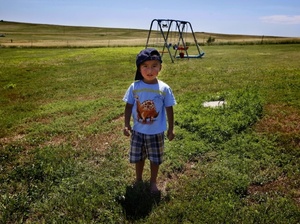
John Poole/NPR , Janice Howe’s grandchildren, from left, Daylyn, 3, Rashauna, 6, and Antoinette, 8, play on the Crow Creek Reservation. The children were taken off the reservation by South Dakota’s Department of Social Services for a year and a half after a social worker heard an unsubstantiated rumor about their mother’s possible abuse of prescription pills. Their mother was never charged with anything.
Howe made one last desperate move. She went to her tribe’s council meeting and told her entire story. She told them how the state was now about to put the children up for adoption. Many on the council nodded with familiarity.
And then they did something they had never done before. They passed a resolution warning the state that if it did not return the Yellow Robe Children, it would be charged with kidnapping and prosecuted.
Nobody thought it would work.
But a few weeks later, a car pulled up outside of Howe’s house with Antoinette, Rashauna and the two twins, who were now 2 1/2 years old.
“Antoinette came in and said ‘Grandma, Grandma. We get to stay! We get to stay!’” Howe says.
The state offered no explanation or apology. The social worker warned that this was a trial run and the state could take them back at anytime.
Howe thinks the babies were treated well. But Rashauna and Antoinette left a size 10 and came back a size smaller. Howe says they hoard food under their pillows and hide under the bed when a car pulls up.
“I feel like they were traumatized so much,” Howe says.
The children don’t remember their native dance, something Howe says is especially important for Antoinette, the oldest.
“We go to sweats,” Howe says. “We have ceremonies at certain times a year. She’s got to be getting ready to learn these things that she has to do in order to become a young lady. They took a year and a half away from us. How are we going to get that back?”
On this day, 48 people showed up, and Antoinette and Rashauna played in the front room. Howe says they usually hide from outsiders and explained that like their mother, they are especially afraid of white people and do not want to talk to them.
Later, Howe asked Rashauna: “What was it like in foster care?”
“I thought we were going to stay there forever,” Rashauna says.
And then suddenly Antoinette blurts out a story about how Rashauna wet her pants and the foster parents made her wear the underwear on her head.
Howe looked away, so they wouldn’t see her eyes fill with tears. As the singing started, they slowly swayed, knowing that even now, social services can come back. Even now, at anytime, they can take the children.
Readers: This story makes me so mad. Can you imagine…Indian children taken away from their Indian families to live with white families so that they state can make money off of them, while the children slowly lose their culture, their traditions, and most importantly their connection to where and who they came from? It is a horrible situation for the families. As if the extermination of the American Indian was not enough, the destruction still continues to this day.
Tomorrow: Part II
ZL: “When I have time”…that’s the rub. I’m not complaining but in reality it still takes me two hours + to do my blog every morning. I read all of the comments, plus online content to inspire my write, (even if it is copy and paste – it’s the formatting that takes time) as well as commenting to readers that I wish to address. Taking more time to comment as an anonymous person, just to give my two cents without being “known”(even if it was to take you OUT in the process :) is not a priority for me.
That being said, I do do exactly how I please. It’s just wishful thinking because sometimes I miss being able to participate in the thick of it. But the best part of it all is that I have many readers who do, and I love that they take the time out of their busy days to be here when there are many other blogs they could be participating in.
In the words of /SB, “Have a loving day today all”.
Peace out.
Lastly, greed over a great story is surfacing from my “loyal”(?) readers. With all this back and forth about who owns what, that appears on my blog, let me reiterate that all material posted on my blog becomes the sole property of my blog. If you want to reserve any proprietary rights don’t post it to my blog. I will prominently display this caveat on my blog from now on to remind those who may have forgotten this notice.
Gratefully your blog host,
michelle
Aka BABE: We all know what this means by now :)
If you love my blog and my writes, please make a donation via PayPal, credit card, or e-check, please click the “Donate” button below. (Please only donations from those readers within the United States. – International readers please see my “Donate” page)
Or if you would like to send a check via snail mail, please make checks payable to “Michelle Moquin”, and send to:
Michelle Moquin PO Box 29235 San Francisco, Ca. 94129
Thank you for your loyal support!
All content on this site are property of Michelle Moquin © copyright 2008-2011
 “ Politics, god, Life, News, Music, Family, Personal, Travel, Random, Photography, Religion, Aliens, Art, Entertainment, Food, Books, Thoughts, Media, Culture, Love, Sex, Poetry, Prose, Friends, Technology, Humor, Health, Writing, Events, Movies, Sports, Video, Christianity, Atheist, Blogging, History, Work, Education, Business, Fashion, Barack Obama, People, Internet, Relationships, Faith, Photos, Videos, Hillary Clinton, School, Reviews, God, TV, Philosophy, Fun, Science, Environment, Design, The Page, Rants, Pictures, Church, Blog, Nature, Marketing, Television, Democrats, Parenting, Miscellaneous, Current Events, Film, Spirituality, Obama, Musings, Home, Human Rights, Society, Comedy, Me, Random Thoughts, Research, Government, Election 2008, Baseball, Opinion, Recipes, Children, Iraq, Funny, Women, Economics, America, Misc, Commentary, John McCain, Reflections, All, Celebrities, Inspiration, Lifestyle, Theology, Linux, Kids, Games, World, India, Literature, China, Ramblings, Fitness, Money, Review, War, Articles, Economy, Journal, Quotes, NBA, Crime, Anime, Islam, 2008, Stories, Prayer, Diary, Jesus, Buddha, Muslim, Israel, Europe, Links, Marriage, Fiction, American Idol, Software, Leadership, Pop culture, Rants, Video Games, Republicans, Updates, Political, Football, Healing, Blogs, Shopping, USA, Class, Matrix, Course, Work, Web 2.0, My Life, Psychology, Gay, Happiness, Advertising, Field Hockey, Hip-hop, sex, fucking, ass, Soccer, sox“
October 28th, 2011 at 9:45 am
”Before our white brothers arrived to make us civilized men, we didn’t have any kind of prison. Because of this, we had no delinquents. Without a prison, there can be no delinquents. We had no locks nor keys and therefore among us there were no thieves. When someone was so poor that he couldn’t afford a horse, a tent or a blanket, he would, in that case, receive it all as a gift. We were too uncivilized to give great importance to private property. We didn’t know any kind of money and consequently, the value of a human being was not determined by his wealth. We had no written laws laid down, no lawyers, no politicians, therefore we were not able to cheat and swindle one another. We were really in bad shape before the white men arrived and I don’t know how to explain how we were able to manage without these fundamental things that (so they tell us) are so necessary for a civilized society.” ~ John (Fire) Lame Deer
http://www.imageshack.us/photo/my-images/843/johnfirelamedeer.jpg/
October 28th, 2011 at 10:18 am
Cell Phones Do Cause Brain Tumors
Magda Havas, PhD
Trent University
About nine out of 10 US households now have at least one cell phone — and that doesn’t include other wireless devices, such as cordless phones, iPads, baby monitors and computers.
Result: The average adult (and child) is flooded with nonionizing radiation, a form of energy that — for the first time — has been officially linked to cancer.
In May, a panel of the World Health Organization (WHO) listed cell phones as a class 2b carcinogen, which means that it’s “possible” that cell phones, like some industrial chemicals, increase the risk for cancer.
This conclusion has been disputed by many scientists. But careful analysis of the best studies to date indicate that people who log the most cell-phone minutes are more likely to develop tumors on the same side of the head that they hold the cell phone, compared with those who use cell phones less often.
DISTURBING RESEARCH
The largest study of cell-phone use, known as INTERPHONE, was conducted in 13 countries over a 10-year period.
The study, published in International Journal of Epidemiology, found that people who used cell phones for at least 1,640 hours over the 10-year period — that comes to about 30 minutes a day — had a 40% higher risk of developing a glioma, a deadly type of brain tumor.
Disturbing: The development of a brain tumor to the point that it can be detected often takes 20 to 30 years.
The fact that these tumors are showing up after 10 years of exposure is disturbing because it is much faster than expected.
Previous studies have linked frequent or prolonged cell-phone use to an increase in parotid (salivary gland) and auditory nerve tumors.
The actual risk probably is higher than the studies indicate.
The INTERPHONE study defined “heavy use” as using a cell phone for about 30 minutes a day. That’s a fraction of the time that many people currently spend on their cell phones.
Also, the study looked only at adults, even though young people are frequent users of cell phones and the ones who face the highest cancer risks from decades of radiation exposure.
In addition, the study “diluted” the data by identifying people as regular cell-phone users who may have used their phones only once a week for at least six months.
These light users were obviously exposed to far less radiation than heavy users. Including them in the study caused the cancer percentages to appear artificially low.
For example, we would not expect someone who smoked one cigarette a week for at least six months to develop lung cancer.
SAFER USE
Skeptics of cell-phone dangers argue that nonionizing radiation is too weak to heat tissues or break chemical bonds, factors that are known to increase cancer risks.
But recent studies indicate damage to DNA in rat brains exposed to cell-phone radiation, and this type of damage can lead to cancer.
Ways to stay safe…
The fine print in cell-phone manuals usually advises users to hold the phone at least 7/8 of an inch away from the ear. Farther is better. Use speakerphone mode.
Wait for good reception. Cell phones emit much higher levels of radiation when the antenna is sending out signals to search for a tower or satellite.
These signals can travel hundreds of miles — and the poorer the reception, the greater the radiation emitted by your cell phone.
Use a hollow-tube headset. This is the safest type of headset because the last few inches, those closest to the ear, consist of a hollow tube. This hollow tube transmits sound like a stethoscope.
Wired headsets need to be kept away from the body because the continuous wire that runs from the phone to the earpiece will expose you to some unnecessary radiation.
Hollow-tube headsets can be purchased at http://www.Mercola.com or http://www.WaveShield.com/products.
Use “airplane mode.” Even when you’re not talking on a cell phone, the phone is sending out signals every few minutes to search for the nearest tower.
Turn off the phone when you’re not using it. Or switch it to airplane mode so that it can’t send or receive signals, but you still can use the phone to listen to music, watch videos and check your calendar.
Keep the phone on your desk when working. When the phone is switched on, don’t keep it in your pocket or attached to your belt. This is particularly important for men.
Preliminary research indicates that men who keep their phones close to their bodies (often in holsters or pockets) have lower sperm counts and poorer sperm quality than those without this exposure.
We do not know the effects on egg cells because they are more difficult to harvest.
Caution: The worst way to use a Bluetooth wireless headset is to place it on your ear with the cell phone in your pocket.
This way, your head and lower body are both being irradiated.
A better way to use a Bluetooth is to keep the cell phone on a table several feet away from all body parts and to periodically move the earpiece from one ear to the other to minimize one-side radiation exposure.
Text instead of talk. There’s a burst of radiation when you send or receive a text message, but the intensity and duration of the radiation are lower than when you talk.
Texting is a better alternative to talking on your cell phone, but keep the phone as far away from your body as possible.
Normal clothing, including leather, will not reduce your exposure.
Don’t use your phone in a car, train or bus. Using a cell phone inside a metal vehicle can increase levels of radiation due to reflection and the fact that your cell-phone signal has to be higher to exit the vehicle.
The best practice is to keep the phone off or in airplane mode and to check it periodically for messages. Then return messages by text or use a landline phone later.
Personal interviewed Magda Havas, PhD, associate professor of environmental and resource studies at Trent University in Peterborough, Ontario, Canada.
She is a leading expert in radiofrequency radiation, electromagnetic fields, dirty electricity and ground current.
She is coauthor, with Camilla Rees, of Public Health SOS: The Shadow Side of the Wireless Revolution (CreateSpace). http://www.MagdaHavas.com
October 28th, 2011 at 10:26 am
Michelle, thank you for making our plight known. The white man continues his war against us. They take our children and sell them like bags of corn.
Ekta
October 28th, 2011 at 10:37 am
Michelle:
South Dakota gets money from the federal government to help indians in foster care. I know for a fact that it is a racket. Many who work here know that their jobs depend on stealing or kidnapping the “little savages” and cashing in on the endowments we get from the federal government for their up keep.
I have been working here for 19 years. It is a money numbers’ game. We have quotas we have to me. We keep track of “possibles” by profiles on each member of the tribes, mostly the women.
We know how many children they have and what the adults are up to. We know that we can make any allegation and the state will allow us to take any child we want.
Somes time people come in and put in an order for a male or female child and we try to fill that after we appropriate the child and cash in on the government allotment for its care.
Then we sell it to the person who made the order. It is a business, nothing more. I am older now and wish to go to make peace with my Lord.
I would be willing to tell all as a “whistle blower” if I thought you could protect my family.
RC
October 28th, 2011 at 10:55 am
We send billions out in foreign aid and nothing to the American Indian.
White america is sick.
October 28th, 2011 at 11:07 am
That is one of the saddest stories I have ever read. Why is my race so cruel?
October 28th, 2011 at 11:39 am
Misch, I don’t doubt that you do exactly as you please *smile* and that it takes you two hours every am to set up blog entries, I commend you on that one bc I know how much work it actually is, and we’re all thankful you do it, too. : D
Lengkeek is absolutely right, this amounts to kidnapping. It’s sick.
Have a loving weekend as well, I’ll pop by but this one is a busy one, Halloween parties and all that…
Luv, Zen Lill
October 28th, 2011 at 11:40 am
We are in 1892:
John and Anna Geyser farmed a homestead in beautiful Otay Mesa, high in the Sierras near San Diego. Half a mile away, their nephew Fred Piper ran another farm.
On October 12 Fred’s daughters were riding across the mesa seeing a friend home, when they heard blows and shouts from the Geyser farm. They cantered home, and Fred Piper and his son sauntered across to see what was going on.
In the dusk they saw two bodies sprawled in front of the house which they agreed were drunken Indians. In the Geysers’ darkened bedroom a moving light was hastily extinguished as the Pipers called out.
A small man escaping from the house was caught and fiercely beaten by the Pipers. It was Joseph “Injun Joe” Gabriele, who had been digging a cistern and clearing soil for John Geyser.
That afternoon, he and two indians had bought wine at a nearby plantation. Joe slept off his heavy boozing in the barn, and then, he said, came over to see where Mr. and Mrs. Geyser were.
His trial, however, was little better. His counsel never made clear that his story was consistent with the evidence, and the two missing Indians (who had certainly been drinking with him that afternoon) might have committed the murders while joe slept.
He didn’t appeal for the mistrial to which Joe was entitled when one juror protested against the sentence.
Joe was just another injun. And they hung him.
AH
October 28th, 2011 at 11:46 am
For those of you Chamorros out there not familiar with sasalaguan, this might be interesting.
+++++++++++++++++++++++
All Souls’ Day and Halloween reflect man’s different views of the after-life. All Souls’ Day reminds us of the hope of resurrection, while Halloween promotes those who may not have left us just yet.
According to Padre San Vitores, ancient Chamorros believed in immortality of the soul, and would “place a basket over the head of one about to expire so their spirit found food and remained in the house.” He said: “Before burying the dead bodies, after painting the lips of the dead with buyo and anointing them with coconut oil, they take them around to the houses of relatives. At the obsequies there are many extraordinary manifestations of sorrow, fasting, tears of lamentations and horn blowing with conch shells, lasting for 60 or more days, depending on the esteem they entertained for the deceased, spending time in lugubrious songs and banquets.”
Fray Juan Pobre (as translated by Dr. Driver) described a burial. “I saw there was a dead person lying there on a woven mat. It was one of the leaders of the village whom they called Soom. Near this house, they had constructed a scaffolding of palms and trees. On top of it, there was a chair in which they placed the already foul-smelling body of the dead Indio. The other leaders were gathered around it, some weeping and wailing and saying many things to him I could not understand. Then they lowered the body and together they carried it down to the beach, where they placed in front of the house of one of his brothers who was his heir. It seems among them it is the brothers and not the children who are the inheritors. They prepared a grave and lowered the body into it. Then they filled it and covered it with a new mat. At the corners of the grave, they placed posts on which to construct a small platform that they covered with new woven mats in such a way that it resembled a covered bier. Then they left the place and accompanied the brother to the house of the deceased where, admidst their tears, they made a great fiesta.”
Those who died violently went to a place called Sasalaguan. A mountain and valley in southern Guam bears this name. Sasalaguan, or “hell,” was considered up — not underground, as other cultures or traditions believed.
Skulls preserved
The ancient Chamorros preserved the skulls of their parents or grandparents, but did not worship them or treat them as statues or saints, according to Fray Juan Pobre. Treated with respect, they believed any act of disrespect would cause them to fail in their work.
Some skulls had other uses. From “Apostle of the Marianas” comes the following: “Among the Pagan rites the Marianas had some specific ceremonies to ask for water from anitos. With superstitious veneration they kept some human skulls which, according to them, have the special power to attract rain when they were invoked and prayed to. These skulls are called maran anuchan (miraculous talismans for rain) and are kept in special houses, guarded by the Macanas or priests.”
Today many people have tales of taotaomo’na or “the first people,” spirits involving sites, paths or events. Anufat is a very ugly taotaomona with hairy arms and ferns growing out of holes in the side of his head. Others have no head, are huge in stature and live in banyan trees. Eerily, these trees are found in unnatural, but seemingly well-kept clearings in a dense jungle. Many times the fragrant smell of ylang-ylang is overpowering.
Then there’s the White Lady from Spanish times, who wanders the Maina Bridge awaiting her groom.
There are many theories of the taotaomo’na and the ancient Chamorros who as children could rip out coconut trees, like young Taga, or Gadao and Malaguana (or Mataguana), who could split a boat in half by rowing the opposite way.
Who were these giants?
So who were these giants and superhumans? According to the Bible, Torah, Quran and Sumerian writings, the “Great Flood” was because fallen angels bred with humans, bearing giants and half-beast called nephilims.
Genesis states: “Now it came about, when men began to multiply on the face of the land, and daughters were born to them; That the sons of God saw that the daughters of men were beautiful; and they took wives for themselves, whomever they chose. … The nephilim were in the land in those days, and also afterward, when the sons of God came in to the daughters of men, and they bore children to them. Those were the mighty men who were of old, men of renown. Then the Lord saw that the wickedness of man was great in the land, and that every intent of the thoughts of his heart was only evil continually. … And the Lord said, ‘I will blot out man whom I have created from the face of the land, from man to animals to creeping things and to birds of the sky; for I am sorry that I have made them. But Noah found favor in the eyes of the Lord.’”
Offspring of mythical gods and goddesses of Greek, Egyptians, Asia Minor, South America, Celtic and others bore nephilim features, including Goliath, cited in the Bible as a nephilim 10 feet in height. Guahan’s taotaomo’na and subsequent groups of Chamorro superhumans were possibly nephilims.
Gachongs, macana
A few on Guahan have gachongs, or taotaomo’na friends. They can perform many acts of strength. However, they do this alone and you only see the end results a moment later. They don’t enter a church. It is said if you want to see a taotaomo’na, rub your eyes with the “mugu” or sleep matter from a dog’s eyes. Most jungles with latte stones, taotaomo’na trees, rivers or ponds contain the paths they frequent. You feel them first. The deep crevice at Puntan Dos Amantes claimed two military lives and two others were injured while rappelling down it. All four were trained and experienced in rappelling. It is now illegal to rappel into the chasm.
Guahan has had a few infamous suruhanus, who were more macana in practice. GPD recruits of the ’80s and early ’90s would tell of an old man they passed while they ran at the bottom by UOG Marine Lab and would be shocked minutes later when they would see him up at the top, casually watching them. No shortcut, no trail. Though I and many know his name, it is for the clan to reveal it.
Likewise, the duendes are little, elf-like pranksters who can lure one into the deep jungle. In the 1980s, a little girl was lost in Manengon area. After a massive three-day search, she was found sleeping unharmed, mere yards from her home. Years later an old man was similarly lost and found.
Sometimes people pick things in a jungle without asking permission or disturb a pond by pushing in a rock and their hand or leg gets swollen. The only cure is to put it back or go to the spot and ask for forgiveness. The Chamorro says, “Guelan yan guelo, despensayu” (ancient elders, excuse me), before relieving themselves in the jungle.
Fanague is the term for a last momentary visit from someone who just died, usually a recognizable phrase, laugh or fragrance.
Guam has many tales. These were just a few. All Souls’ Day, Halloween and ancient practices reflect man’s varied answers to where we go from here or if we go at all.
Many things remind us who we descend from. For thousands of faithful, All Souls’ Day is one of their most personal. Be safe on Halloween.
God bless Guahan, God bless America.
Anthony P. Sanchez (Fongu) is the editor for Guahan/Guam A History of Guam.
===================
Happy Halloween.
Anna
October 28th, 2011 at 11:51 am
Last week, the Washington Post attacked Marco Rubio for “misrepresenting” his family’s story. The Post got called out by other newspapers for their egregious truth stretching to make its story fit.
In the quotes the Washington Post cited, the reporter misrepresented the context of Marco Rubio’s remarks. It was true that Rubio had gotten some details wrong.
But it was also very clear that they were the innocent mistakes of a son retelling his parents’ story. It was also true the Washington Post got parts of its reporting wrong.
But the Washington Post has not stopped. Now the paper is back and it’s premising a new article on the last story, without anything on the key elements the Post itself got wrong in its initial story.
This time, the Washington Post wants to make the case that Marco Rubio could be a risky Vice Presidential pick for the GOP.
Seriously?
We have a President of the United States who, for twenty years, worshipped in Jeremiah Wright’s church, had his house paid for by Tony Rezko, claimed his uncle freed Jews at Auschwitz, snorted cocaine, and got other key biographical details wrong, and the Washington Post never seemed to think he was too risky.
I’ve got a lot more on this over at RedState. Read more about the bad reporting here.
—Erick Erickson
October 28th, 2011 at 4:01 pm
Health info:
Magda Havas, PhD — Trent University
Your topic claiming that Cell Phones can cause Tumors was very informative to me. It made me think about my Cell Phone Habits. Should I shut my phone off? I never have before. Should I treat it like a radioactive hot potato?
Since just about everyone living in the modern world has a cell phone — from children to Grandma and Grandpa, this is a serious problem.
Is it really worth Cancer for the convenience or should protective devices be used to keep phones from injuring our cells and possibly causing Cancer.
I will certainly begin by not keeping my phone on my person and purchasing a hollow-tube headset
that allows me to keep my phone further away from my head.
HOWIE
October 28th, 2011 at 4:20 pm
Howie:
I would do all of the above. It is a a radioactive hot potato. You can keep it off or turn up the ringing volume and put it away from you immediate vicinity. Or you can leave it off for a period then check your messages or calls received and then leave it on for a period.
Whatever one can do to eliminate his or her exposure would be good.
October 28th, 2011 at 5:52 pm
Let’s be honest. Buchannan can stay on MSNBC the same reasons declared bigots can run for the presidency of the USA because OTW feelings don’t count in white controlled america.
But when that they is over, they had better remember what happened to Gaddffil. Not everyone will remember their shit with tolerance.
October 28th, 2011 at 5:58 pm
Hafa adai Robert: I’ m with you. I just wish more Guamanians took their situation more seriously.
================================
Guam – For the past few weeks, several forums and discussions were held regarding Guam’s political status. And clearly, the island’s quest for decolonization isn’t ending anytime soon.
Before lawmakers, political status specialists and concerned community members, another forum was held regarding Guam’s quest for decolonization this time in a more formal setting at the Guam Legislature.
In addition to hearing from Speaker Judi Won Pat, University of Guam president Dr. Robert Underwood and visiting international advisor on governance and self-determination Dr. Carlyle Corbin, several in the community also provided their perspective of political status including Chamorro voting rights and appraisal of self-determination under international law.
Attorney Therese Terlaje spoke on strengthening the pursuit of justice for Guam and says effectiveness of the government and pursuit of change in political status is vulnerable to distractions and special interests.
“We must all be extremely diligent to stay unified in the face of competing and divisive agendas,” she noted.
Attorney Leevin Camacho says the biggest threat to the decolonization movement is apathy. He says because the three branches of Guam’s government are subservient to the U.S. Congress and governed by a federal statute.
He says the people of Guam should know more about how much power Guam may or may not have. “People need to understand that our current political status is unacceptable and takes away power from the people who need to have it in our hands,” he explained.
Dr. Corbin says he has been able to spread the knowledge and his experience in the past few weeks on the united nation’s role in the political status process.
Although he leaves Monday, he says his time on Guam won’t be his last and will take back with him even more knowledge and concerns raised by the community.
“Always further enlightenment is what I take with me,” he shared. “I’m always energized by the activities of various sectors of Guam on this issue certainly in respect to political evolution.”
The Guam Legislature announced that it will hold another forum early next year.
October 28th, 2011 at 6:04 pm
The art of poetry has always been considered the most difficult of writing forms, but, as we have already seen, it is not difficult for children.
Where an adult might very well labor for weeks or even months over a single sonnet, a child sits down and knocks off a poem with all the facility he might employ in eating a banana.
Jean Stafford, whose present-day fiction is considered to be of exceptional quality and loaded with hidden meanings, produced a poem at the age of six. It follows:
Gravel, gravel on the ground,
Lying there so safe and sound,
Why is it you look so dead?
Is it because you have no head?
October 28th, 2011 at 11:43 pm
Each year, South Dakota removes an average of 700 Native American children from their homes. Indian children are less than 15 percent of state’s the child population, but make up more than half the children in foster care.
October 29th, 2011 at 7:58 am
Hafa adai
My point is all the inconveniences we have to endure in the name of security seems to be for naught if a guy can go from Portland Oregon to Guam with 500 rounds of ammo in his carry on.
As had been pointed out on your blog many times Michelle all that pretense is about groping and power plays by the high school diplomats with uniforms(thanks for the hint Robert).
===========================
Feds: Gresham man flew from Portland to Guam with 500 rounds of ammo in luggage
A 66-year-old Gresham man is facing a federal felony charge after 500 rounds of .22 caliber ammunition was discovered in his carry-on luggage following a flight from Portland to Guam, the Associated Press reports.
Nario Eter was arrested by Transportation Safety Administration personnel in Guam Monday as he tried to board a Continental Airlines flight to Chuuk, located in the Federated States of Micronesia, according to documents obtained from the U.S. District Court for the Territory of Guam.
The documents state that Eter covered the box containing the ammunition with tape in an attempt to avoid detection by airport security.
Eter plans to enter a guilty plea to one count of delivery of ammunition to a common carrier without notification. That charge carries a maximum of 5-years in jail.
Both the TSA and the FBI are investigating the case. Steve Johnson with the Port of Portland tells KOIN Local 6 that the agency is not involved in the investigation at this time.
– The Associated Press contributed to this report.
============================
What we can expect next is MORE restrictions and even more idiotic demands from passengers.
Lani
October 29th, 2011 at 8:00 am
Rick Perry – is going to limit his debate because he knows that he will get the bigot white vote by skipping the debates.
He hasn’t lost an election in the stars and bars states by refusing to debate his competition in Texas. He knows that the racists and bigots far out number the OTWs and in the places where their numbers are greatest, his Voting Commissioner sets artificial limits to prevent them from voting or compromise the count.
October 29th, 2011 at 9:00 am
Michelle: This has got to be one of the most heartbreaking stories I have heard in quite a while. Haven’t we taken enough from the Native American? Foster care for children who already have loving families and a tribe to teach them about their history and culture. This is kidnapping.
Did you know that 1 in 5 foster children in Florida are prescribed psychotropic meds that are not recommended for those under 18 years of age? I would guess that the children would be easier to control in a zombie like daze.
Foster care has a real bad reputation in this state, with many deaths due to overdose and suicide. They generally live in overcrowded squalor, underfed, malnourished and overmedicated. I wouldn’t think conditions would be any better in South Dakota for Native American children.
It is hard to fathom the state of S. Dakota taking all these Native American children from their families and sticking them in foster care (which is like a prison for children). These children must have a high resale value.
Is there no bottom to the depths of inhumanity that the white establishment will stoop to.
Sadly,
Al
October 29th, 2011 at 9:10 am
I did not intend to sign in anonymously. Something is set wrong on my browser.
Bye,
Al
November 11th, 2011 at 4:43 am
bonus kladionice…
[...]Michelle Moquin's "A day in the life of…" » Blog Archive » The Continued Destruction Of The Native American Indian: Part I[...]…
November 13th, 2011 at 7:55 am
[ボニック][ボニック 口コミ]…
[...]Michelle Moquin's "A day in the life of…" » Blog Archive » The Continued Destruction Of The Native American Indian: Part I[...]…