


An End To The VCR After 60 Years
Posted by Michelle Moquin on August 3rd, 2016

Good Morning!
I thought this was an interesting read for hump day.
REMEMBER THESE?
In Memoriam: The VCR, 1956 – 2016
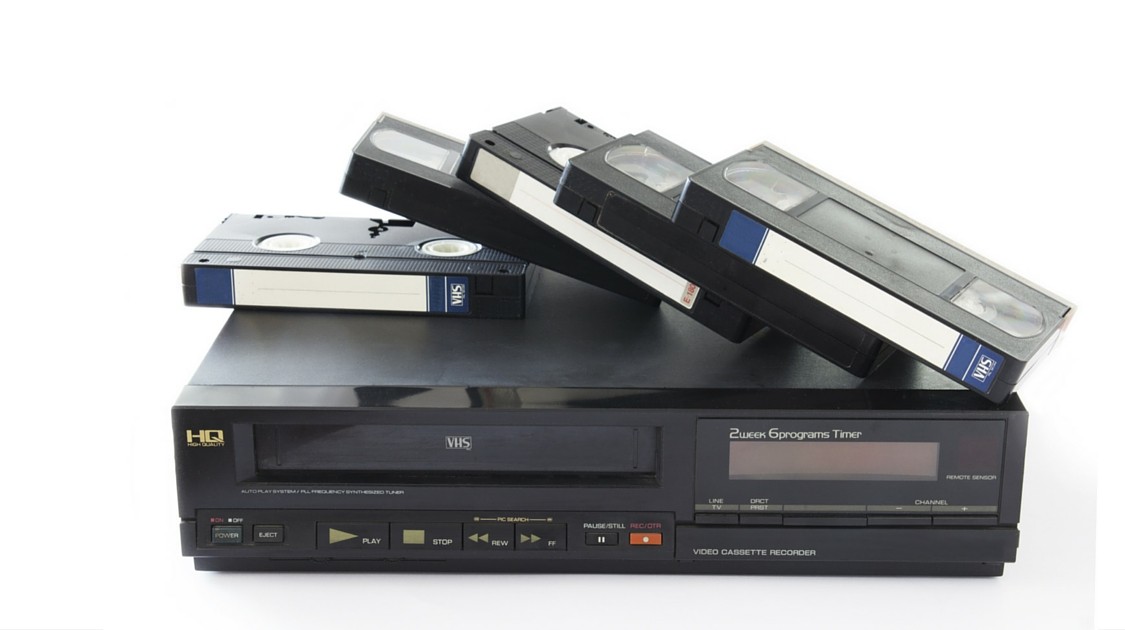
The Videocassette Recorder, a piece of technology already so obsolete you would be forgiven for not realizing it hadn’t died long ago, finally kicked it for good last Thursday, when Funai Corporation of Japan, the last known VCR manufacturer on the face of the Earth, announced it would cease production by the end of July. According to the New York Times, a company spokesperson said Funai will keep on selling VCRs “though its subsidiary until inventory runs out and will provide maintenance services as long as it can.”
The VCR is survived by the technologies that fueled its demise, which rule for now (the DVD), the foreseeable future (the DVR, streaming video) and probably forever (piracy). It was 60 years old.
It was a player and it crushed a lot (of the competition)
The Ampex Electric and Manufacturing Company introduced “the world’s first economically and technically successful magnetic videotape recorder,” the VR1000 — colloquially known as the Mark-4 video recorder — in the mid-1950s. As Fred Pfost, an engineer at the time, wrote in a blog post, he and his team introduced the Mark IV recorder at the National Association of Radio and Television Broadcasters’ convention on April 16, 1956. They were announced by the vice president of CBS; Pfost surreptitiously recorded the opening remarks and, as soon as they were over, pressed play. (This was new invention in and of itself: Not just the first working video recorder, but the first instant replay! The sports world is forever in his debt.)
“There were about ten seconds of total silence until they suddenly realized just what they were seeing on the twenty video monitors located around the room,” Pfost wrote. “Pandemonium broke out with wild clapping and cheering for five full minutes. This was the first time in history that a large group (outside of Ampex) had ever seen a high quality, instantaneous replay of any event…The experience still brings tears to my eyes when I recall this event.”
These Ampex VCRs were prohibitively expensive for most; they cost $50,000. The first video tape recorder for home use was the Sony CV-2000, which was marketed in 1965. The reel-to-reel CV-2000 could record and play back black and white images, but most of those machines wound up being used for medical and industrial purposes, according to Sony’s history site.
The future was closer than ever with the hip-sounding Sony U-matic, which came on the market in 1971. It could fast-forward and rewind! Then the Philips VCR, made available to consumers in 1972, changed the game with its first model, the N1500, that incorporated all the best qualities of recorders that came before it. There were basic controls — the play, pause, fast-forward, and rewind buttons — plus a clock with a timer, so you could record shows when you weren’t even home.
How the porn industry saved the VHS tape
Sony’s Betamax came out in 1975; hot on its heels was the Betamax’s rival, the VHS format by JVC.
VHS (Video Home System) was developed in 1976. Its features were impressive: A super-compact two-hour tape, longer playtime, and speedier rewinding and fast-forwarding. The JVC system, called Vidstar, was quite pricey. The VCR would set you back $1,280 (as Wired reported, it would be $4,600 in inflation-adjusted dollars). The blank tapes were $20, or $72 in today-bucks. Still, it was appealing: Back in the day, before every Marvel movie was approximately eighteen hours long, a two-hour tape was enough to record an entire feature film. The Betamax tapes had only half that recording capability and were more expensive than VHS-players.
JVC licensed its format to other electronics producers, filling the marketplace with VHS machines, Wired reported. “In just its first year, the VHS format took 40 percent of the business away from Sony. By 1987, about 90 percent of the $5.25 billion market of VCRs sold in the United States were based on the VHS format.”
The fight for market share between these two incompatible formats lasted ten years, until 1985, when JVC introduced VHS HQ (high quality) and, two years later, Super VHS. What really fueled the victory, though, was allegedly not that crisp sound and image but an even more powerful force: Pornography. Legend has it that Sony, pure as the driven snow, would not allow smut to sully its Betamax tapes. JVC and the rest of the VHS scene operated by more of a live-and-let-live ethos; powered by this nation’s unstoppable thirst for pornography, the VHS emerged as the dominant format.
Before Netflix and chill: A trip to Blockbuster
Today’s children may never grasp the infuriating feeling of getting home from the video store– you know what, I’m getting ahead of myself. A video store was like a Netflix you had to pace through, where you could easily run into people you knew. This limited what you could rent, because what if Josh — not marching band Josh but Josh in a band which is a completely different thing — knew you were renting the Lindsay Lohan remake of The Parent Trap for the eight billionth time? You would die, RIP you, like the VCR is dying now.
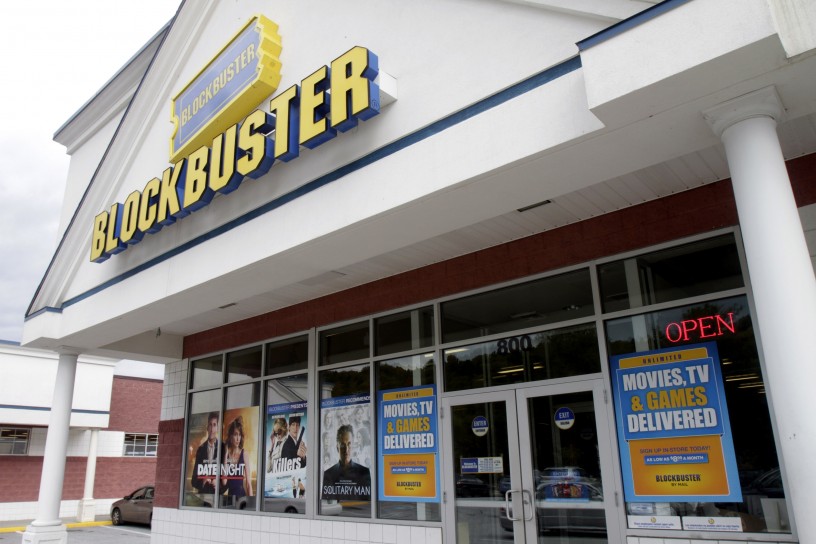
At first consumers shopped at small, cool video stores, and the people who worked at these establishments were medium-pretentious: snobbier than independent bookstore employees, less condescending than record store staffers. Those small stores were crushed, as small stores often are, by the entry of a corporate behemoth, Blockbuster. Blockbuster went defunct in 2014, but just twelve years earlier, it was the king of the video rental market; the chain boasted over 2,800 stores worldwide. Sometimes you would go to Blockbuster, or your local video store, on a Friday night after waiting all week to see the movie of your choice only to find that your movie of choice had been rented out. There was nothing you could do. You were helpless in the face of this devastation.
But Blockbuster was edged off the throne by Netflix, which — from its beginnings as a DVD-delivery service in 1997 to its present-form as streaming hub — was something of an accessory to the murder of the VCR. As lore has it, Netflix founder Reed Hastings started his company in part out of frustration that Blockbuster charged him a $40 late fee for failing to return Apollo 13 on time. (Late fees were Blockbuster’s bread and butter: In 2000, the chain took in a stunning $800 million in late fees, 16 percent of its revenue for the year.)
Anyway, back to today’s children! For it is these youths, those who are too young to bear the mantle of millennial, who can scarcely fathom the struggles their elders faced. (Do we have a name for them yet? Are they “Generation Z”? Snapchildren? God I hope not.) They can never know how it felt to be ready to watch a movie — popcorn all popped, blanket just so, the good corner of the couch secured while your sibling was running to the bathroom like an amateur — only to discover after sticking that VHS tape into your VCR that the previous renters had been so callous as to notbe kind and rewind. This feeling, the waiting during the interminable whirring of the rewind, was buffering’s ancestor.
Later than same evening, an entirely enjoyable night with the family spent watching That Thing You Do! could be ruined by what was, looking back, the reasonable request of a parent to rewind the video before returning it to the shelf.
I made that glitch famous
In theory one could use a VCR to record television shows. This liberated audiences from the time-space continuum, allowing us to watch television shows on our schedules. We didn’t have to be beholden to some corporation’s idea of when shows are supposed to air! No, we could watch what we wanted to watch when we wanted to watch it. Free at last, free at last, etc.
But freedom in theory so rarely manifests as freedom in fact. What would actually end up happening is you would set the recording for Tuesday night on the WB at 8:00 p.m. for an hour — to do this, you entered a bright screen in a shade technically known as Doogie Howser Blue; this was the secret control center of the TV set and every time you used it you were convinced you’d broken the precious television for good — and even if you did everything right, some baseball game or breaking news or whatever would run late.
Of course your VCR couldn’t adjust like some nimble, modern thing. No, the VCR was as clunky and slow as it looked. It was not a “smart” device. In the 1990s, we were naive, and we did not ask our devices to be smart. We thought: We can be smart, and we can operate the devices, and that will be enough.
So the VCR would just start recording at eight like you told it to and then stop recording at nine, cutting off the last eleven minutes of Buffy the Vampire Slayer. And because this was the real deal dark ages, of dial-up internet and nothingness, you couldn’t just download the episode somewhere or even read a witty, informative recap, nope, you just had to LIVE there, in the not-knowing, until next week’s “previously, on Buffy the Vampire Slayer” gave you the bullet points. A person might have thought: That this baseball game, a sport for men, is displacing Buffy, a feminist superhero who fights against the forces of darkness, is a metaphor too perfect to invent. And also: Why is this technology so flawed and annoying to use?
Families also stored home videos on VHS tapes, and then teenagers (it was always a teenager) would record over these priceless memories — competitive rounds of Coke and Pepsi at bar mitzvahs, bowling alley birthday parties captured with that shaky, handheld Blair Witchcinematography — replacing them with something else of arguably equal importance, like the 1991 MTV Video Music Awards.
Literally dead
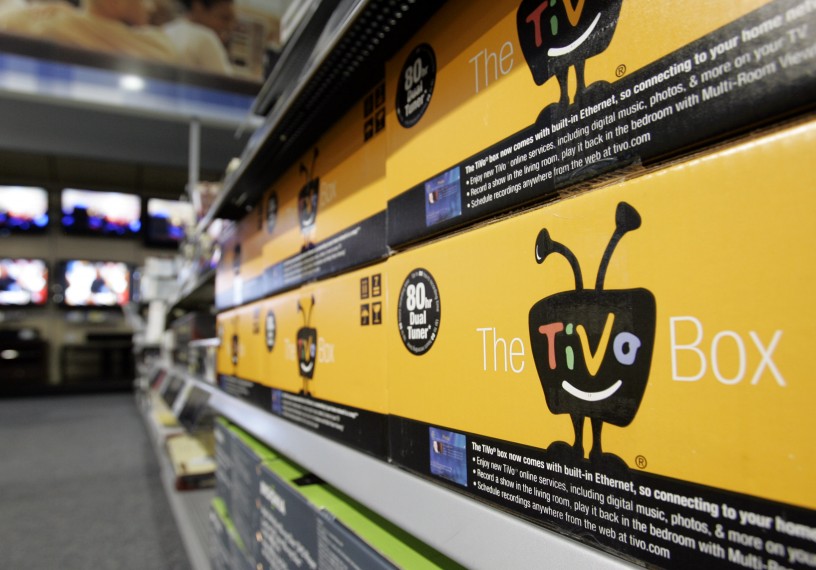
The VCR was killed, finally, by a one-two punch of technological advancements: The arrival of the DVD (first sold in the United States in 1997 and ruling the marketplace by 2000) and, in 1999, the DVR;TiVo unveiled its Personal Television Service that January and shipped its first TiVO DVR on March 31. And these technologies, too, can probably feel irrelevance on the horizon, as streaming rises like the climate-changed-tides and “TV” becomes less a physical thing, bound to the box itself, and more of a style of storytelling that can be accessed on any platform at any time.
Redbox, a DVD ATM, is still a thing, though revenue is in decline. Most of the kiosks are outside convenience stores, lingering there even when no one has much use for them, like 14-year-old boys on skateboards.
What was once the dominant entertainment viewing and recording device of its day is now the kind of thing modern, iPad-owning toddlers look at in fascination and horror, wondering how we ever lived in such lame, inefficient times. VCRs used to feel like the future. Obsolescence, like death, comes for us all. RIP, VCRs.
Readers: How I loved going to Blockbusters or a small independent to rent a VHS movie. Enjoyed walking the aisles and finding an old classic or the latest. Miss those lazy evenings of at-home movie watching with my own concoction of homemade popcorn doused in olive oil, sprinkles of cayenne, and a little sea salt. Yummy memories. I rarely watch movies at home anymore. You?
Blog me.
Lastly, greed over a great story is surfacing from my “loyal”(?) readers. With all this back and forth about who owns what, that appears on my blog, let me reiterate that all material posted on my blog becomes the sole property of my blog. If you want to reserve any proprietary rights don’t post it to my blog. I will prominently display this caveat on my blog from now on to remind those who may have forgotten this notice.
Gratefully your blog host,
michelle
Aka BABE: We all know what this means by now :)
If you love my blog and my writes, please make a donation via PayPal, credit card, or e-check, please click the “Donate” button below. (Please only donations from those readers within the United States. – International readers please see my “Donate” page)
Or if you would like to send a check via snail mail, please make checks payable to “Michelle Moquin”, and send to:
Michelle Moquin PO Box 29235 San Francisco, Ca. 94129
Thank you for your loyal support!
All content on this site are property of Michelle Moquin © copyright 2008-2016

“Though she be but little, she be fierce.” – William Shakespeare Midsummer Night’s Dream

" Politics, god, Life, News, Music, Family, Personal, Travel, Random, Photography, Religion, Aliens, Art, Entertainment, Food, Books, Thoughts, Media, Culture, Love, Sex, Poetry, Prose, Friends, Technology, Humor, Health, Writing, Events, Movies, Sports, Video, Christianity, Atheist, Blogging, History, Work, Education, Business, Fashion, Barack Obama, People, Internet, Relationships, Faith, Photos, Videos, Hillary Clinton, School, Reviews, God, TV, Philosophy, Fun, Science, Environment, Design, The Page, Rants, Pictures, Church, Blog, Nature, Marketing, Television, Democrats, Parenting, Miscellaneous, Current Events, Film, Spirituality, Obama, Musings, Home, Human Rights, Society, Comedy, Me, Random Thoughts, Research, Government, Election 2008, Baseball, Opinion, Recipes, Children, Iraq, Funny, Women, Economics, America, Misc, Commentary, John McCain, Reflections, All, Celebrities, Inspiration, Lifestyle, Theology, Linux, Kids, Games, World, India, Literature, China, Ramblings, Fitness, Money, Review, War, Articles, Economy, Journal, Quotes, NBA, Crime, Anime, Islam, 2008, Stories, Prayer, Diary, Jesus, Buddha, Muslim, Israel, Europe, Links, Marriage, Fiction, American Idol, Software, Leadership, Pop culture, Rants, Video Games, Republicans, Updates, Political, Football, Healing, Blogs, Shopping, USA, Class, Matrix, Course, Work, Web 2.0, My Life, Psychology, Gay, Happiness, Advertising, Field Hockey, Hip-hop, sex, fucking, ass, Soccer, sox"
August 3rd, 2016 at 11:17 am
I still have my VCR. Thanks for this article Michelle.
August 3rd, 2016 at 11:18 am
Yes, great article Michelle, I still have some great porn tapes and shows I taped before the new restrictions we have today.
August 3rd, 2016 at 1:50 pm
Whenever I hear 14,000,000 people voted for Donald Trump in the primaries followed by the brag that it is more votes in a primary than any other republican has ever gotten, it scares me. The reason it scares me is that it says that there are enough racist white people in this country that if they could get the nazi ovens open here, I and those I love would be in serious danger.
I look at my white friends who I think, don’t feel that way, and I am reminded that in Germany many whites that weren’t racist went along with the murder of 6,000,000 jews by those who whites who were.
Imagine living in a country that would support a man like trump. If you are not insane you know that most of his support comes from people who put party and race above the country’s welfare.
August 3rd, 2016 at 1:52 pm
Where is Howie? Did he go to the “Unknown Universe” or something?
August 3rd, 2016 at 1:52 pm
My VCR is still going strong. I have so many VHS takes.
August 3rd, 2016 at 1:55 pm
Trump will never debate Hilary. This will be the first POTUS election in decades where neither candidate debated the issues one on one. I understand the republicans know that trump is incapable of winning against Hilary, but why is the news media so quiet on this?
August 3rd, 2016 at 2:00 pm
Avoid Aluminum for Better Brain Health
I’ve written many times about threats to your brain’s health. The brain uses such a large portion of the body’s energy and circulation that any foreign substance will likely make its way there eventually. And because the brain is made up mostly of fatty tissue, it tends to accumulate invaders rather than releasing them back into the bloodstream.
The number-one threat to your brain’s health is aluminum. Its effects are cumulative, and can take many years to show up as full-blown disease.
Here are five ways to reduce your exposure to aluminum:
Instead of using aluminum for your cookware, utensils, or food containers, use stainless steel, cast iron, copper, or glass.
Many deodorants use aluminum compounds as their active ingredient. As a first step, you can switch from a spray to a roll-on or stick. At least that way you’ll avoid inhaling the spray. The next step is to switch to an aluminum-free deodorant. (Watch out for the newer ‘crystal’ deodorants, though—recent research shows that they, too, contain aluminum.)
Read food and medicine labels closely. You’ll discover several products you should avoid or at least minimize. Aluminum is frequently added to items like pancake batter, cake mix, nondairy creamers, baking powder, and even salt to keep them from clumping together.
Aluminum can also be found in antacids, diarrhea medicines, and douches. There are plenty of aluminum-free alternatives available.
Make sure you’re getting enough calcium, either in your diet or through supplementation. Calcium hampers aluminum’s absorption by the body.
Drink distilled water. Alum, or aluminum sulfate, is widely used in the process of purifying water in this country. When added to the water it works as a coagulant to attract suspended particles, which can later be filtered out.
Unfortunately some of the dissolved aluminum will remain in the water. (Post filtration aluminum levels are rarely, if ever, checked since the Environmental Protection Agency doesn’t have any enforceable standards on aluminum levels in drinking water.)
August 3rd, 2016 at 11:26 pm
70% of this country is white, until that changes get used to sick, stupid shit. If you wonder how a mediocre singer can make $170 million dollars there’s your answer. If you wonder why a complete idiot can be a vote away from being president of the United States, there’s you answer.
If you wonder why this country can’t, there’s your answer. Our only hope is a change of demographics.
August 4th, 2016 at 7:18 am
Hafa adai
To those of you have maintained that this molestation of our youth by priests on Guam I submit this link http://www.guampdn.com/story/news/2016/08/04/former-guam-priest-says-s-possible-he-abused-altar-boys/88058346/
Besides the graphic testimony, you have a confession by Father Louis Brouillard, now 95, was removed from his position in 1985 while serving in a Minnesota diocese. That he molested boys in the 1950s. He is still receiving income from the catholic church here on Guam.
We are dealing with a sick cult that acts to keep women in a position of inequality while molesting our youth.
August 4th, 2016 at 7:43 am
Wouldn’t a Trump supporter consist of a peanut shell and a couple rubber bands?
August 4th, 2016 at 7:51 am
The GOP should be hugely embarrassed by its presidential candidate EVERY DAY.
CNN should be hugely embarrassed by Corey Lewandowski, Trump’s former campaign manager EVERY DAY. During a panel discussion on CNN about Obama’s criticisms of Donald TRump, former Trump campaign manager decided going full birther was the right strategy.
This is a must listen. http://crooksandliars.com/cltv/2016/08/corey-lewandowski-goes-birther
Only in white america could a person like this racist idiot get a job as a supposed to be unbiased addition to a major news outlet. White people just think their shit don’t stink.
Coincidence? It’s way over due for both bodies to FIRE the source of their embarrassment.
August 4th, 2016 at 7:53 am
It’s just a matter of time, as we can see, when people will have had enough of this racist bullshit. They’ll know how to respond to these fucks. They’ll know what they’re gonna say..
And I’d wager President Obama doesn’t give two shits about what they say about him now. He probably tells HRC, hey, no prob. I’ll handle these liars..giving her a break..
A showdown is coming. A reckoning…and Trump is going down..
August 4th, 2016 at 7:54 am
Liz Mair is a straight-shooter. Yes, she’s a Republican and she’s worked as RNC online communications director in the past, but I have followed her for eight years and she has always, always been honest about what she sees.
Her appearance on Anderson Cooper’s show was no exception. When asked by Cooper about Trump’s messaging, Mair laid it out there straight, and told Cooper that Trump’s “message is being a loudmouthed dick.”
August 4th, 2016 at 8:02 am
I have to share this some of my family and friends (yes, we are white Americans) have a problem with Michelle Obama saying she lives in a house built by slaves and she’s the first lady.
They are accusing her of playing the race card. LOL My cousin said she didn’t like the part where Michelle Obama said that the Whitehouse was built by slaves.
One of my sisters screamed “I’m pretty certain the slaves that were forced to build it didn’t like it either.
September 1st, 2016 at 7:05 am
Zen Lill, I didn’t have a problem loading the link. It was very interesting. I don’t think I can duplicate the pictures here but here is the dialogue.
Astronomers engaged in the search for extraterrestrial intelligence (SETI) are training their instruments on a star around 94 light years from Earth after a very strong signal was detected by a Russian telescope.
An international team of researchers is now examining the radio signal and its star, HD 164595 — described in a paper by Italian astronomer Claudio Maccone and others as a “strong candidate for SETI” — in the hopes of determining its origin.
“The signal from HD 164595 is intriguing, because it comes from the vicinity of a sun-like star, and if it’s artificial, its strength is great enough that it was clearly made by a civilization with capabilities beyond those of humankind,” astronomer Douglas Vakoch, president of METI International, which searches for life beyond Earth, tells CNN.
Whenever a strong signal is detected, “it’s a good possibility for some nearby civilization to be detected,” Maccone tells CNN.
But experts say it is highly unlikely to be a message from alien beings.
“Without corroboration from an independent observatory, a putative signal from extraterrestrials doesn’t have a lot of credibility,” Vakoch says.
Advanced civilization?
Paul Gilster of the Tau Zero Foundation, which conducts interstellar research, said that if the signal was artificial, its strength suggested it would have to come from a civilization more advanced than our own.
Such a civilization would likely be Type II on the Kardashev scale, an attempt by the Soviet astronomer of the same name to categorize various technological stages of civilizations.
“The Kardashev scale is based basically on the energy that that civilization might be able to funnel for its own use,” says Maccone.
At present, our own species is somewhere near Type I on the scale, whereby a civilization is able to harness all the energy available to it on its own planet, including solar, wind, earthquakes, and other fuels.
Dyson swarm (pictured) or Dyson spheres are proposed technologies for capturing all energy emitted by a star.
A Type II civilization would be able to harness the entirety of the energy emitted by its star, billions of billions of watts.
Doing so would require a colossal undertaking, likely the construction of some kind of superstructure, such as a giant sphere or swarm of super-advanced solar panels popularized by astronomer Freeman Dyson that could catch and store all radiation put out by the sun.
Scientists believe superstructures are probably our best chance of detecting alien life unless they are actively trying to communicate with us.
A Dyson sphere was one of the solutions suggested to the peculiar light fluctuations detected around Tabby’s Star, which caused great excitement when they were detected last year.
Maccone is working on developing an alternative mathematical measure of how advanced civilizations are, based on the amount of knowledge and information available to them, that “might help us in the future classify alien civilizations” that we detect.
Dimming star remains mystery, but it’s likely not caused by comets
Photos: Where life might live beyond Earth
This diagram lines up planets recently discovered by Kepler in terms of their sizes, compared with Earth. Kepler-22b was announced in December 2011; the three Super-Earths were announced April 18, 2013. All of them could potentially host life, but we do not know anything definitive about their compositions or atmosphere.
Hide Caption
8 of 14
Photos: Where life might live beyond Earth
This illustration depicts Kepler-62e, a planet in the habitable zone of a star smaller and cooler than the sun. It is about 1,200 light-years from Earth in the constellation Lyra.
Hide Caption
9 of 14
Photos: Where life might live beyond Earth
This illustration depicts Kepler-62f, a planet in the habitable zone of a star smaller and cooler than the sun, in the same system as Kepler-62e.
Hide Caption
10 of 14
Photos: Where life might live beyond Earth
This diagram compares the planets of our own inner solar system to Kepler-62, a five-planet system about 1,200 light-years from Earth. Kepler-62e and Kepler-62f are thought capable of hosting life.
Hide Caption
11 of 14
Photos: Where life might live beyond Earth
The planet Kepler-69c is about 2,700 light-years from Earth in the constellation Cygnus.
Hide Caption
12 of 14
Photos: Where life might live beyond Earth
This diagram compares the planets of our own inner solar system to Kepler-69, which hosts a planet Kepler-69c that appears to be capable of hosting life, in addition to planet Kepler-69b.
Hide Caption
13 of 14
Photos: Where life might live beyond Earth
This artist’s illustration represents the variety of planets being detected by NASA’s Kepler spacecraft.
Hide Caption
14 of 14
Photos: Where life might live beyond Earth
The Kepler mission has discovered 1,284 new planets. Of these newly discovered planets, nine orbit in the habitable zone of their star and nearly 550 are possibly rocky planets roughly around the same size as Earth.
Hide Caption
1 of 14
Photos: Where life might live beyond Earth
This artist’s impression shows an imagined view from the surface one of the three planets orbiting an ultracool dwarf star just 40 light-years from Earth that were discovered using the TRAPPIST telescope at ESO’s La Silla Observatory. Given the proximity of the dwarf star, the rosy sun would appear very large in the sky.
Hide Caption
2 of 14
Photos: Where life might live beyond Earth
On Thursday, July 23, NASA announced the discovery of Kepler-452b, “Earth’s bigger, older cousin.” This artistic concept shows what the planet might look like. Scientists can’t tell yet whether Kepler-452b has oceans and continents like Earth.
Hide Caption
3 of 14
Photos: Where life might live beyond Earth
Kepler-452b is about 60% larger than Earth, left. It’s about 1,400 light-years from Earth in the constellation Cygnus.
Hide Caption
4 of 14
Photos: Where life might live beyond Earth
A team of astronomers announced April 17, 2014, that they discovered the first Earth-size planet orbiting a star in the “habitable zone”: the distance from a star where liquid water might pool on the surface. That doesn’t mean this planet has life on it, says Thomas Barclay, a scientist at the Bay Area Environmental Research Institute at Ames and a co-author of a paper on the planet, called Kepler-186f. He says the planet can be thought of as an “Earth-cousin rather than an Earth-twin. It has many properties that resemble Earth.” The planet was discovered by NASA’s Kepler Space Telescope. It’s about 500 light-years from Earth in the constellation Cygnus. The picture above is an artist’s concept of what it might look like.
Hide Caption
5 of 14
Photos: Where life might live beyond Earth
Scientists announced in June 2013 that three planets orbiting star Gliese 667C could be habitable. This is an artist’s impression of the view from one of those planets, looking toward the parent star in the center. The other two stars in the system are visible to the right.
Hide Caption
6 of 14
Photos: Where life might live beyond Earth
This diagram shows the planets thought to orbit star Gliese 667C, where c, f and e appear to be capable of having liquid water. The relative sizes, but not relative separations, are shown to scale.
Hide Caption
7 of 14
Photos: Where life might live beyond Earth
This diagram lines up planets recently discovered by Kepler in terms of their sizes, compared with Earth. Kepler-22b was announced in December 2011; the three Super-Earths were announced April 18, 2013. All of them could potentially host life, but we do not know anything definitive about their compositions or atmosphere.
Hide Caption
8 of 14
Photos: Where life might live beyond Earth
This illustration depicts Kepler-62e, a planet in the habitable zone of a star smaller and cooler than the sun. It is about 1,200 light-years from Earth in the constellation Lyra.
Hide Caption
9 of 14
Photos: Where life might live beyond Earth
This illustration depicts Kepler-62f, a planet in the habitable zone of a star smaller and cooler than the sun, in the same system as Kepler-62e.
Hide Caption
10 of 14
Photos: Where life might live beyond Earth
This diagram compares the planets of our own inner solar system to Kepler-62, a five-planet system about 1,200 light-years from Earth. Kepler-62e and Kepler-62f are thought capable of hosting life.
Hide Caption
11 of 14
Photos: Where life might live beyond Earth
The planet Kepler-69c is about 2,700 light-years from Earth in the constellation Cygnus.
Hide Caption
12 of 14
Photos: Where life might live beyond Earth
This diagram compares the planets of our own inner solar system to Kepler-69, which hosts a planet Kepler-69c that appears to be capable of hosting life, in addition to planet Kepler-69b.
Hide Caption
13 of 14
Photos: Where life might live beyond Earth
This artist’s illustration represents the variety of planets being detected by NASA’s Kepler spacecraft.
Hide Caption
14 of 14
Photos: Where life might live beyond Earth
The Kepler mission has discovered 1,284 new planets. Of these newly discovered planets, nine orbit in the habitable zone of their star and nearly 550 are possibly rocky planets roughly around the same size as Earth.
Hide Caption
1 of 14
Photos: Where life might live beyond Earth
This artist’s impression shows an imagined view from the surface one of the three planets orbiting an ultracool dwarf star just 40 light-years from Earth that were discovered using the TRAPPIST telescope at ESO’s La Silla Observatory. Given the proximity of the dwarf star, the rosy sun would appear very large in the sky.
Hide Caption
2 of 14
Photos: Where life might live beyond Earth
On Thursday, July 23, NASA announced the discovery of Kepler-452b, “Earth’s bigger, older cousin.” This artistic concept shows what the planet might look like. Scientists can’t tell yet whether Kepler-452b has oceans and continents like Earth.
Hide Caption
3 of 14
Photos: Where life might live beyond Earth
Kepler-452b is about 60% larger than Earth, left. It’s about 1,400 light-years from Earth in the constellation Cygnus.
Hide Caption
4 of 14
Photos: Where life might live beyond Earth
A team of astronomers announced April 17, 2014, that they discovered the first Earth-size planet orbiting a star in the “habitable zone”: the distance from a star where liquid water might pool on the surface. That doesn’t mean this planet has life on it, says Thomas Barclay, a scientist at the Bay Area Environmental Research Institute at Ames and a co-author of a paper on the planet, called Kepler-186f. He says the planet can be thought of as an “Earth-cousin rather than an Earth-twin. It has many properties that resemble Earth.” The planet was discovered by NASA’s Kepler Space Telescope. It’s about 500 light-years from Earth in the constellation Cygnus. The picture above is an artist’s concept of what it might look like.
Hide Caption
5 of 14
Photos: Where life might live beyond Earth
Scientists announced in June 2013 that three planets orbiting star Gliese 667C could be habitable. This is an artist’s impression of the view from one of those planets, looking toward the parent star in the center. The other two stars in the system are visible to the right.
Hide Caption
6 of 14
Photos: Where life might live beyond Earth
This diagram shows the planets thought to orbit star Gliese 667C, where c, f and e appear to be capable of having liquid water. The relative sizes, but not relative separations, are shown to scale.
Hide Caption
7 of 14
What’s happening at HD 164595?
In a statement, Seth Shostak, a senior astronomer with the SETI Institute, said that “it’s hard to understand why anyone would want to target our solar system with a strong signal.”
“This star system is so far away they won’t have yet picked up on any TV or radar that would tell them that we’re here,” he added.
METI International will be observing the star from the Boquete Optical SETI Observatory in Panama, Vakoch says, “searching for any brief laser pulses that might be sent as a beacon from advanced extraterrestrials.”
NASA: Proof of alien life in 20 years 01:08
The SETI Institute is also examining HD 164595, using the Allen Telescope Array in California.
So far, the team has not found any signals to match those originally detected by the Russian telescope, but Shostak notes that “we have not yet covered the full range of frequencies in which the signal could be located.”
“A detection, of course, would immediately spur the SETI and radio astronomy communities to do more follow-up observations.”
According to Vakoch, “if this were really a signal from extraterrestrials, we’d want to survey the target star across as much of the electromagnetic spectrum as we could.”
The discovery of a strange star could mean alien life 01:46
So is it aliens?
Probably not, says Vakoch, pointing to potential technological interference or amplification through gravitational lensing, where a signal behind a planet or other large object appears to be far stronger than it actually is, as potential causes.
Maccone says gravitational lensing is “an important possibility that should be taken into account for future SETI research.”
“We should learn how to discriminate that against real extraterrestrial signals,” he added.
Vakoch says “the greatest limitation of the May 2015 signal is that it hasn’t been replicated. Before we can give any credence to a signal as coming from extraterrestrials, we need to see it repeatedly to make sure it wasn’t just a transient phenomenon.”
“It deserves at least a few hours of observing time by SETI researchers at other locations to make sure we don’t miss an opportunity to make first contact, however remote.”
If it does prove to be transient and unexplained, HD 164595 could become another “Wow! signal,” frustratingly tantalizing and mysterious in equal measures.
Shostak writes that “of course (it’s) possible” the signal could be from an extraterrestrial civilization, but without confirmation, “we can only say that it’s ‘interesting’.”
======================
Hope that helps.
October 19th, 2016 at 6:20 am
Anonymous#13, I didn’t see the show, but LOL, that must have been a moment.
October 19th, 2016 at 6:25 am
Victoria#13, I’m white also, and I also hear that the “race card” is being played whenever a minority mentions something our race did to theirs that we are uncomfortable hearing.
As you said, certainly the race that suffered the indignity or harm must have not liked it either. Thank you for suppling me with that nice come-back and logical piece of wisdom.
October 19th, 2016 at 7:31 am
Hillary Clinton’s email problems just came roaring back
By Chris Cillizza | The Washington Post Updated 2 hrs ago (0)
For the past few months, Hillary Clinton’s decision to exclusively use a private email server while at the State Department has receded as a campaign issue as Donald Trump’s comments about women have come to dominate the daily chatter about the 2016 race.
On Monday, however, the various issues associated with Clinton’s email setup came roaring back. According to emails released by the FBI, Undersecretary of State Patrick Kennedy asked the FBI to ease up on classification decisions in exchange for allowing more FBI agents in countries where they were not permitted to go. The words “quid pro quo” were used to describe the proposed exchange by the FBI official. (The State Department insists it was no such thing; “This allegation is inaccurate and does not align with the facts,” said State Department deputy spokesman Mark Toner in a statement. “To be clear: the State Department did upgrade the document at the request of the FBI when we released it back in May 2015.”)
The FBI responded that the classification specialist with whom Kennedy made this request was not part of the investigation into Clinton’s emails and is now retired.
Happens all the time? Not really
The Clinton campaign will, as it has done every time there is any news about whether she sent or received classified material on her private server, chalk this up to an interagency dispute over classification. Typical bureaucratic mumbo-jumbo, they will say. This sort of stuff happens all the time!
Except, not really. First of all, we already know from FBI Director James B. Comey that Clinton sent and received emails and information that was classified at the time. (“110 e-mails in 52 e-mail chains have been determined by the owning agency to contain classified information at the time they were sent or received,” Comey said in his remarkable press conference on the FBI investigation.) Clinton’s explanation has now evolved to this: She didn’t know documents marked with a “c” meant they were confidential (and therefore classified) and, therefore, she never knowingly sent or received classified material – with the emphasis on “knowingly.”
That’s a tough position to hold in light of Kennedy’s attempted quid pro quo, which suggests that at least some people at State were actively trying to fiddle with classification determinations made by the FBI.
It’s hard to square the idea of Kennedy offering a quid pro quo to the FBI regarding a classification decision and Clinton not even knowing that “c” on documents stands for “classified.” One suggests deep understanding of how the classification process works. The other doesn’t.
Now, simply because Kennedy asked for a quid pro quo regarding classification doesn’t mean that Clinton asked him to do so. There’s no evidence of that. There’s also no evidence that Clinton had a conversation of any sort with Kennedy about his classification request. And it’s important to remember that Kennedy is a career officer at State, having worked in the same administrative job for Condoleezza Rice prior to Clinton, so he’s not exactly a partisan.
Where there’s smoke, there’s fire
That said, this latest revelation adds more evidence to the “where there’s smoke, there’s fire” argument that Republicans have long made about Clinton’s email setup. The idea of setting up a quid pro quo when it comes to classifications of information will, for many people, confirm their suspicions that the government bureaucracy is simply protecting Clinton. If a State Department official is offering a quid pro quo in this one exchange, can you imagine what they are doing off the books?
Speaker Paul Ryan’s statement speaks directly to that suspicion. “A senior State Department official’s attempt to pressure the FBI to hide the extent of this mishandling bears all the signs of a cover-up,” Ryan said. “This is why our aggressive oversight work in the House is so important, and it will continue.”
Donald Trump was more succinct. “Unbelievable,” he tweeted.
Although a Twitter account he retweeted laid it out in no uncertain terms:
“CORRUPTION CONFIRMED: FBI confirms State Dept. offered ‘quid pro quo’ to cover up classified email”
If the fire burning in Republicans over Clinton’s email server was threatening to flicker out – or at least lose some of its heat – this new information is the equivalent of taking a can’s worth of lighter fluid and dousing the conflagration. It’s going to start burning a lot hotter very soon.
October 19th, 2016 at 7:32 am
Thanks Zen Lill for the link info. I couldn’t open it either.