Michelle Moquin's "A day in the life of…"

Creative Discussions, Inspiring Thoughts, Fun Adventures, Love & Laughter, Peaceful Travel, Hip Fashions, Cool People, Gastronomic Pleasures, Exotic Indulgences, Groovy Music, and more!

  • Hello!

    Welcome To My OUR Blog!


    Michelle Moquin's Facebook profile "Click here" to go to my FaceBook profile. Visit me!
  • Copyright Protected

    Protected by Copyscape Plagiarism Checker
  • Let Michelle Style YOU!

    I am a "Specialist in Styles" Personal Stylist. Check out my Style website to see how I can help you discover, define, and refine your unique style.
  • © Copyright 2008-2023

    All content on this site are property of Michelle Moquin © copyright 2008-2023. All material posted on my blog becomes the sole property of my blog. If you want to reserve any proprietary rights don't post it to my blog.
  • In Pursuit Of…

    Custom Search
  • Madaline Speaks

    For those of you interested in reading an Earthling Girl's Guide to a better Government, and a Greener world, check out the blog:
  • Contact Your Representatives and Senators Here!

    To send letters to your representatives about any issue of interest, Click here


    To send letters to your Senators about any issue of interest, Click here


    Get involved - Write your letters today!
  • On The Issues

    Don't be uninformed! Click here to see how every political leader on every issue voted.
  • Don’t Believe The Lies – Get The Facts

    FactCheck.org is a nonpartisan, nonprofit “consumer advocate” for voters that aims to reduce the level of deception and confusion in U.S. politics. They monitor the factual accuracy of what is said by major U.S. political players in the form of TV ads, debates, speeches, interviews and news releases. Their goal is to apply the best practices of both journalism and scholarship, and to increase public knowledge and understanding.

    Click here to get the facts.

    Pulitzer Prize Winner Politifact.com is another trusted site to get the facts. Click here to get the facts.

  • Who’s Paying Who?

    On The Issues is a nonpartisan guide to money's influence on U.S. elections and public policy.
  • Blog Rules of Conduct

    Rule #1: "The aliens can not reveal anything about anyone’s life that would not be known without the use of our technology. The exception being that if a reader has a question about his or her health and the assistance of alien technology would be necessary to answer that question.”

    Rule #2: "Aliens will not threaten humans and Humans will not threaten aliens."

    Rule #3:

    Posting Comments:

    When posting a comment in regards to any past or archived article, please reference the title and date of the article and post your comment on the present day to keep the conversation contemporary.

    NOTE: You do not need to add your e-mail address when posting a comment. Your real name, an alias, a moniker, initials...whatever ...even simply "anonymous" is all you need to add in the fields in order to post a comment.

    Thank you.

  • *********

    Yellow Pages for San Francisco, CA
  • Meta

  • Looking For A Personal Stylist?

    Michelle has designed and styled for the stars! She can be your "Specialist in Styles" Personal Stylist too. Check out Michelle's style website
  • Recent Posts

  • Michelle’s E-mail:

    E-mail me! ~~~~~~~~~~~~~~
  • Care To Twitter? Come Tweet Me!

  • Disclaimer: Adult Blog

    I DO NOT CENSOR COMMENTS POSTED TO THIS BLOG: Therefore this blog is not for the faint hearted, thin skinned, easily offended or the appointed people's moralist. If you feel that you may fit in any of those categories, please DO NOT read my blog or its comments. There are plenty of blogs that will fit your needs, find one. This warning also applies to those who post comments who would find it unpleasant or mentally injurious to receive an opposing opinion via a raw to vulgar delivery. I DO NOT censor comments posted here. If you post a comment, you are on notice that you may receive a comment in language or opinion that you will not approve of or that you feel is offensive. If that would bother you, DO NOT post on my blog.

    27Mar2011
  • Medical Disclaimer:

    I am not a doctor nor am I medically trained in any field. No one on this website is claiming to be a medical physician or claiming to be medically trained in any field. However, anyone can blog information about health articles, folk remedies, possible cures, possible treatments, etc that they have heard of on my blog. Please see your physician or a health care professional before heeding or using any medical information given on this blog. It is not intended to replace any medical advice given to you by your licensed medical professional. This blog is simply providing a medium for discussion on all matters concerning life. All opinions given are the sole responsibility of the person giving them. This blog does not make any claim to their truthfulness, honesty, or factuality because of their presence on my blog. Again, Please consult a health care professional before heeding any health information given here.

    27Mar2011
  • Legal Disclaimer:

    Michelle Moquin's "A Day In The Life Of..." publishes the opinions of expert authorities in many fields. But the use of these opinions is no substitute for legal, accounting, investment, medical and other professional services to suit your specific personal needs. Always consult a competent professional for answers to your specific questions.

    27Mar2011
  • Fair Use Notice Disclaimer

    This web site may contain copyrighted material the use of which has not always been specifically authorized by the copyright owner. We are making such material available in our efforts to advance the understanding of humanity's problems and hopefully to help find solutions for those problems. We believe this constitutes a 'fair use' of any such copyrighted material as provided for in section 107 of the US Copyright Law. In accordance with Title 17 U.S.C. Section 107, the material on this site is distributed without profit to those who have expressed a prior interest in receiving the included information for research and educational purposes. A click on a hyperlink is a request for information. However, if you wish to use copyrighted material from this site for purposes of your own that go beyond 'fair use', you must obtain permission from me. You can read more about "fair use' and US Copyright Law"at the"Legal Information Institute of Cornell Law School." This notice was modified from a similar notice at "Common Dreams."

Vote Early!

Posted by Michelle Moquin on October 21st, 2014

Bookmark and Share

President Obama just did!

Screen shot 2014-10-21 at 9.36.36 AM

Good morning!

From The Wash Po:

Both parties poured big money into early voting. Who’s got the edge?

For candidates in tight races and the parties that fund expensive get-out-the-vote efforts, Election Day has turned into Election Month: By Monday, voters in 34 states and the District of Columbia will be able to cast ballots in person.

The success or failure of each party’s efforts to get voters to the polls early will determine the outcome of critical contests across the nation, including the battle for control of the Senate. Both parties have invested accordingly — and early data suggests the millions of dollars they’ve poured into those efforts are paying off.

In Iowa, where Rep. Bruce Braley (D) and state Sen. Joni Ernst (R) are fighting over an open Senate seat, more than 185,000 people had cast ballots by Friday — a far higher number than had voted by this time during the last midterms in 2010. More than 782,000 Floridians have already cast their ballots this year, a little more than one-third the number who voted early in 2010.

More than 100,000 voters have cast ballots in each of these three states: California, Georgia and Michigan. Over the weekend, early-vote locations opened in Nevada and New Mexico. And on Monday, voters will be able to cast in-person ballots in Alaska, Arkansas, Idaho, Illinois, North Dakota, Texas, Wisconsin and the District of Columbia, with three states slated to begin early voting on Tuesday.

Since the first ballots of the 2014 midterm elections were cast in early September, in North Carolina, at least 1.7 million people have voted in this year’s elections, according to public records compiled by Michael McDonald, a political scientist at the University of Florida who runs the U.S. Elections Project.

Not every state that conducts early voting makes its voting statistics public. Three states — Oregon, Washington and Colorado — will conduct their elections entirely by mail this year, and ballots have already been sent in all three states. Combined with incomplete data from other states, that means the total number of votes cast probably exceeds several million.

The higher-than-expected turnout, long before Election Day, suggests early predictions of dismally low turnout might be too pessimistic.

“There’s going to be high turnout, both in the early vote and on Election Day combined,” McDonald said.

This year, Senate Democrats have invested heavily in what they call the Bannock Street Project, a multimillion-dollar effort to register, identify and turn out what they call “drop-off” voters, registered voters who tend to show up in a presidential year but “drop off” in a lower-turnout midterm.

Getting those people to cast a ballot “is absolutely critical” for Democratic hopes of keeping the Senate, said Matt Canter, deputy executive director of the Democratic Senatorial Campaign Committee. “There’s a whole lot that’s critical to our efforts to hold the Senate. There’s no question this is one of the fundamental pieces, but we’ve been preparing for this for a long time.”

After the 2012 elections, in which President Obama’s campaign used early-voting windows to run up their vote totals long before November, Republicans also have redoubled their efforts to drive their supporters to the polls before Election Day. Americans for Prosperity, the grass-roots organization attached to the network of conservative donors including the libertarian billionaires Charles and David Koch, has invested $125 million in voter mobilization projects — money that is apparently paying off.

With incomplete statistics, it isn’t clear which party has the edge overall. But it is clear that in some areas, Republicans have maintained or improved on past efforts to turn voters out before Election Day.

About 43 percent of Iowa voters who have already voted are Democrats, a sign that the party is turning out voters who might otherwise have stayed home. But around 40 percent are Republicans, a dramatic improvement over the party’s performance in 2012, when just 32 percent of the early electorate was registered Republican, and 2010, when 38 percent of early voters were Republicans.

In Florida, where Gov. Rick Scott (R) and his opponent, former governor Charlie Crist (D), have invested heavily in canvassing operations, Scott deputy campaign manager Tim Saler pointed to early statistics that show Republicans making up 48 percent of the early-vote total, compared with about 35 percent for Democrats.

That’s a nearly identical advantage to the one Scott had in 2010, when Republicans outnumbered Democrats 49 percent to 37 percent among early voters. That year, Scott won election by just over one percentage point. Many Republican-leaning counties in Florida don’t open their early voting locations until Saturday.

In 2012, when Democrats outnumbered Republicans in early voting by almost 4 percentage points, Obama won Florida by less than one point.

With numbers that tight, it’s no shock that early voting has become the latest partisan battleground in state legislatures nationwide. Between 2000 and 2010, Democratic-led legislatures expanded early-voting hours in a number of states. And since 2010, Republican-led legislatures in eight states have curtailed the number of days or hours during which early voting can take place, according to the Brennan Center for Justice.

Republicans in Missouri advanced a ballot measure that would create a six-day window for early voting — the first time voters there will be allowed to cast a ballot in person before Election Day — after early-voting supporters threatened to put a measure requiring six weeks of early voting on this year’s ballot. Voters in Connecticut this year will decide whether to remove language from the state constitution that prohibits early voting.

Methods for turning early voters out to the polls vary by state. Some campaigns rent vans or buses to drive voters to polling places. Democrats have long used Sunday church services to turn out African American voters, a practice they call “souls to the polls.” Every campaign will spend the next two weeks knocking on as many doors as possible.

The public records showing who has voted and who hasn’t help campaigns focus on turning out voters most likely to back their candidates. Campaigns and party committees have spent months, and tens of millions of dollars, identifying their supporters. Once those supporters vote, the campaigns can cross them off the target list and move on to the next potential voter.

McDonald, the University of Florida political scientist, said the focus on getting people to the polls amounted to a grand experiment, one academics have been theorizing about for years. Democrats are working to change the electorate through a concerted focus on voter mobilization, and Republicans are aiming to make up in an area where they’ve fallen behind.

“This is what the election is going to come down to: Can Democrats overcome the turnout deficits they have among their key constituencies — young people, poor people, minorities,” McDonald said. “This is a huge experiment. This is something that political scientists and parties have been doing experiments on, voter mobilization, for the last decade. And this is being done on a big scale.”

*****

Readers: Let’s get the edge! The time is drawing near and we cannot rest on our laurels and expect miracles to happen unless we all get involved. That means everyone. We’ve done a good job and we’re now coming to the finish line. I know so many of you, like me,  have given it your all for the past 6 years. I’m not going to give up now, and I know you aren’t either. This is the time where we must do more than we have ever done before or we will surely feel the repercussions of the right should they become the majority. And it won’t be pretty or a party.

This is about EVERYONE getting involved. Miracles will happen when we all do as best as we can. It is not enough to go to the polls and vote. We must encourage others to get there too, even if it means we have to pick them up and wait for hours in voting lines to make sure everyone casts their vote. Really, our effort is quite minimal when you realize the impact of our efforts, will be for decades to come. Let’s ensure that our efforts pay off for the Dems, so that our future will be promising.

Get to the polls and vote early, especially if you feel that it will be challenging voting on election day! And then help someone else get to the polls to vote.

What will you do to help people get to the polls and vote? Blog me. 

Adolfo, Juanita, Sophia…et al: Right on. Thanks for taking the time to comment on the rest of the write that I personally didn’t address.

Bach: Thanks for reading for six years and for posting your first comment! FYI: It was not my write, therefore I did not personally include anything in the write. It was taken word for word from a write I found on NPR.

Alycedale: Thanks for letting me know that I was not clear in my message. I agree with you. I completely disagree that laws should be passed against this practice. My comment was simply stating that it was “amazing” (not in a good way) that we could get a law passed but that we can’t seem to get laws passed about men that are “disrespectful” to women walking the streets. My point was…Whether you think “sagging pants” are disrespectful or not, they aren’t harming anyone unless you consider an unsightly visual as harm. Women, on the other hand, are being disrespected on the streets by men, and it is harming women.

Being in the fashion industry, I was focusing more on the “fashion statement” that was being made in the write. Clothing is a form of self expression, and I feel that you should be able to wear anything that you desire. (This does not include graphic or written statements on clothing that disses an individual in a racist or sexist, etc. manner.) I wasn’t addressing much else in the write – leaving it up to the rest of the readers to comment on.

Thanks for bringing it up, though. Since my comment was clearly unclear, it probably was not clear to other readers either. I HOPE it is now.

Rita: I read that write last night. Sickening how low the right will go to win. It just means that we too need to be “vigilant.” (That’s a nod to you Alycedale and Bach) Vigilant: An attitude that we all need to possess right now.

Irene: I intend to spare no power to defeat them.

Helen: I appreciate that you have that much confidence in me. I have confidence in you too. And I know that if we all come together and voice what we know is right and appeal to our sisters, they will see that now is the time to seize our equality and independence, step up and lose the lock-step, and vote in support of our sisters. It doesn’t have to be an uphill battle. Women have the majority of the voting power. We’re just stupid if we don’t take advantage when we can. This is our time…all we have to do is take it.

Jamie: I applaud you for not joining the crowd. I’m happy that you are a strong, thinking woman who sees that the sick blatant acts of harassment and intimidation of OTWs is wrong. Now, I encourage you to take the next step and have your own meeting with the other women and inspire them to think and do as you do.

The fact that you even read my blog tells me that you are an independent woman with her own opinions. And, if you’ve been reading here for even a short while, you are well prepared to influence them to do the right thing. I have total faith.

Pattie: Wonderful comment – Love the enthusiasm and advice! I HOPE all of my readers will read and heed. And of course, take advantage of early voting if you can.

Teresa: What world are you living in? More importantly, what media are you listening to? Evidently it is Faux FOX news. You’re being brainwashed with lies. C’mon sister, you can do much better by using your own mind. Empower yourself and empower other women, by thinking for yourself, and inspiring other women to do the same.

I’m done. Peace out. 

Lastly, greed over a great story is surfacing from my “loyal”(?) readers. With all this back and forth about who owns what, that appears on my blog, let me reiterate that all material posted on my blog becomes the sole property of my blog. If you want to reserve any proprietary rights don’t post it to my blog. I will prominently display this caveat on my blog from now on to remind those who may have forgotten this notice.

Gratefully your blog host,

michelle

Aka BABE: We all know what this means by now :)

If you love my blog and my writes, please make a donation via PayPal, credit card, or e-check, please click the “Donate” button below. (Please only donations from those readers within the United States. – International readers please see my “Donate” page)

Or if you would like to send a check via snail mail, please make checks payable to “Michelle Moquin”, and send to:

Michelle Moquin PO Box 29235 San Francisco, Ca. 94129

Thank you for your loyal support!

All content on this site are property of Michelle Moquin © copyright 2008-2014

me

“Though she be but little, she be fierce.” – William Shakespeare Midsummer Night’s Dream 

" Politics, god, Life, News, Music, Family, Personal, Travel, Random, Photography, Religion, Aliens, Art, Entertainment, Food, Books, Thoughts, Media, Culture, Love, Sex, Poetry, Prose, Friends, Technology, Humor, Health, Writing, Events, Movies, Sports, Video, Christianity, Atheist, Blogging, History, Work, Education, Business, Fashion, Barack Obama, People, Internet, Relationships, Faith, Photos, Videos, Hillary Clinton, School, Reviews, God, TV, Philosophy, Fun, Science, Environment, Design, The Page, Rants, Pictures, Church, Blog, Nature, Marketing, Television, Democrats, Parenting, Miscellaneous, Current Events, Film, Spirituality, Obama, Musings, Home, Human Rights, Society, Comedy, Me, Random Thoughts, Research, Government, Election 2008, Baseball, Opinion, Recipes, Children, Iraq, Funny, Women, Economics, America, Misc, Commentary, John McCain, Reflections, All, Celebrities, Inspiration, Lifestyle, Theology, Linux, Kids, Games, World, India, Literature, China, Ramblings, Fitness, Money, Review, War, Articles, Economy, Journal, Quotes, NBA, Crime, Anime, Islam, 2008, Stories, Prayer, Diary, Jesus, Buddha, Muslim, Israel, Europe, Links, Marriage, Fiction, American Idol, Software, Leadership, Pop culture, Rants, Video Games, Republicans, Updates, Political, Football, Healing, Blogs, Shopping, USA, Class, Matrix, Course, Work, Web 2.0, My Life, Psychology, Gay, Happiness, Advertising, Field Hockey, Hip-hop, sex, fucking, ass, Soccer, sox"

Posted in Human Rights and Equality, Political Powwow | 29 Comments »

Money Matters

Posted by Michelle Moquin on October 20th, 2014


Bookmark and Share

Good morning!


Why is it that the repugs always tout that they are fiscally responsible, yet spend, no, “waste” so much money holding the country hostage.


The Progress Report Banner

One Year Later

BY CAP ACTION WAR ROOM POSTED ON 

A Year After The Government Shutdown, Conservatives Haven’t Learned Their Lesson

Today marks the one-year anniversary of when federal offices began closing due to a Republican-forced government shutdown — that lasted 16 days — in an effort to pursue their extreme ideological agenda. A quick reminder of what the government shutdown costs America:

  • $24 Billion: What the shutdown cost the economy.
  • $2.5 Billion: What the shutdown cost taxpayers.
  • 120,000 Jobs: The number of jobs lost due to the shutdown.
  • $414 Million: The estimated lost revenue to parks and surrounding communities due to the closure of 401 national parks.

Despite the deep unpopularity of the government shutdown shenanigans among the American public, Senate Minority Leader Mitch McConnell has promised more of the same if the GOP takes control of the upper chamber in 2015.

“The typically reserved McConnell laid out his clearest thinking yet of how he would lead the Senate if Republicans gain control of the chamber. The emerging strategy: Attach riders to spending bills that would limit Obama policies on everything from the environment to health care, consider using an arcane budget tactic to circumvent Democratic filibusters and force the president to “move to the center” if he wants to get any new legislation through Congress. McConnell risks overreaching if he follows through with his pledge to attach policy riders to spending bills. If Obama refuses to accept such measures, a government shutdown could ensue. Republicans bore much of the blame for last year’s government shutdown, and their fortunes rebounded only when the administration bungled the rollout of Obamacare…But asked about the potential that his approach could spark another shutdown, McConnell said it would be up to the president to decide whether to veto spending bills that would keep the government open.

This is a stark reminder of how much is at stake this election cycle. But the implications go beyond just government shutdown threats. A Republican-controlled Senate would also mean:

  • A Senate focused on creating an economy that only works for the wealthiest and select few, instead of an economy that works for everyone.
  • A Senate focused on taking away people’s healthcare and gutting environmental safeguards that provide vital public health protections.
  • A Senate focused on obstruction of progressive appointments to the executive and judiciary, which will impact voting rights, marriage equality, health care, immigration and more.
  • A Senate focused on overblown Administration scandals instead of addressing the serious issues facing Americans.

BOTTOM LINE: One year after the shutdown, it’s clear conservatives haven’t learned their lesson. Americans want a Senate that works for them, not one that holds them hostage for political reasons.

*****

Readers: Conservatives don’t care about learning lessons, they only care about control, and will do anything they need to, to be holding the keys and back in control. Yeah, we do care about a Senate that works for us, but the repubs in control is not going to be a Senate that works for the American people, at least not the 99%. They will be the demise of this country if they control the Senate. Our only HOPE is if the Dems retain control.

Patricia, Tina: Both of your statements cannot be said enough in the next two and a half weeks. Go to the polls and vote them out.

Peace out. 

Lastly, greed over a great story is surfacing from my “loyal”(?) readers. With all this back and forth about who owns what, that appears on my blog, let me reiterate that all material posted on my blog becomes the sole property of my blog. If you want to reserve any proprietary rights don’t post it to my blog. I will prominently display this caveat on my blog from now on to remind those who may have forgotten this notice.

Gratefully your blog host,

michelle

Aka BABE: We all know what this means by now :)

If you love my blog and my writes, please make a donation via PayPal, credit card, or e-check, please click the “Donate” button below. (Please only donations from those readers within the United States. – International readers please see my “Donate” page)

Or if you would like to send a check via snail mail, please make checks payable to “Michelle Moquin”, and send to:

Michelle Moquin PO Box 29235 San Francisco, Ca. 94129

Thank you for your loyal support!

All content on this site are property of Michelle Moquin © copyright 2008-2014

me

“Though she be but little, she be fierce.” – William Shakespeare Midsummer Night’s Dream 

" Politics, god, Life, News, Music, Family, Personal, Travel, Random, Photography, Religion, Aliens, Art, Entertainment, Food, Books, Thoughts, Media, Culture, Love, Sex, Poetry, Prose, Friends, Technology, Humor, Health, Writing, Events, Movies, Sports, Video, Christianity, Atheist, Blogging, History, Work, Education, Business, Fashion, Barack Obama, People, Internet, Relationships, Faith, Photos, Videos, Hillary Clinton, School, Reviews, God, TV, Philosophy, Fun, Science, Environment, Design, The Page, Rants, Pictures, Church, Blog, Nature, Marketing, Television, Democrats, Parenting, Miscellaneous, Current Events, Film, Spirituality, Obama, Musings, Home, Human Rights, Society, Comedy, Me, Random Thoughts, Research, Government, Election 2008, Baseball, Opinion, Recipes, Children, Iraq, Funny, Women, Economics, America, Misc, Commentary, John McCain, Reflections, All, Celebrities, Inspiration, Lifestyle, Theology, Linux, Kids, Games, World, India, Literature, China, Ramblings, Fitness, Money, Review, War, Articles, Economy, Journal, Quotes, NBA, Crime, Anime, Islam, 2008, Stories, Prayer, Diary, Jesus, Buddha, Muslim, Israel, Europe, Links, Marriage, Fiction, American Idol, Software, Leadership, Pop culture, Rants, Video Games, Republicans, Updates, Political, Football, Healing, Blogs, Shopping, USA, Class, Matrix, Course, Work, Web 2.0, My Life, Psychology, Gay, Happiness, Advertising, Field Hockey, Hip-hop, sex, fucking, ass, Soccer, sox"

Posted in Health & Well Being, Political Powwow | 18 Comments »

Just Noticing: “Observations of a Blogger”

Posted by Michelle Moquin on October 19th, 2014

Bookmark and Share

Good morning!

I am in the fashion business and haven’t written about style in a very along time. This write caught my eye. From NPR:

Just noticing…

Sagging Pants And The Long History Of ‘Dangerous’ Street Fashion

ap100401161664-8d3bdce370e08245003c1c8e6df4e0a45e319805-s40-c85

Plenty of fashions adopted by young people get under the skin of adults, but the opposition to sagging often has the feel of a moral panic.

Mary Sue Rich finally had enough.

The council member from Ocala, Fla., was tired of seeing the young people in her town wearing their pants low and sagging, and successfully pushed to prohibit the style on city-owned property. It became law in July. Violators face a $500 fine or up to six months in jail.

“I’m just tired of looking at young men’s underwear, it’s just disrespectful,” Rich said. “I think it would make [people who wear sagging pants] respect themselves, and I would wager 9 out of 10 of them don’t have jobs.”

The rationale behind the ban enacted last year in Wildwood, N.J., was similar. “I’m not trying to be the fashion police, but personally I find it offensive when a guy’s butt is hanging out,” said Ernest Troiana, the town’s mayor, after he announced that his city would very much be policing fashion.

Pikeville, Tenn., switched it up a little: Officials there said they were doing so in part because of health concerns related to the “improper gait” of the saggers. Themayor even pointed to a study from a Dr. Mark Oliver Mansbach of the National American Medical Association that supposedly found that around 8 in 10 saggers suffered from sexual problems like premature ejaculation. One problem: Neither Mark Oliver Mansbach nor NAMA actually exist; the much-referenced study was an April Fools’ joke.

This isn’t merely the hobbyhorse of small-town politicos — no less a figure than President Obama has weighed in on sagging. “Brothers should pull up their pants,” he told MTV a few years ago. “That doesn’t mean you have to pass a law … but that doesn’t mean folks can’t have some sense and some respect for other people. And, you know, some people might not want to see your underwear — I’m one of them.”

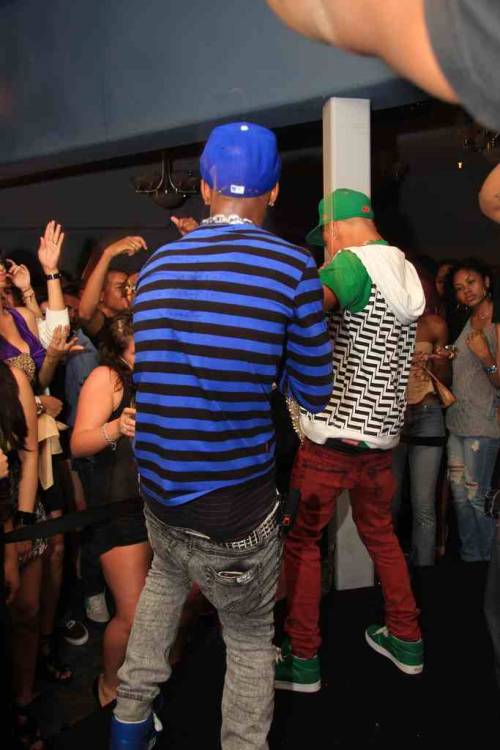
For sagging’s many detractors, kids wearing their pants below the waist — or below the butt cheeks, in the case of the look’s most fervent adherents — has doubled as a reliable shorthand for a constellation of social ills ostensibly befalling or propagated by young black men. A dangerous lack of self-respect. An embrace of gang and prison culture. Another harbinger of cultural decline. Those are all things that people say about hip-hop, which helped popularize the sagging aesthetic. And if those are the presumed stakes, it’s hardly any wonder why opposition to sagging sometimes has the feel of a full-on moral panic.

Such is the apoplexy around the styles that many of the most vocal proponents of sagging bans are people who might otherwise be wary of putting young black men into unnecessary contact with the criminal justice system. When Jefferson Parish, La., banned sagging last year, the move got a big cosign from the head of the nearby chapter of the NAACP. ”There is nothing positive about people wearing saggy pants,” he told a local TV station. (The national NAACP, it should be noted, has fought back against bans like these.) And a group called the Black Mental Health Alliance of Massachusetts began airing public service announcements in Boston last year that pointedly used the threat of arrest as deterrent. “Our community and our people are tired of these kids walking around like this,” Omar Reid, one of the initiative’s leaders, told the Boston Globe.

There’s certainly nothing novel about adults thinking that young people’s fashions are distasteful — indeed, that’s often kind of the point. Full disclosure time: Like an awful lot of people in my generational cohort, I used to sag. Here’s what I’ll say about that: Everyone who thought he was cool as a teenager and reaches his 30s will look back at photos of himself from high school and cringe mightily. But that isn’t specific to sagging, of course. Like goth dress, it freaks out old people, and then most of its practitioners move on to other things. The difference is that the anxieties around something like goth dress don’t get codified into laws that threaten jail time.

There’s another argument against sagging, which you can see in this video that’s part of the “Pull Up Your Pants Challenge,” that tries to appeal to respectability and pragmatism: Black kids should jettison the look if only to avoid agitating unnecessary suspicion from police and strangers.

But if history is any indication, that suspicion has proven to be pretty sticky, and it’s attached itself to a bunch of different styles — hoodies, construction boots, do-rags.

Sagging, though, has been a uniquely long-lived source of agita.

The Murky Genesis Of Saggy Pants

Los Angeles police officer Victor Vinson was talking to an audience of local parents, warning them about the lure of street gangs. He told them how they might recognize if their own kids had come under the thrall of gangs. The biggest tell, he said, was their sagging pants.

“Kids today are dressing for death,” Vinson said.

That sentiment sounds a lot like the feelings of Mary Sue Rich, the Ocala, Fla., council member. But Vinson is quoted in a Los Angeles Times article from way back in 1988, one of the earliest mentions of the trend in the press. It’s a reminder that people have been fretting about sagging for nearly three decades.

The world has changed a lot since then. Los Angeles in 1988 really was a violent place, especially compared with today, and much of that violence was gang-related. Hip-hop hadn’t become a staple of mainstream music yet. Fashion has changed, too, as people have moved to more contoured, fitted clothing. Sagging has tracked with that: the huge, baggy jeans of the 1990s have been replaced withskinny jeans and pants today. (Unless, you know, you’re Michael Jordan.)

But let’s back up a bit. The most familiar origin myth for sagging goes something like this: Convicts prohibited from wearing belts often wore sagging prison-issued uniforms, and they carried that look with them once they were back on the outside. Another story goes that some prisoners would wear their pants low to let other inmates know they were sexually available. Both have been tentpoles of “scared straight” arguments against sagging for a long time. Um, literally so in the case of the latter.

“You want to walk around looking like a criminal? Pull up your damn pants!”

“You know that in jail that look meant you wanted to have sex with other prisoners? Pull up your damn pants!”

But it’s murky as to how true this be.

“I don’t think we can definitively say that sagging began in prisons,” said Tanisha C. Ford, a historian at the University of Massachusetts at Amherst who researches fashion.

An entry about sagging’s genesis on Snopes, the online dictionary of urban legends, says the trend did in fact originate in prison, but the article doesn’t link to its sources.

Consider the many other fashions that once carried the stigma of imprisonment that have migrated to the outside world. It’s probably not an accident that the mainstreaming of tattoos and body art have coincided with the explosion of the American incarceral state.

Whatever the origins, people have actively courted that connection by positioning themselves against mainstream American ideas of propriety through their dress. But when that fashion itself goes mainstream, what counts as oppositional requires some occasional recalibrating.

It’s highly possible, then, that sagging might still be a thing all these decades later because it hasn’t lost its unique ability to rankle.

When ‘Hoodlums’ Wore Suit Jackets

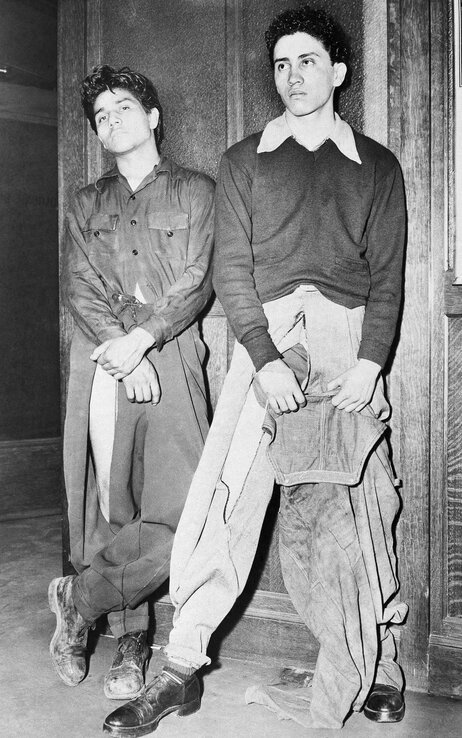
But all this drama around young brown kids, baggy clothes and crime goes back much further than hip-hop and street gangs. In the 1930s, black and Mexican-American men in California began rocking big, oversize suit jackets, and pants that tapered down at their ankles: zoot suits.

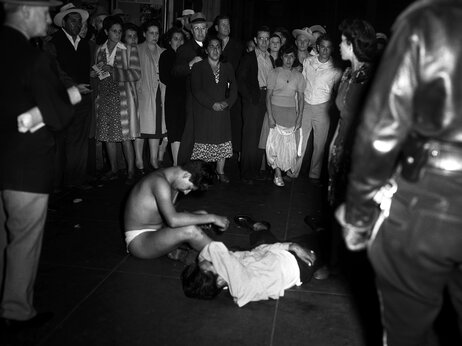
Young men were stripped of their clothes and badly beaten as policemen scoured the streets in Los Angeles for zoot-suited young men they blamed for petty crime.

Harold P. Matosian/AP

Ford, the fashion historian, said the look was born out of improvisation, since many of those kids couldn’t afford tailors. “A lot of kids would just go to the thrift store to buy those suits, and then get their mom or their aunts to taper the pants,” she said.

But Luis Alvarez, a historian at University of California, San Diego who wrote a book on that period called The Power of the Zoot, said that just like the origins of sagging, the genesis of the zoot suit is pretty murky. “Some might argue that [people started wearing it because] it looked better when they were spinning girls around the dance floor,” he said. “I argued with a guy who said they got it from [Clark Gable] in Gone with the Windbecause he was sort of wearing a baggy suit in that movie.”

What isn’t in doubt, he said, is that the look was spread by black jazz musicians as they traveled around the country.

Today, those zoot suits are synonymous with Jazz Age and World War II-era cool. But back then, they were seen as the wardrobe of black and Mexican-American delinquents and gang members. Zoot suiters’ opponents — and there were lots — saw them as harbingers of a moral decline. In his book, Alvarez cites a 1943Washington Post article that was typical of the way the trend was covered in big-city newspapers. The language in it sounds an awful lot like the speech Officer Vinson would give those Los Angeles parents decades later on the dangers posed by saggers.

“Chief features are the broad felt hat, the long key chain, the pocket knife of a certain size and shape, worn in the vest pocket by boys, in the stocking by girls, the whisky flask of peculiar shape to fit into the girl’s bosoms, the men’s haircut of increasing density and length at the neck — all of which paraphernalia has symbolic and secret meanings for the initiates. In some places, the wearing of the uniform by the whole gang is a danger signal, indicating a predetermine plan for concerted action and attack.”

In 1943, Noe Vasquez and Joe Vasquez — both 18 years old but not relatives — told Los Angeles police that they were roughed up by sailors who tore their zoot suit-style clothes. And even after all that? Swag.

“The style is linked to jazz music, it’s linked to urban spaces, it’s linked to a criminal underworld — gambling and numbers-running,” Ford said. And those crimes were associated with blacks and Latinos.

Alvarez wrote that “[z]oot syle came to represent what was morally and politically deficient with the home front during World War II — violence, drinking, premarital sex, and the threat of street attacks.” That distaste for the clothes and the culture associated with it persisted even though a good number of the people in the military and war industry were themselves zoot suiters.

As the war ramped up, Americans were, uh, tightening their belts. (My bad, y’all.) There were strict rations put on textiles and fabrics, which angered zoot suit opponents even more — those baggy, bulky threads weren’t just criminal, but an affront to the nation’s war goals.

“In ’42 and ’43 it becomes a flashpoint for ideas that were larger than just youth style,” Alvarez told me. “This is when it becomes the platform for arguments about who is or who isn’t American.”

That anger exploded into violence in Los Angeles when bands of white servicemen — joined by hundreds of police officers — left their posts to search for young black and Mexican-American men dressed in that style to beat up. People were pulled from streetcars and pummeled by crowds. They were bludgeoned in the streets. The violence went on for more than four days.

“These kids wearing those outfits were stripped by sailors and LAPD and their suits were burned in the street,” Ford said. But the anti-zoot marauders were hardly picky; people who weren’t wearing zoot suits were jumped, too.

Similar but smaller paroxysms of violence would unfold in other big cities across the country as zoot suiters clashed with the police and angry whites. When things calmed down, the Zoot Suit Riots became a kind of national scandal, with both left-leaning folks and conservatives arguing that they might have been part of a plot to sow disunity on the domestic front.

Dangerous Fashion Goes Mainstream

The war ended. Fashion moved on. Ford said that as time went on, looks like dashikis and Afros would come to take on their own aura of black menace, although the threat in those style choices was more about fears of militancy and political unrest than street crime.

“We look at the Afro and the dashikis … as part of iconography of the 1970s, but we don’t remember how controversial and political those were,” she said. Some historically black colleges like Hampton University once placed bans on Afros, and the hairstyle was verboten in Cuba and Tanzania.

Untethered from their contemporary messiness, though, those looks have folded into mainstream life. Afros used to scandalize white folks and older black people alike. Today college-educated women post their ”big chop” pics to Facebook, Instagram or the countless blogs dedicated to natural hair, and they’re greeted with affirmation and cosigns.

And zoot suits? Ford joked that the “Steve Harvey suits” that were the preferred dressed-up look for millionaire athletes looked a whole lot like the zoot suits of the World War II era. “You’d see these huge, 6-8 basketball players walking with the big, long suit jackets,” she said. (I’ve been looking for any excuse to link to this draft night photo of Jalen Rose. Thank you, Dr. Ford.)

You might still see teenagers rocking them, too. “Nowadays I can’t go a week or two in May or June without driving past some kids wearing zoot suits to their prom,” Alvarez said.

I wondered if sagging was likely to ever make that same transition into ordinariness. “Once historians go and tell the story of the late 20th century — which we haven’t done yet — there’s a way that sagging and hoodies and t-shirts will be revered as markers of a particular era,” Ford told me. She said that the hoodie and sagging pants look might even become the way we remember the youth resistance of our time. But, she said, “it’s definitely still going to be tied to [ideas of] criminality.”

Alvarez said zoot suits and sagging share much of the same DNA: They were ways that people made statements about their relationships to other people and their circumstances.

“[For the wearers,] it’s a mechanism to reclaim dignity that’s been taken away from them,” he said.

A lot of people would roll their eyes and shake their fists if you told them that there was anything dignifying about sagging pants, I said.

“Youth culture, in general, is not always decipherable to those outside of the inner circle,” Alvarez responded. “In many ways, our dress and our vocabulary and our vernacular becomes powerful because [outsiders] can’t understand it.”

*****

Readers: Amazing that we can get laws passed prohibiting “sagging pants,” because they are considered “disrespectful” to some,  but we can’t seem to get laws passed about men that are “disrespectful” to women walking the streets. Something is majorly wrong with this “logic.”

With respect to the strictly fashion part of this write, I can tell you I am not a fan of the “sagging pant.” But obviously some women are because men wear them and women go out with the men that wear them. Not me. Never.

In my opinion, the only way we can really have an influence over the men, really boys (Would real men be caught dead wearing these?), to stop wearing their pants that way is if women say something and demand that the men they are dating not wear those when they go out…or ever. They look horrible. Believe me, if women refuse to date men dressed like that, men will stop. But women, put up with it. Or like it for whatever reason. Really? Do women really like that look? If you do, let me know – blog me.

Women for the most part, enjoy looking nice and want to look nice when they go out. I am alsways disappointed when I see a woman who has made an effort to look nice, out with a man and he looks like he hasn’t made any effort. FYI: “Saggy pants” in my mind, is also conidered no effort. I love it when a man wants to look good for his lady.

In fact, I am working with a man who is a husband of one of my clients. During our first meeting he confessed to me that he felt that he has been letting his wife down for years by not dressing well, and wants to up his game so that she can feel good when they go out. I loved that. Granted, he’s not wearing “sagging pants” but you get the point. I wish more men thought like that.

I love getting dressed up for a night in the city. I love getting dressed up. Period. And I am so disappointed when I see a woman dressing her best, putting out all the effort and you can tell the guy didn’t give his outfit a second thought. Whether you know it or care about it or not, your style is making a statement. Did you read the above write, what statement “sagging pants” are making? I doubt many guys want to make that kind of statement with their style, but whether you know it or not, you are. Pull them pants up! I don’t want to look at your underwear.

Let me tell you, I work with many men, and if you’re a guy out looking to get an edge over the competition in any arena, pull up your pantsdress well, be mindful of the statement your style is making, dress on purpose not by default…because most men out there don’t. Losing the “sagging pants” are just part of it, but a huge step if you’re one wearing them.

What are your thoughts about the “sagging pant?” What else are you just noticing in street fashion?

Thoughts? Blog me.

Lastly, greed over a great story is surfacing from my “loyal”(?) readers. With all this back and forth about who owns what, that appears on my blog, let me reiterate that all material posted on my blog becomes the sole property of my blog. If you want to reserve any proprietary rights don’t post it to my blog. I will prominently display this caveat on my blog from now on to remind those who may have forgotten this notice.

Gratefully your blog host,

michelle

Aka BABE: We all know what this means by now :)

If you love my blog and my writes, please make a donation via PayPal, credit card, or e-check, please click the “Donate” button below. (Please only donations from those readers within the United States. – International readers please see my “Donate” page)

Or if you would like to send a check via snail mail, please make checks payable to “Michelle Moquin”, and send to:

Michelle Moquin PO Box 29235 San Francisco, Ca. 94129

Thank you for your loyal support!

All content on this site are property of Michelle Moquin © copyright 2008-2014

me

“Though she be but little, she be fierce.” – William Shakespeare Midsummer Night’s Dream 

" Politics, god, Life, News, Music, Family, Personal, Travel, Random, Photography, Religion, Aliens, Art, Entertainment, Food, Books, Thoughts, Media, Culture, Love, Sex, Poetry, Prose, Friends, Technology, Humor, Health, Writing, Events, Movies, Sports, Video, Christianity, Atheist, Blogging, History, Work, Education, Business, Fashion, Barack Obama, People, Internet, Relationships, Faith, Photos, Videos, Hillary Clinton, School, Reviews, God, TV, Philosophy, Fun, Science, Environment, Design, The Page, Rants, Pictures, Church, Blog, Nature, Marketing, Television, Democrats, Parenting, Miscellaneous, Current Events, Film, Spirituality, Obama, Musings, Home, Human Rights, Society, Comedy, Me, Random Thoughts, Research, Government, Election 2008, Baseball, Opinion, Recipes, Children, Iraq, Funny, Women, Economics, America, Misc, Commentary, John McCain, Reflections, All, Celebrities, Inspiration, Lifestyle, Theology, Linux, Kids, Games, World, India, Literature, China, Ramblings, Fitness, Money, Review, War, Articles, Economy, Journal, Quotes, NBA, Crime, Anime, Islam, 2008, Stories, Prayer, Diary, Jesus, Buddha, Muslim, Israel, Europe, Links, Marriage, Fiction, American Idol, Software, Leadership, Pop culture, Rants, Video Games, Republicans, Updates, Political, Football, Healing, Blogs, Shopping, USA, Class, Matrix, Course, Work, Web 2.0, My Life, Psychology, Gay, Happiness, Advertising, Field Hockey, Hip-hop, sex, fucking, ass, Soccer, sox"

Posted in Good Reads and Good See'ds, Just noticing: Observations of a blogger | 33 Comments »

Wonderful Women Of The World

Posted by Michelle Moquin on October 18th, 2014


Bookmark and Share

Good morning!

I’ve blogged on Ada Lovelace before, but this takes women and computers to an entirely different level.

All Tech Considered – from NPR:

The Forgotten Female Programmers Who Created Modern Tech

Jean Jennings (left) and Frances Bilas set up the ENIAC in 1946. Bilas is arranging the program settings on the Master Programmer.

Jean Jennings (left) and Frances Bilas set up the ENIAC in 1946. Bilas is arranging the program settings on the Master Programmer.

If your image of a computer programmer is a young man, there’s a good reason: It’s true. Recently, many big tech companies revealed how few of their female employees worked in programming and technical jobs. Google had some of the highest rates: 17 percent of its technical staff is female.

It wasn’t always this way. Decades ago, it was women who pioneered computer programming — but too often, that’s a part of history that even the smartest people don’t know.

I took a trip to ground zero for today’s computer revolution, Stanford University, and randomly asked over a dozen students if they knew who were the first computer programmers. Almost none knew.

“I’m in computer science,” says a slightly embarrassed Stephanie Pham. “This is so sad.”

A few students, like Cheng Dao Fan, get close. “It’s a woman, probably,” she says searching her mind for a name. “It’s not necessarily [an] electronic computer. I think it’s more like a mechanic computer.”

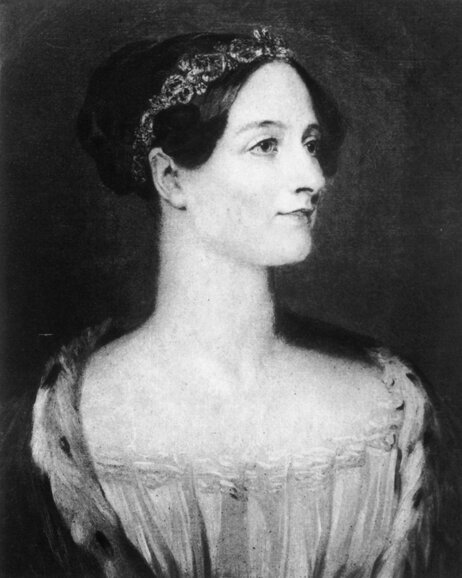
She’s thinking of Ada Lovelace, also known as the Countess of Lovelace, born in 1815. Walter Isaacson begins his new book,The Innovators: How a Group of Hackers, Geniuses and Geeks Created the Digital Revolution, with her story.

Augusta Ada, Countess of Lovelace, was the daughter of poet Lord Byron. The computer language ADA was named after her in recognition of her pioneering work with Charles Babbage.

“Ada Lovelace is Lord Byron’s child, and her mother, Lady Byron, did not want her to turn out to be like her father, a romantic poet,” says Isaacson. So Lady Byron “had her tutored almost exclusively in mathematics as if that were an antidote to being poetic.”

Lovelace saw the poetry in math. At 17, she went to a London salon and met Charles Babbage. He showed her plans for a machine that he believed would be able to do complex mathematical calculations. He asked Lovelace to write about his work for a scholarly journal. In her article, Lovelace expresses a vision for his machine that goes beyond calculations.

She envisioned that “a computer can do anything that can be noted logically,” explains Isaacson. “Words, pictures and music, not just numbers. She understands how you take an instruction set and load it into the machine, and she even does an example, which is programming Bernoulli numbers, an incredibly complicated sequence of numbers.”

Babbage’s machine was never built. But his designs and Lovelace’s notes were read by people building the first computer a century later.

The women who would program one of the world’s earliest electronic computers, however, knew nothing of Lovelace and Babbage.

As part of the oral history project of the Computer History Museum, Jean Jennings Bartik recalled how she got the job working on that computer. She was doing calculations on rocket and canon trajectories by hand in 1945. A job opened to work on a new machine.

“This announcement came around that they were looking for operators of a new machine they were building called the ENIAC,” recalls Bartik. “Of course, I had no idea what it was, but I knew it wasn’t doing hand calculation.”

Bartik was one of six female mathematicians who created programs for one of the world’s first fully electronic general-purpose computers. Isaacson says the men didn’t think it was an important job.

“Men were interested in building, the hardware,” says Isaacson, “doing the circuits, figuring out the machinery. And women were very good mathematicians back then.”

Isaacson says in the 1930s female math majors were fairly common — though mostly they went off to teach. But during World War II, these skilled women signed up to help with the war effort.

Bartik told a live audience at the Computer History Museum in 2008 that the job lacked prestige. The ENIAC wasn’t working the day before its first demo. Bartik’s team worked late into the night and got it working.

“They all went out to dinner at the announcement,” she says. “We weren’t invited and there we were. People never recognized, they never acted as though we knew what we were doing. I mean, we were in a lot of pictures.”

At the time, though, media outlets didn’t name the women in the pictures. After the war, Bartik and her team went on to work on the UNIVAC, one of the first major commercial computers.

The women joined up with Grace Hopper, a tenured math professor who joined the Navy Reserve during the war. Walter Isaacson says Hopper had a breakthrough. She found a way to program computers using words rather than numbers — most notably a program language called COBOL.

“You would be using a programming language that would allow you almost to just give it instructions, almost in regular English, and it would compile it for whatever hardware it happened to be,” explains Isaacson. “So that made programming more important than the hardware, ’cause you could use it on any piece of hardware.”

Grace Hopper originated electronic computer automatic programming for the Remington Rand Division of Sperry Rand Corp.

Hopper retired from the Navy Reserve as a rear admiral. An act of Congress allowed her to stay past mandatory retirement age. She did become something of a public figure and even appeared on the David Letterman show in 1986. Letterman asks her, “You’re known as the Queen of Software. Is that right?”

“More or less,” says the 79-year-old Hopper.

But it was also just about this time that the number of women majoring in computer science began to drop, from close to 40 percent to around 17 percent now. There are a lot of theories about why this is so. It was around this time that Steve Jobs and Bill Gates were appearing in the media; personal computers were taking off.

Computer science degrees got more popular, and boys who had been tinkering with computer hardware at home looked like better candidates to computer science departments than girls who liked math, says Janet Abbate, a professor at Virginia Tech who has studied this topic.

“It’s kind of the classic thing,” she says. “You pick people who look like what you think a computer person is, which is probably a teenage boy that was in the computer club in high school.”

For decades the women who pioneered the computer revolution were often overlooked, but not in Isaacson’s book about the history of the digital revolution.

“When they have been written out of the history, you don’t have great role models,” says Isaacson. “But when you learn about the women who programmed ENIAC or Grace Hopper or Ada Lovelace … it happened to my daughter. She read about all these people when she was in high school, and she became a math and computer science geek.”

Lovelace, the mathematician, died when she was 36. The women who worked on the ENIAC have all passed away, as has Grace Hopper. But every time you write on a computer, play a music file or add up a number with your phone’s calculator, you are using tools that might not exist without the work of these women.

Isaacson’s book reminds us of that fact. And perhaps knowing that history will show a new generation of women that programming is for girls.

W*O*M*E*N*R*O*C*K*

Readers: Big kudos go to these Wonderful Women Of The World. I was one of those girls that loved math – I still do today. Numbers have always been fascinating to me, and I have incorporated them into my life and business. And not just in the form of $$$.

If it were not for these ladies we may not be where we are today in the computer world. I just wonder how much farther we would be if these women were recognized throughout the years and had more of a chance to be teachers and mentors to young girls.  These women didn’t get the recognition they so deserved. Let’s HOPE they get it now, and inspire more girls to major in computer science. Thanks to Isaacson’s book, they just may.

Blog Me. 

Happy Saturday. Thanks for being here with me!


Lastly, greed over a great story is surfacing from my “loyal”(?) readers. With all this back and forth about who owns what, that appears on my blog, let me reiterate that all material posted on my blog becomes the sole property of my blog. If you want to reserve any proprietary rights don’t post it to my blog. I will prominently display this caveat on my blog from now on to remind those who may have forgotten this notice.

Gratefully your blog host,

michelle

Aka BABE: We all know what this means by now :)

If you love my blog and my writes, please make a donation via PayPal, credit card, or e-check, please click the “Donate” button below. (Please only donations from those readers within the United States. – International readers please see my “Donate” page)

Or if you would like to send a check via snail mail, please make checks payable to “Michelle Moquin”, and send to:

Michelle Moquin PO Box 29235 San Francisco, Ca. 94129

Thank you for your loyal support!

All content on this site are property of Michelle Moquin © copyright 2008-2014

me

“Though she be but little, she be fierce.” – William Shakespeare Midsummer Night’s Dream 

" Politics, god, Life, News, Music, Family, Personal, Travel, Random, Photography, Religion, Aliens, Art, Entertainment, Food, Books, Thoughts, Media, Culture, Love, Sex, Poetry, Prose, Friends, Technology, Humor, Health, Writing, Events, Movies, Sports, Video, Christianity, Atheist, Blogging, History, Work, Education, Business, Fashion, Barack Obama, People, Internet, Relationships, Faith, Photos, Videos, Hillary Clinton, School, Reviews, God, TV, Philosophy, Fun, Science, Environment, Design, The Page, Rants, Pictures, Church, Blog, Nature, Marketing, Television, Democrats, Parenting, Miscellaneous, Current Events, Film, Spirituality, Obama, Musings, Home, Human Rights, Society, Comedy, Me, Random Thoughts, Research, Government, Election 2008, Baseball, Opinion, Recipes, Children, Iraq, Funny, Women, Economics, America, Misc, Commentary, John McCain, Reflections, All, Celebrities, Inspiration, Lifestyle, Theology, Linux, Kids, Games, World, India, Literature, China, Ramblings, Fitness, Money, Review, War, Articles, Economy, Journal, Quotes, NBA, Crime, Anime, Islam, 2008, Stories, Prayer, Diary, Jesus, Buddha, Muslim, Israel, Europe, Links, Marriage, Fiction, American Idol, Software, Leadership, Pop culture, Rants, Video Games, Republicans, Updates, Political, Football, Healing, Blogs, Shopping, USA, Class, Matrix, Course, Work, Web 2.0, My Life, Psychology, Gay, Happiness, Advertising, Field Hockey, Hip-hop, sex, fucking, ass, Soccer, sox"

Posted in Human Rights and Equality, Political Powwow | 8 Comments »

No, Ebola Didn’t Have To Kill Duncan.

Posted by Michelle Moquin on October 17th, 2014

Bookmark and Share

It didn’t need to. Racism stepped in and handled it. 

Good morning!

From Dallas News:


Exclusive: Ebola didn’t have to kill Thomas Eric Duncan, nephew says

On Friday, Sept. 25, 2014, my uncle Thomas Eric Duncan went to Texas Health Presbyterian Hospital Dallas. He had a high fever and stomach pains. He told the nurse he had recently been in Liberia. But he was a man of color with no health insurance and no means to pay for treatment, so within hours he was released with some antibiotics and Tylenol.

Two days later, he returned to the hospital in an ambulance. Two days after that, he was finally diagnosed with Ebola. Eight days later, he died alone in a hospital room.

Now, Dallas suffers. Our country is concerned. Greatly. About the lack of answers and transparency coming from a hospital whose ignorance, incompetence and indecency has yet to be explained. I write this on behalf of my family because we want to set the record straight about what happened and ensure that Thomas Eric did not die in vain. So, here’s the truth about my uncle and his battle with Ebola.

Thomas Eric Duncan was cautious. Among the most offensive errors in the media during my uncle’s illness are the accusations that he knew he was exposed to Ebola — that is just not true. Eric lived in a careful manner, as he understood the dangers of living in Liberia amid this outbreak. He limited guests in his home, he did not share drinking cups or eating utensils.

And while the stories of my uncle helping a pregnant woman with Ebola are courageous, Thomas Eric personally told me that never happened. Like hundreds of thousands of West Africans, carefully avoiding Ebola was part of my uncle’s daily life.

And I can tell you with 100 percent certainty: Thomas Eric would have never knowingly exposed anyone to this illness.

Thomas Eric Duncan was a victim of a broken system. The biggest unanswered question about my uncle’s death is why the hospital would send home a patient with a 103-degree fever and stomach pains who had recently been in Liberia — and he told them he had just returned from Liberia explicitly due to the Ebola threat.

Some speculate that this was a failure of the internal communications systems. Others have speculated that antibiotics and Tylenol are the standard protocol for a patient without insurance.

The hospital is not talking. Until then, we are all left to wonder. What we do know is that their error affects all of society. Their bad judgment or misjudgment sent my uncle back into the community for days with a highly contagious case of Ebola. And now, officials suspect that a breach of protocol by the hospital is responsible for a new Ebola case, and that all health care workers who care for my uncle could potentially be exposed.

Their error set the wheels in motion for my uncle’s death and additional Ebola cases, and their ignorance, incompetence or indecency has created a national security threat for our country.

Thomas Eric Duncan could have been saved. Finally, what is most difficult for us — Thomas Eric’s mother, children and those closest to him — to accept is the fact that our loved one could have been saved. From his botched release from the emergency room to his delayed testing and delayed treatment and the denial of experimental drugs that have been available to every other case of Ebola treated in the U.S., the hospital invited death every step of the way.

When my uncle was first admitted, the hospital told us that an Ebola test would take three to seven days. Miraculously, the deputy who was feared to have Ebola just last week was tested and had results within 24 hours.

The fact is, nine days passed between my uncle’s first ER visit and the day the hospital asked our consent to give him an experimental drug — but despite the hospital’s request they were never able to access these drugs for my uncle. (Editor’s note: Hospital officials have said they started giving Duncan the drug Brincidofovir on October 4.) He died alone. His only medication was a saline drip.

For our family, the most humiliating part of this ordeal was the treatment we received from the hospital. For the 10 days he was in the hospital, they not only refused to help us communicate with Thomas Eric, but they also acted as an impediment. The day Thomas Eric died, we learned about it from the news media, not his doctors.

Our nation will never mourn the loss of my uncle, who was in this country for the first time to visit his son, as my family has. But our nation and our family can agree that what happened at Texas Health Presbyterian Hospital Dallas must never happen to another family.

In time, we may learn why my uncle’s initial visit to the hospital was met with such incompetence and insensitivity. Until that day comes, our family will fight for transparency, accountability and answers, for my uncle and for the safety of the country we love.

*****

Readers: The write says that “…the lack of answers and transparency coming from a hospital whose ignorance, incompetence and indecency has yet to be explained.” That may all be true but what it doesn’t mention is that racism was involved. Yeah, Duncan didn’t have insurance but that wasn’t the reason they let him go. They let him go because he was a black man, and they just didn’t care enough about him to do what they would have done had he not been black.

As always, they make the black man out to be the bad guy…accusing Duncan of knowing that he was exposed to Ebola. He’s the victim and they’re treating him like he’s a perpetrator. Same same old story. If he was a white guy, they would be feeling so sorry for him and immediately blaming the hospital for their incompetency, etc.

They didn’t care about him and now other lives have been affected and the country risks the spreading of a very infectious and fatal disease.

No, Ebola didn’t have to kill Duncan. It didn’t need to. Racism stepped in and handled it – people who let him go with a 103-degree fever, stomach pains, and the knowledge that they had been informed by Duncan that he was in Liberia.

In my opinion, those who let Duncan go knew he was exposed to Ebola and had the potential of testing positive for it, and just didn’t give a damn.

This is just a microcosm, albeit one that has the potential of escalating into something much greater, of what is happening all over the world. Racism is so deeply ingrained that racists risk the demise of people and the country because they can’t see past their racism.

That’s just my opinion. Thoughts? Blog me. 

Lastly, greed over a great story is surfacing from my “loyal”(?) readers. With all this back and forth about who owns what, that appears on my blog, let me reiterate that all material posted on my blog becomes the sole property of my blog. If you want to reserve any proprietary rights don’t post it to my blog. I will prominently display this caveat on my blog from now on to remind those who may have forgotten this notice.

Gratefully your blog host,

michelle

Aka BABE: We all know what this means by now :)

If you love my blog and my writes, please make a donation via PayPal, credit card, or e-check, please click the “Donate” button below. (Please only donations from those readers within the United States. – International readers please see my “Donate” page)

Or if you would like to send a check via snail mail, please make checks payable to “Michelle Moquin”, and send to:

Michelle Moquin PO Box 29235 San Francisco, Ca. 94129

Thank you for your loyal support!

All content on this site are property of Michelle Moquin © copyright 2008-2014

me

“Though she be but little, she be fierce.” – William Shakespeare Midsummer Night’s Dream 

" Politics, god, Life, News, Music, Family, Personal, Travel, Random, Photography, Religion, Aliens, Art, Entertainment, Food, Books, Thoughts, Media, Culture, Love, Sex, Poetry, Prose, Friends, Technology, Humor, Health, Writing, Events, Movies, Sports, Video, Christianity, Atheist, Blogging, History, Work, Education, Business, Fashion, Barack Obama, People, Internet, Relationships, Faith, Photos, Videos, Hillary Clinton, School, Reviews, God, TV, Philosophy, Fun, Science, Environment, Design, The Page, Rants, Pictures, Church, Blog, Nature, Marketing, Television, Democrats, Parenting, Miscellaneous, Current Events, Film, Spirituality, Obama, Musings, Home, Human Rights, Society, Comedy, Me, Random Thoughts, Research, Government, Election 2008, Baseball, Opinion, Recipes, Children, Iraq, Funny, Women, Economics, America, Misc, Commentary, John McCain, Reflections, All, Celebrities, Inspiration, Lifestyle, Theology, Linux, Kids, Games, World, India, Literature, China, Ramblings, Fitness, Money, Review, War, Articles, Economy, Journal, Quotes, NBA, Crime, Anime, Islam, 2008, Stories, Prayer, Diary, Jesus, Buddha, Muslim, Israel, Europe, Links, Marriage, Fiction, American Idol, Software, Leadership, Pop culture, Rants, Video Games, Republicans, Updates, Political, Football, Healing, Blogs, Shopping, USA, Class, Matrix, Course, Work, Web 2.0, My Life, Psychology, Gay, Happiness, Advertising, Field Hockey, Hip-hop, sex, fucking, ass, Soccer, sox"

Posted in Health & Well Being, Human Rights and Equality | 12 Comments »