Michelle Moquin's "A day in the life of…"

Creative Discussions, Inspiring Thoughts, Fun Adventures, Love & Laughter, Peaceful Travel, Hip Fashions, Cool People, Gastronomic Pleasures, Exotic Indulgences, Groovy Music, and more!

  • Hello!

    Welcome To My OUR Blog!


    Michelle Moquin's Facebook profile "Click here" to go to my FaceBook profile. Visit me!
  • Copyright Protected

    Protected by Copyscape Plagiarism Checker
  • Let Michelle Style YOU!

    I am a "Specialist in Styles" Personal Stylist. Check out my Style website to see how I can help you discover, define, and refine your unique style.
  • © Copyright 2008-2023

    All content on this site are property of Michelle Moquin © copyright 2008-2023. All material posted on my blog becomes the sole property of my blog. If you want to reserve any proprietary rights don't post it to my blog.
  • In Pursuit Of…

    Custom Search
  • Madaline Speaks

    For those of you interested in reading an Earthling Girl's Guide to a better Government, and a Greener world, check out the blog:
  • Contact Your Representatives and Senators Here!

    To send letters to your representatives about any issue of interest, Click here


    To send letters to your Senators about any issue of interest, Click here


    Get involved - Write your letters today!
  • On The Issues

    Don't be uninformed! Click here to see how every political leader on every issue voted.
  • Don’t Believe The Lies – Get The Facts

    FactCheck.org is a nonpartisan, nonprofit “consumer advocate” for voters that aims to reduce the level of deception and confusion in U.S. politics. They monitor the factual accuracy of what is said by major U.S. political players in the form of TV ads, debates, speeches, interviews and news releases. Their goal is to apply the best practices of both journalism and scholarship, and to increase public knowledge and understanding.

    Click here to get the facts.

    Pulitzer Prize Winner Politifact.com is another trusted site to get the facts. Click here to get the facts.

  • Who’s Paying Who?

    On The Issues is a nonpartisan guide to money's influence on U.S. elections and public policy.
  • Blog Rules of Conduct

    Rule #1: "The aliens can not reveal anything about anyone’s life that would not be known without the use of our technology. The exception being that if a reader has a question about his or her health and the assistance of alien technology would be necessary to answer that question.”

    Rule #2: "Aliens will not threaten humans and Humans will not threaten aliens."

    Rule #3:

    Posting Comments:

    When posting a comment in regards to any past or archived article, please reference the title and date of the article and post your comment on the present day to keep the conversation contemporary.

    NOTE: You do not need to add your e-mail address when posting a comment. Your real name, an alias, a moniker, initials...whatever ...even simply "anonymous" is all you need to add in the fields in order to post a comment.

    Thank you.

  • *********

    Yellow Pages for San Francisco, CA
  • Meta

  • Looking For A Personal Stylist?

    Michelle has designed and styled for the stars! She can be your "Specialist in Styles" Personal Stylist too. Check out Michelle's style website
  • Recent Posts

  • Michelle’s E-mail:

    E-mail me! ~~~~~~~~~~~~~~
  • Care To Twitter? Come Tweet Me!

  • Disclaimer: Adult Blog

    I DO NOT CENSOR COMMENTS POSTED TO THIS BLOG: Therefore this blog is not for the faint hearted, thin skinned, easily offended or the appointed people's moralist. If you feel that you may fit in any of those categories, please DO NOT read my blog or its comments. There are plenty of blogs that will fit your needs, find one. This warning also applies to those who post comments who would find it unpleasant or mentally injurious to receive an opposing opinion via a raw to vulgar delivery. I DO NOT censor comments posted here. If you post a comment, you are on notice that you may receive a comment in language or opinion that you will not approve of or that you feel is offensive. If that would bother you, DO NOT post on my blog.

    27Mar2011
  • Medical Disclaimer:

    I am not a doctor nor am I medically trained in any field. No one on this website is claiming to be a medical physician or claiming to be medically trained in any field. However, anyone can blog information about health articles, folk remedies, possible cures, possible treatments, etc that they have heard of on my blog. Please see your physician or a health care professional before heeding or using any medical information given on this blog. It is not intended to replace any medical advice given to you by your licensed medical professional. This blog is simply providing a medium for discussion on all matters concerning life. All opinions given are the sole responsibility of the person giving them. This blog does not make any claim to their truthfulness, honesty, or factuality because of their presence on my blog. Again, Please consult a health care professional before heeding any health information given here.

    27Mar2011
  • Legal Disclaimer:

    Michelle Moquin's "A Day In The Life Of..." publishes the opinions of expert authorities in many fields. But the use of these opinions is no substitute for legal, accounting, investment, medical and other professional services to suit your specific personal needs. Always consult a competent professional for answers to your specific questions.

    27Mar2011
  • Fair Use Notice Disclaimer

    This web site may contain copyrighted material the use of which has not always been specifically authorized by the copyright owner. We are making such material available in our efforts to advance the understanding of humanity's problems and hopefully to help find solutions for those problems. We believe this constitutes a 'fair use' of any such copyrighted material as provided for in section 107 of the US Copyright Law. In accordance with Title 17 U.S.C. Section 107, the material on this site is distributed without profit to those who have expressed a prior interest in receiving the included information for research and educational purposes. A click on a hyperlink is a request for information. However, if you wish to use copyrighted material from this site for purposes of your own that go beyond 'fair use', you must obtain permission from me. You can read more about "fair use' and US Copyright Law"at the"Legal Information Institute of Cornell Law School." This notice was modified from a similar notice at "Common Dreams."

Archive for the 'Human Rights and Equality' Category

Wonderful Servicewomen Of The World

Posted by Michelle Moquin on 17th May 2012

Bookmark and Share

Good morning!

Unseen: Trailblazing Military Women Forced To Fight For Recognition, Equal Treatment

After a rocket-propelled grenade sent the Black Hawk helicopter tumbling out of the sky over Iraq, the medics got to work fast on the co-pilot, Capt. Duckworth. Standard operating procedure: cut away the desert-camo uniform before burnt fabric melds with burnt flesh. Get at the wounds. Stop the bleeding. Save what’s left.

When you show up at Walter Reed Medical Center in that kind of condition, you show up naked, with nothing except the hospital gown. So you’re given a “comfort kit,” a little backpack containing some toiletries and clothes. Duckworth awoke there around Thanksgiving 2004, a few weeks after the shootdown, to find a comfort kit waiting with slippers, a shaving kit and men’s jockey shorts.

She had to laugh.

“It was great. I don’t have feet, so I can’t wear the slippers, and you know, I just had my legs blown off, it’s not like I’m gonna shave my legs any time soon,” she chuckles. “I don’t have jockey, I’m not gonna wear men’s jockey shorts.”

Tammy Duckworth had just become the first female double amputee from Iraq, losing one leg above the knee and one below, but she had been a woman for a while already.

“They just had kits for men,” Duckworth says. “It never occurred to them to make kits for women.”

Duckworth is one of more than 282,000 American women who have deployed to Iraq and Afghanistan during a decade of war, according to Pentagon figures. That’s more than six times the number of women deployed in the first Gulf War and more than 35 times the number sent to Vietnam.

(An interactive timeline of U.S. women at war can be found here.)

The 207,308 women currently serving on active duty comprise some 14.5 percent of the U.S. armed forces, according to the military. While more than 2 million women have served since the Revolutionary War, some 1.9 million of them are currently living — an unprecedented generation of women at war. The number of female veterans hasdoubled since 1990 and is expected to skyrocket given further drawdowns in the Middle East.

They are helicopter pilots, linguists and flight nurses, mechanics, mental health administrators and homeland security-force directors, intelligence officers and combat correspondents, Ph.D.s and amputees, Purple Heart recipients and prisoners of war. Over seventy have become generals. Two, one in the Army and another in theAir Force, have four stars.

Duckworth, who received the Purple Heart, is one of 868 servicewomen who have been wounded in Iraq and Afghanistan. One hundred forty-four have been killed.

tammy duckworth

Tammy Duckworth looks on as President Barack Obama departs from the White House in November 2009.


Yet while women are undeniably at war, the full extent of their roles and capabilities still isn’t formally recognized by the military brass. Today’s servicewomen perform many of the roles that official policy says they cannot. Often, their service and suffering remain ignored by or invisible to the Pentagon and the public.

“First thing we can do for women veterans is to raise the awareness that women are veterans,” says Maj. Gen. Irene Trowell-Harris, director of the Center for Women Veterans at the Department of Veterans Affairs and the first African American woman to reach the rank of general in the National Guard.

Of the 1.2 million positions available throughout the military, 252,179, roughly 21 percent, are closed to women, according to a Department of Defense report to Congress ordered under the defense budget bill for fiscal year 2011. At the report’s release in February, the DOD announced plans to open 14,325 more jobs — an additional 1.2 percent of that total – slated for implementation on Monday.

All graphics by Chris Spurlock. A detailed table can be found here.

“The Department of Defense is committed to removing all barriers that would prevent Service members from rising to the highest level of responsibility that their talents and capabilities warrant,” the report says. But it continues, voicing the concern of those who oppose women in combat: “There are serious practical barriers, which if not approached in a deliberate manner, could adversely impact the health of our Service members and degrade mission accomplishment. Change of this magnitude requires sufficient time and resources.”

Incremental reforms, however, don’t address the fundamental problem: a segregated system that denies women the chance to compete for the most elite positions in the military — typically the fast track to advancement through the ranks — as well as the respect that their service and sacrifice has earned.

That hasn’t stopped Duckworth, named President Barack Obama’s assistant secretary of Veterans Affairs in 2009 and now a Democratic candidate for Congress in Illinois. Yet for every Duckworth, thousands of military women remain trapped between the Pentagon’s policy and practice, between rhetoric and reality.

‘LET’S NOT TELL HIM UNTIL THE WAR’S OVER’

American women have served in the military since there has been an America to serve. During the Civil War, women on both sides disguised themselves as men to enlist. More than 400,000 women served during the World Wars, but as the United States demobilized, the military pushed women back to the homefront.

During Vietnam, Congress began to recognize that more women were needed for the U.S. military machine, repealing legal provisions that had prevented them from comprising more than 2 percent of the nation’s troops. With the end of the draft in 1973, the military turned greater attention toward recruiting women, but struggled to treat them as equals — the Pentagon’s 1988 “Risk Rule” officially excluded women even from support missions if they were deemed as likely as combat troops to take a bullet.

The first Gulf War soon proved this doctrine untenable, however, as a clear gap emerged between the risk rule and the facts on the ground.

Rhonda Cornum lived in that gap. The call to war was a big change for Cornum, a biochemistry and nutrition Ph.D. recruited by the Army in 1978 to study wound healing — when Iraq invaded Kuwait in 1990, she was primarily conducting research on helicopter pilot performance and helmet-mounted displays. For Operation Desert Storm, the Army assigned her as a flight-surgeon to an attack-helicopter battalion, directly contravening the risk rule.

commander cornum

You know, women aren’t supposed to be in combat, Cornum recalls a colleague telling her at their staging grounds in Saudi Arabia just before the U.S. air assault on Iraq.

“Right, I know that,” was her answer.

Do you think the colonel knows you’re a girl? he asked.

“I said, ‘Well, I’ve been living in the parking space next to him in the Dhahran Airport parking lot for the last four months,’” she says. “‘If he doesn’t know by now, let’s not tell him until the war’s over.’”

This kind of doublethink was a standard part of Cornum’s experience in the Gulf. “So when people would come around or dignitaries would come,” she says, “they’d send me off to the motor pools.”

Yet by the end of the Gulf War, Cornum had participated in roughly one-quarter of her battalion’s attack missions. “One time, it didn’t go all that well,” she deadpans.
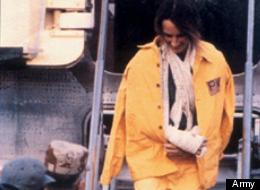
rhonda cornum
Rhonda Cornum deplanes after being released from Iraqi captivity on March 6, 1991.


On the last day of the war in 1991, Cornum’s Black Hawk was downed by Iraqi forces during a rescue mission. She broke both her arms and a finger, tore knee ligaments and, yes, took a bullet, but nonetheless managed to crawl out of the wrecked bird. She and the two other survivors of her eight-person crew spent a week as Iraqi prisoners of war before being released.

“Nobody made any comments about, ‘Oh, she shouldn’t have been there,’” says Brig. Gen. Cornum, who was awarded the Purple Heart. “My boss got promoted again.”

A 1993 Government Accountability Office study concluded that the some 40,000 servicewomen who deployed to the Gulf performed well on all fronts. Congress quickly repealed legislation dating to the 1950s that barred women from flying in combat and serving on combat ships.

Yet while the Pentagon also lauded servicewomen’s combat performance, the official expansions of opportunities for military women did not include ground combat. Instead, Clinton Defense Secretary Les Aspin replaced the risk rule in 1994 with the “Direct Ground Combat Definition and Assignment Rule,” still the military’s official policy. Aspin’s rule gave women more options than the risk rule, but it also severely constrains them, excluding them from ground combat that could involve hostile fire and physical contact “well forward on the battlefield.”

His rule also gave the services broad discretion to further restrict women from positions that entail physically demanding tasks, special operations, direct combat, stationing or cohabitating with combat troops and a lack of privacy.

With the Sept. 11, 2001, terrorist attacks and a global “war on terror,” America’s definition of combat radically changed. The Pentagon’s policy, however, has not.

An April report by the Congressional Research Service argues that the Defense Department’s embrace of counterinsurgency strategies should prompt officials to rethink more than 14,325 positions. “Recent changes in Army doctrine have in many ways called into question the ground exclusion policy, or at least, the services’ adherence to it,” the report’s author writes.

“In 1994, we didn’t know what was coming,” says Rajiv Srinivasan, who led an Army platoon as a lieutenant in Afghanistan. Now, he says, “There is no front line, no protected circle where we can hide the women.”

ATTACHMENT VS. ASSIGNMENT

The military is about to roll back the part of Aspin’s rule that bars women from officially serving in direct ground combat units below the brigade level — allowing them to be assigned at the narrower battalion level, in specialties in which they are already serving. It will also lift the portion barring women from serving in units or positions that co-locate with direct ground combat units that are closed to them. The Army accounts for the majority of the 14,325 affected positions.

Army Maj. Gen. Gary Patton, the Defense Department’s principal director for personnel policy, says the changes are a response to servicewomen’s performance during the past decade of war. Like many throughout the chain of command, he says the new policy isn’t a change in at least one way: women are already mission-critical.

majgen gary patton
Maj. Gen. Gary Patton discusses the DOD Women in Service Review at a Pentagon press conference on Feb. 9.


“Women have shown immense courage and have contributed greatly to our mission — we simply could not accomplish our objectives without them,” Patton, who served as a top commander in Iraq and Afghanistan, says in an email.

This line of reasoning also acknowledges that the military has for years tacitly violated the spirit of its own policy, if not the letter. While the 1994 rule bars women from being officially assigned to combat units, they can still be assigned to support positions “attached to” combat units. Thousands of the “new” positions opening to women are just formal assignment, rather than attachment, to units they already serve with, according to Pentagon spokeswoman Eileen Lainez.

Both Patton and Lainez cite as an example the position of Army tank mechanic among those newly opening to women. But Spc. Latoya Lucas served in a comparable role nine years ago.

Under Aspin’s rule, Lucas could not be assigned to an infantry battalion or brigade. She could, however, be attached as a mechanic to an infantry division, as she was to the 101st Airborne a month after the 2003 invasion of Iraq. She was part of an engineering unit tasked with resupply and infrastructure work in Mosul, an Iraqi provincial capital where fighting was heavy.

“DOD’s policy regarding women in combat was due for a revision,” she says, “particularly because so many [Iraq] and [Afghanistan] female veterans have found themselves in combat situations.”

Lucas was one of them. During a supply run, she was blown out of her Humvee when it took a direct hit from a rocket-propelled grenade. She suffered burns, shrapnel wounds, broken bones, hearing loss, paralysis and traumatic brain injury, as well as intestinal damage that required a permanent ostomy — surgery to reattach her intestine to the surface of the skin.

“I will have these ailments for the rest of my life,” Lucas writes in an email. “When I look at my scars, I cannot help but feel resilient. You have to be.”

She received her Purple Heart at her bedside during her five months at Walter Reed. A year later, she was forced to retire, even as she continued what would total two and a half years of rehab to regain her mobility. Now a public speaker, she continues to serve in a different way: Late last year, she was appointed to the VA’s advisory committee on women veterans.

latoya

At the committee’s annual meeting in late March, Lucas sits toward the end of a long table surrounded by glass and a projector screen, her sleeveless white shirt an outlier in a roomful of somber suits. Dark lines of scar tissue snake across the rippled skin of her bare arm. She asks about the transfer of medical records for combat veterans — a particular concern to women seeking treatment for injuries that, officially, they shouldn’t need.

“Did you serve in theater?” asks Michael Cardarelli, the VA’s principal deputy undersecretary for benefits and one of the only men in the room. From the head of the table, he can’t see her scars.

Like Lucas, Staff Sgt. Marti Ribeiro officially should not have been in a position to take fire, but she did. A combat correspondent who spent eight years with the Air Force, Army, Navy and Marines, she deployed to Afghanistan’s Bagram Air Base in 2006, accompanying medical convoys to remote areas without local doctors. The Army deployed such clinics in set locations rather than going door-to-door, so the locals needed significant advance warning of their arrival.

Unsurprisingly, that also made the convoys vulnerable to attack. The first night that they set up on the fringes of the northeast province of Laghman, bullets started flying. When the weapon on top of Ribeiro’s Humvee jammed, the driver got out to give suppressive fire while Ribeiro provided cover. Returning fire under fire earned her a Combat Action Badge.

By the end of her last deployment, the 5-foot-9 blonde also had a nickname, “Combat Barbie,” and was suffering from post-traumatic stress disorder, traced to trauma from combat and from a sexual assault by a fellow member of the military. Yet she faced raised eyebrows when she sought treatment: The first time she walked into a VA clinic, an older male veteran asked, “You lost, darlin’?”

(More on the issue of military sexual assault in the second installment of this series.)
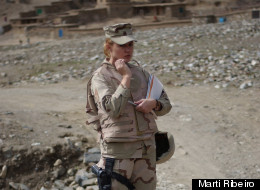
marti ribeiro
Marti Ribeiro at an Afghan village in 2006.


Given the military’s official policy, Ribeiro says, women veterans face dismissive treatment from the VA’s staff, too. “They’re getting denied filing for PTSD because they’re not allowed in combat,” she says. “The VA’s looking at them going, ‘You’re not allowed in combat.’”

In their February report, Defense Department officials say they have learned much over the last decade “regarding the demands of operating for extended periods at the limits of human capability.” But until they’re satisfied that women won’t hamper units operating at those limits, they say, broader changes to the 1994 rule remain off the table.

FORCE-READINESS AND THE FAST TRACK

Pentagon officials say they plan to develop gender-neutral physical standards and use the coming changes as a step toward more fundamental reconsideration of the 1994 rule. “As a former infantry battalion commander, I can tell you I wish I’d had the opportunity afforded by this change to policy,” says Patton, the personnel policy director. “Commanders want the best talent available to maximize their unit’s capabilities.”

The 14,325 positions, Patton adds, mark the beginning of a process, not the end. Defense officials often hedge, however, when it comes to eliminating gender restrictions entirely, with the caveat, “where feasible while maintaining force readiness.”

Translation: Barring outside pressure, enlisted infantry, special operations units and other elite, especially intense military positions are likely to remain denied to women for the foreseeable future, as is the advancement that comes with them.

That’s not to say women cannot rise through the ranks, as Duckworth, Trowell-Harris, Cornum and others have demonstrated. But while women account for 14.5 percent of active-duty military personnel, they make up just over 7 percent of general officers.

The Defense Department calls these figures “strong,” because far fewer women than men serve for more than 20 years, and it generally takes longer than that to reach a senior rank. (Generals, for example, typically put in 30 years.) Given that, the DOD’s February report concluded, women are not disadvantaged under the current assignment policy.

Yet the Military Leadership Diversity Commission reports that while the percentages of occupations open to women “do not appear inordinately low, exclusion from these occupations has a considerable influence on advancement.” In the Army, where only two-thirds of positions are currently available to women, four in five general officers came from the third of positions that are not.

“You’re keeping women from rising from the ranks,” Duckworth says. “You need to have some real combat under your belt. You want them to have a shot, just like you would want anyone to have a shot.”

tammy army
Tammy Duckworth with her Black Hawk in Iraq, 2004.

For her part, Duckworth says she stayed with the military because she “fell in love” with the physical and psychological demands. And given clear physical standards, she argues, there is no reason to keep women out of infantry or special ops. “Let’s not bar a few women who might be capable of doing it,” she says, “same way we wouldn’t bar a man from a desk job.”

“Any general who doesn’t think, any politician who doesn’t think women can handle it” is sorely mistaken, says Srinivasan, the platoon commander. As for space-sharing and privacy, he says, “We’re all adults.”

The “legacy thinking” restricting military women is a kind of “iceberg,” says Cornum, alluding to her work on the “comprehensive soldier fitness” program, which treats psychological well-being like physical well-being. “That’s one of the skills we teach,” she says, “to recognize that you have an iceberg, a deeply held belief that may be getting in the way of you seeing what’s going on around you.”

In any case, she says, future servicewomen have time on their side. “Eventually,” she says, “everybody who believed the world is flat died off.”

‘THE INVISIBLE ONES’

For veterans like Latoya Lucas or Tammy Duckworth, the costs of their service are visibly striking, undeniable. But when women’s wounds are tougher to spot, since they should not officially be facing the rigors of ground combat anyway, the military bureaucracy has often left them unseen or unaddressed. This blind spot forced Ribeiro to take her story public, and it nearly cost Jennifer Crane her life.

Crane, whose first morning of Army training was Sept. 11, 2001, arrived at Bagram, in Afghanistan, in 2003. Bagram was then just a seven-mile circle of wire around three concrete buildings and a mass of tents. Crane principally served as a paralegal for the Judge Advocate General Corps, but she still had to drive mine-pocked roads and patrol for Taliban fighters in dangerous territory.

jennifer crane
Jennifer Crane in Afghanistan in 2003.

“We were in a valley,” she says. “They could literally just stand on the edges of the cliffs and drop bombs on us.”

Within the first two weeks, she saw her first military funeral after a friend who deployed with her dropped dead of a heart attack. By the latter half of 2003, she found it difficult to eat or drink, and became consistently, critically malnourished and dehydrated. To her superiors’ credit, she says, they tried to send her home, but she managed to convince them she’d pull through — until her heart began racing and the base medics were unable to slow it back down. At that point, she was at constant risk of a heart attack herself.

Spc. Crane was forcibly evacuated from Afghanistan. Her official discharge was administrative separation: adjustment disorder. “I couldn’t ‘adjust’ to wartime service,” she says of the Army’s assessment, with a hollow laugh. “A physical condition, not a disability.”

Years later, the Defense Department began recognizing such cases as post-traumatic stress. “If I would’ve known then what I know now,” Crane says, “I might have been able to get actual retirement from the military.”

She was home in time for Christmas, but it wasn’t home anymore. Nightmares kept her from sleeping much, and even while she was awake, she’d have sudden flashbacks, feel like she was back in Afghanistan. Loud noises or lights, from sirens to fireworks and thunderstorms, would leave her hyperventilating or unconscious.

Yet because Crane’s PTSD went undiagnosed, she says, she struggled even to seek help. “I stigmatized myself because I was a woman,” she says. “Other people, they’d been through it, lost limbs, been in firefights and everything else. I really discounted my own experiences. Quite a few years self-medicating, getting rid of the nightmares, the flashbacks. Getting rid of myself.”

In 2004, Crane started using cocaine, which ended her nightmares by keeping her awake — she barely slept for a month. Her boyfriend kicked her out, and her drug use left her unwelcome at her parents’ house, too. She started self-mutilating. After attempting suicide, she was admitted into a VA program, where she was diagnosed with PTSD. By that time, however, she was far gone: After the five-week VA program ended, it was “right back down the hill,” to crack.

She spent two years homeless. “I had decided I was gonna let the drugs kills me,” she says. During that time, she started paying her dealers in sexual favors.

In a desperate moment, she says, she prayed for help, for someone to save her. “And 12 hours later,” she laughs, “I was arrested.”

After her arrest, for possession of crack cocaine, Crane was allowed to enter the drug court program in lieu of serving time. She moved back home. The program, her parents and the one friend who stuck by her saved her life, she says.

jennifer crane
Jason and Jennifer Crane.

That friend, Jason, is now her husband. Their daughter, Hailey, turns 4 on May 17, a few months before Crane is to begin nursing school. She was recently awarded a fellowship to work at the VA.

The military and the VA have come a long way in treating veterans since 2003, Crane says. She remains concerned, however, for the latest waves of returning troops, especially the women. People still tell her she doesn’t “look like a vet.”

“I had high commanding officers question me once, about how I had PTSD if I was JAG Corps,” she says. “I think them allowing women to be in more ‘combat fields’ could dramatically impact the respect women get in the military.”

Military women who do not have combat decorations, high rank or visible war wounds often do not receive enough respect from their peers, Crane says. But the greater problem, she says, remains the skepticism that meets such women when they seek treatment or other help.

“It’s the invisible ones we’re struggling with,” she says. “These veterans could just fall through the crack. And we may never hear from them again.”

‘LET’S NOT WAIT TOO LONG’

Defense Secretary Leon Panetta has directed the services to update him on military gender integration in November. His department’s upcoming changes carry the caveat, however, that the Pentagon respects Congress’ intent to “remain the arbiter of the ground combat exclusion policy.”

Servicewomen have found some advocates in Congress. Duckworth hopes to join them. But as in the Pentagon and the court of public opinion, there are those on Capitol Hill who turn a blind eye to or even dismiss women’s service.

“What else has she done? Female, wounded veteran … ehhh. Now let’s move on,” Rep. Joe Walsh (R-Ill.), the freshman incumbent Duckworth is looking to unseat, said of his opponent in March. “Wearing the uniform should immediately earn everyone’s respect,” he said in a statement after the minor furor his earlier comments caused. “It should not, however, earn everyone’s vote.”

Through a spokesman, House Armed Services Chairman Buck McKeon (R-Calif.) declined to comment.

On the campaign trail, the Pentagon’s February announcement of new openings for women elicited opposition from then-presidential candidate Rick Santorum, once the third-ranking Republican senator and a favorite among social conservatives. “I do have concerns about women in front-line combat,” Santorum said. “I think that could be a very compromising situation.”

Retiring Sen. Olympia Snowe (R-Maine) counsels patience, predicting in an email that “barriers that prevent women from serving in certain roles will continue to fall in the years ahead.” But Rep. Niki Tsongas (D-Mass.), who serves on McKeon’s armed services committee, says women have waited long enough. “Let’s not wait too long to do more,” Tsongas says.

On her first trip to Afghanistan, Tsongas recounts, she had lunch with a female first lieutenant, whose brother had worked on Tsongas’ campaign. Three weeks later, the woman was killed by an improvised explosive device — a testament, Tsongas says, to the combat risks women already face.

“I think the steps they’ve made also acknowledge there’s an inevitability to this,” she says of the Pentagon, citing estimates that women will comprise as much as 25 percent of the military by 2025.

Beyond Capitol Hill, however, Cornum says her decades in the Army taught her that any policy change will come slowly, citing “don’t ask, don’t tell,” the longstanding, now-repealed ban on openly gay service members. Positions like hers started becoming available to women, she says, because the military found it increasingly difficult to enlist enough men.

Retention remains a problem for the armed forces, with multiple deployments sidelining ever-greater numbers of veterans. “We live in a country where the same 500,000 to a million people have been going to war over the past 10 years,” says Srinivasan, the Army platoon leader. “Anyone who is willing to volunteer, more power to them. Who is our nation to judge?”

Ultimately, necessity may force the end of the 1994 rule, though the military’s stated plan is to radically reduce ground combat operations in the coming years. “We cannot exclude an entire force of very capable people who can do those jobs,” says Duckworth, who became a Black Hawk pilot because aviation was the closest she could get to ground combat.

After her shootdown, Duckworth refused medical retirement. Now a lieutenant colonel, she still drills with the National Guard.

“We’re warriors,” she says. “We’re not victims.”

**********

Connie: I only read my comments this morning from yesterday, but I had to respond to your because I did not see the comment posted from Anonymous, the day before,  (I thought Alycedale was the last) so I had to check it out. I agree with your sentiments. Truly beautiful. I will have to comment more later…I am so late. Got to run.

Blog me.

Lastly, greed over a great story is surfacing from my “loyal”(?) readers. With all this back and forth about who owns what, that appears on my blog, let me reiterate that all material posted on my blog becomes the sole property of my blog. If you want to reserve any proprietary rights don’t post it to my blog. I will prominently display this caveat on my blog from now on to remind those who may have forgotten this notice.

Gratefully your blog host,

michelle

Aka BABE: We all know what this means by now :)

If you love my blog and my writes, please make a donation via PayPal, credit card, or e-check, please click the “Donate” button below. (Please only donations from those readers within the United States. – International readers please see my “Donate” page)

Or if you would like to send a check via snail mail, please make checks payable to “Michelle Moquin”, and send to:

Michelle Moquin PO Box 29235 San Francisco, Ca. 94129

Thank you for your loyal support!

All content on this site are property of Michelle Moquin © copyright 2008-2012

“Though she be but little, she be fierce.” – William Shakespeare Midsummer Night’s Dream 

" Politics, god, Life, News, Music, Family, Personal, Travel, Random, Photography, Religion, Aliens, Art, Entertainment, Food, Books, Thoughts, Media, Culture, Love, Sex, Poetry, Prose, Friends, Technology, Humor, Health, Writing, Events, Movies, Sports, Video, Christianity, Atheist, Blogging, History, Work, Education, Business, Fashion, Barack Obama, People, Internet, Relationships, Faith, Photos, Videos, Hillary Clinton, School, Reviews, God, TV, Philosophy, Fun, Science, Environment, Design, The Page, Rants, Pictures, Church, Blog, Nature, Marketing, Television, Democrats, Parenting, Miscellaneous, Current Events, Film, Spirituality, Obama, Musings, Home, Human Rights, Society, Comedy, Me, Random Thoughts, Research, Government, Election 2008, Baseball, Opinion, Recipes, Children, Iraq, Funny, Women, Economics, America, Misc, Commentary, John McCain, Reflections, All, Celebrities, Inspiration, Lifestyle, Theology, Linux, Kids, Games, World, India, Literature, China, Ramblings, Fitness, Money, Review, War, Articles, Economy, Journal, Quotes, NBA, Crime, Anime, Islam, 2008, Stories, Prayer, Diary, Jesus, Buddha, Muslim, Israel, Europe, Links, Marriage, Fiction, American Idol, Software, Leadership, Pop culture, Rants, Video Games, Republicans, Updates, Political, Football, Healing, Blogs, Shopping, USA, Class, Matrix, Course, Work, Web 2.0, My Life, Psychology, Gay, Happiness, Advertising, Field Hockey, Hip-hop, sex, fucking, ass, Soccer, sox"

Posted in Human Rights and Equality, Wonderful Women Of The World | 16 Comments »
History Retweeted

Posted by Michelle Moquin on 12th May 2012

Bookmark and Share

Good morning!

Well, as usual, my readers are always so on top of the latest. I too am so delighted over Obama’s support of gay marriage.  And since this news is so huge, I couldn’t help but blog about it today.

Obama has made history in perhaps more ways than one. And in this modern world, there are so many more ways to get the word out. People were so excited, the “tweeting” of this historic moment may also have made history in the Twitter world.

Did Obama’s same-sex marriage tweet break Twitter records?

To say that President Obama’s announcement of support for gay marriage yesterday was historic is something of an understatement. But it appears that it didn’t just make history in the fight for gay rights — it may have also made Twitter history as one of the most retweeted messages of all time, as well.

Twitter’s interface only shows exact retweet numbers up to a total of 50, referring to all totals higher as “50+.” But thanks to self-proclaimed hacker Michael Schonfeld, we know exactly how many times the Obama message has been retweeted. According to retweetingobama.com, a site that uses the Twitter API to generate an exact total of the number of retweets Obama’s historic announcement received, it has been shared over 56,726 times in the last 24 hours… and counting.

The most retweeted comment of all time appears to be a June 2011 tweet from restaurant chain Wendy’s, which offered 50 cents to charity for each time someone clicked to send the message off to their friends. There are no official numbers offered by Twitter, but the retweet count is well over 100,000.

That Wendy’s tweet, however, was “sponsored” — meaning that the Wendy’s Corporation paid to have it appear in all users’ Twitter streams. President Obama’s tweet was not sponsored, meaning that it had to go viral organically, without paid assistance.

Twitter has yet to confirm whether or not President Obama’s tweet is indeed the most retweeted, non-sponsored tweet of all time, but there is plenty of evidence in his favor. And if it isn’t yet, given that people are still feverishly hitting that “retweet” button, it may just be a matter of time until it is.

*******


Readers: Congratulations to all of the gays and lesbians for being recognized by our president.

Thoughts? Blog me.

Peace & Love to all… 

Lastly, greed over a great story is surfacing from my “loyal”(?) readers. With all this back and forth about who owns what, that appears on my blog, let me reiterate that all material posted on my blog becomes the sole property of my blog. If you want to reserve any proprietary rights don’t post it to my blog. I will prominently display this caveat on my blog from now on to remind those who may have forgotten this notice.

Gratefully your blog host,

michelle

Aka BABE: We all know what this means by now :)

If you love my blog and my writes, please make a donation via PayPal, credit card, or e-check, please click the “Donate” button below. (Please only donations from those readers within the United States. – International readers please see my “Donate” page)

Or if you would like to send a check via snail mail, please make checks payable to “Michelle Moquin”, and send to:

Michelle Moquin PO Box 29235 San Francisco, Ca. 94129

Thank you for your loyal support!

All content on this site are property of Michelle Moquin © copyright 2008-2012

“Though she be but little, she be fierce.” – William Shakespeare Midsummer Night’s Dream 

" Politics, god, Life, News, Music, Family, Personal, Travel, Random, Photography, Religion, Aliens, Art, Entertainment, Food, Books, Thoughts, Media, Culture, Love, Sex, Poetry, Prose, Friends, Technology, Humor, Health, Writing, Events, Movies, Sports, Video, Christianity, Atheist, Blogging, History, Work, Education, Business, Fashion, Barack Obama, People, Internet, Relationships, Faith, Photos, Videos, Hillary Clinton, School, Reviews, God, TV, Philosophy, Fun, Science, Environment, Design, The Page, Rants, Pictures, Church, Blog, Nature, Marketing, Television, Democrats, Parenting, Miscellaneous, Current Events, Film, Spirituality, Obama, Musings, Home, Human Rights, Society, Comedy, Me, Random Thoughts, Research, Government, Election 2008, Baseball, Opinion, Recipes, Children, Iraq, Funny, Women, Economics, America, Misc, Commentary, John McCain, Reflections, All, Celebrities, Inspiration, Lifestyle, Theology, Linux, Kids, Games, World, India, Literature, China, Ramblings, Fitness, Money, Review, War, Articles, Economy, Journal, Quotes, NBA, Crime, Anime, Islam, 2008, Stories, Prayer, Diary, Jesus, Buddha, Muslim, Israel, Europe, Links, Marriage, Fiction, American Idol, Software, Leadership, Pop culture, Rants, Video Games, Republicans, Updates, Political, Football, Healing, Blogs, Shopping, USA, Class, Matrix, Course, Work, Web 2.0, My Life, Psychology, Gay, Happiness, Advertising, Field Hockey, Hip-hop, sex, fucking, ass, Soccer, sox"

Posted in Human Rights and Equality, Political Powwow | 6 Comments »

“Just Noticing”: Observations Of A Blogger

Posted by Michelle Moquin on 6th May 2012

Bookmark and Share

Good morning!


“Just noticing…”

…The racists are at it again.

Patrick Lanzo, Georgia Bar Owner, Calls Obama ‘N*****’ On Road Sign Again

Georgia bar owner Patrick Lanzo of Paulding County has made habit of claiming he’s not racist, an argument that becomes harder to make each time he decides to display the n-word on a large roadside sign outside his establishment, the Georgia Peach Oyster Bar.

Lanzo’s latest message reads, “I do not support the n***** in the White House.” He recently told a local reporter that the offensive wording was not meant to be racist.

“I say just because you’re offended by it doesn’t mean you don’t have the right to say something just the opposite,” Lanzo said, according to a report from Atlanta’s Fox 5. “I don’t feel bad about anything whatsoever. Therefore, they can go out and put their own sign in their own yard and I will not be offended.”

Controversy is nothing new to Lanzo, who seems to bask in the negative attention each time he posts a new inflammatory message.

In 2009, Lanzo drew outrage with a sign that read, “Obama’s plan for health-care: n***** rig it.” Again Lanzo maintained it was just a simple health care protest and not racist, a strange claim considering he advertises his establishment as a “Klan Bar” and has a rich history of catering to some of the nation’s most notorious racist groups.

Asked why he had chosen those words to express his feelings on the matter, Lanzo replied, “Well, I’ve used it most of my life. There are different ways to put your opinion up, but that’s just the words I choose.”

Fox 5 reports that Paulding County officials know about the sign, but can’t do much about it. Unsuccessful protests have also been mounted by the NAACP, a group that Lanzo once told CBS Atlanta he was a member of. From previous coverage of his actions, his sign has been a longstanding issue in the area, as have the strange displays of prominent black leaders alongside racist imagery inside his bar.

Lanzo isn’t the first “not-racist” to protest against Obama with language that many would consider patently racist. Paula Smith, distributor of a much-maligned “Don’t re-nig in 2012″ anti-Obama bumper sticker, argued that neither she nor her product were actually racist.

*L*S*O*S*R*A*C*I*S*T*

Readers: To be so blatantly racist and then say that you are not meaning to be racist, is just such a lie. And to make an excuse that is it okay to use such language because “I’ve used it all of my life”, is just so cold and insensitive. And he advertises his Bar as  ”Klan Bar”? This guy is a racist and a LSOS for even trying to deny it.

Robert, RT: Like the rest, I too like your meaning of GOP.

Delores: Well, better late than never but I too say, “Thank you Mr. President”.

Beverly: Nice comment. Not sure I agree with Maddow being the only one worth watching on MSNBC, but I am a huge fan of Maddow – she is my fave too.

xo

Lastly, greed over a great story is surfacing from my “loyal”(?) readers. With all this back and forth about who owns what, that appears on my blog, let me reiterate that all material posted on my blog becomes the sole property of my blog. If you want to reserve any proprietary rights don’t post it to my blog. I will prominently display this caveat on my blog from now on to remind those who may have forgotten this notice.

Gratefully your blog host,

michelle

Aka BABE: We all know what this means by now :)

If you love my blog and my writes, please make a donation via PayPal, credit card, or e-check, please click the “Donate” button below. (Please only donations from those readers within the United States. – International readers please see my “Donate” page)

Or if you would like to send a check via snail mail, please make checks payable to “Michelle Moquin”, and send to:

Michelle Moquin PO Box 29235 San Francisco, Ca. 94129

Thank you for your loyal support!

All content on this site are property of Michelle Moquin © copyright 2008-2012

“Though she be but little, she be fierce.” – William Shakespeare Midsummer Night’s Dream 

" Politics, god, Life, News, Music, Family, Personal, Travel, Random, Photography, Religion, Aliens, Art, Entertainment, Food, Books, Thoughts, Media, Culture, Love, Sex, Poetry, Prose, Friends, Technology, Humor, Health, Writing, Events, Movies, Sports, Video, Christianity, Atheist, Blogging, History, Work, Education, Business, Fashion, Barack Obama, People, Internet, Relationships, Faith, Photos, Videos, Hillary Clinton, School, Reviews, God, TV, Philosophy, Fun, Science, Environment, Design, The Page, Rants, Pictures, Church, Blog, Nature, Marketing, Television, Democrats, Parenting, Miscellaneous, Current Events, Film, Spirituality, Obama, Musings, Home, Human Rights, Society, Comedy, Me, Random Thoughts, Research, Government, Election 2008, Baseball, Opinion, Recipes, Children, Iraq, Funny, Women, Economics, America, Misc, Commentary, John McCain, Reflections, All, Celebrities, Inspiration, Lifestyle, Theology, Linux, Kids, Games, World, India, Literature, China, Ramblings, Fitness, Money, Review, War, Articles, Economy, Journal, Quotes, NBA, Crime, Anime, Islam, 2008, Stories, Prayer, Diary, Jesus, Buddha, Muslim, Israel, Europe, Links, Marriage, Fiction, American Idol, Software, Leadership, Pop culture, Rants, Video Games, Republicans, Updates, Political, Football, Healing, Blogs, Shopping, USA, Class, Matrix, Course, Work, Web 2.0, My Life, Psychology, Gay, Happiness, Advertising, Field Hockey, Hip-hop, sex, fucking, ass, Soccer, sox"

Posted in Human Rights and Equality, Just noticing: Observations of a blogger, Political Powwow | 23 Comments »

Wonderful Women Of The World

Posted by Michelle Moquin on 5th May 2012

Bookmark and Share

Good morning!

Lately, the only time I have made to listen to the news has been in my car on my way to see clients. And lately what I have been listening to has really held my interest. About a week ago I blogged about Wells Fargo and the fact that they are major investors in CCA and GEO – the nations two largest for-profit prison companies.

And then, the other day while listening in my car, I heard a woman talk about mass incarceration in our country. What I heard was so much more of the same same proving once again, that our justice system really is “just us”. But hearing it from this woman who was so passionate about her purpose, her story so compelling, that I had to pull my car over to stop and listen.

This is some of the shocking evidence that she relayed with respect to mass incarceration in our country:

  • In the past few decades, our nation’s prison population quintupled. Not doubled or tripled, quintupled. We’ve gone from a prison population of 300,000 to well over 2 million.
  • There are more African Americans under correctional control today — in prison or jail, on probation or parole — than were enslaved in 1850, a decade before the Civil War began.
  • As of 2004, more African American men were disenfranchised (due to felon disenfranchisement laws) than in 1870, the year the Fifteenth Amendment was ratified, prohibiting laws that explicitly deny the right to vote on the basis of race.
  • A black child born today is less likely to be raised by both parents than a black child born during slavery.  The recent disintegration of the African American family is due in large part to the mass imprisonment of black fathers.
  • If you take into account prisoners, a large majority of African American men in some urban areas have been labeled felons for life.  (In the Chicago area, the figure is nearly 80%.) These men are part of a growing undercaste — not class, caste — permanently relegated, by law, to a second-class status.  They can be denied the right to vote, automatically excluded from juries, and legally discriminated against in employment, housing, access to education, and public benefits, much as their grandparents and great-grandparents were during the Jim Crow era.

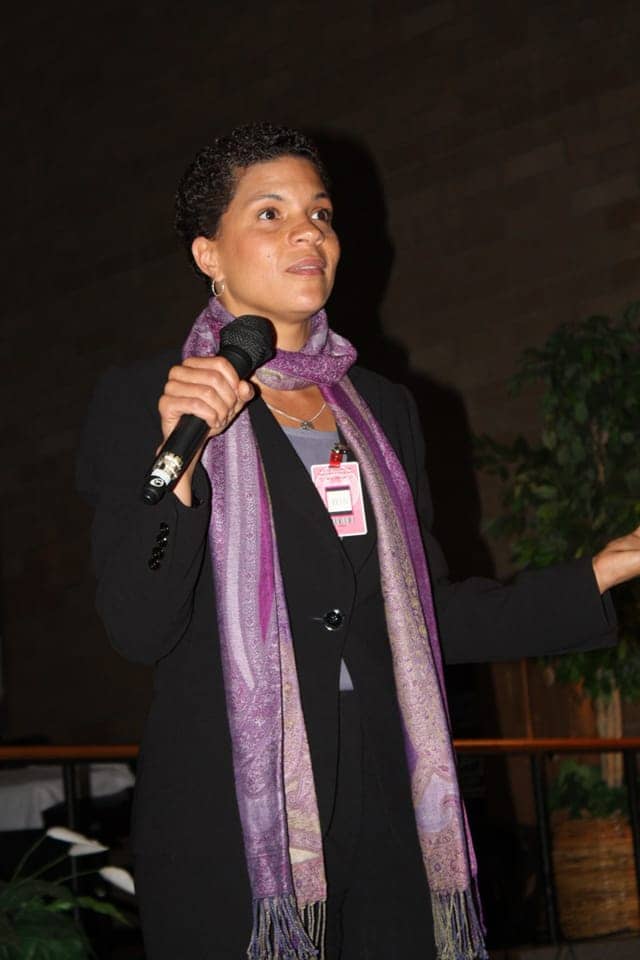
The woman I am talking about is Michelle Alexander, and she wrote a riveting book two years ago called, “The New Jim Crow: Mass Incarceration in the Age of Colorblindness.”

Alexander is a highly acclaimed civil rights lawyer, advocate, and legal scholar who currently holds a joint appointment at the Kirwan Institute for the Study of Race and Ethnicity and the Moritz College of Law at The Ohio State University. Prior to joining the Kirwan Institute, Professor Alexander was an Associate Professor of Law at Stanford Law School, where she directed the Civil Rights Clinic.

Alexander challenges the conventional wisdom that, with the election of Barack Obama as president, our nation has “triumphed over race.” Jim Crow laws were wiped off the books decades ago, but today an astounding percentage of the African American community is warehoused in prisons or trapped in a permanent, second-class status, much like their grandparents before them who lived under an explicit system of racial control. Alexander argues that the sudden and dramatic mass incarceration of African American men, primarily through the War on Drugs, has created a new racial under caste—a group of people defined largely by race that is subject to legalized discrimination, scorn, and social exclusion. The old forms of discrimination—discrimination in employment, housing, education, and public benefits; denial of the right to vote; and exclusion from jury service—are suddenly legal once you’re labeled a felon. She challenges the civil rights community, and all of us, to place mass incarceration at the forefront of a new movement for racial justice in America. 

This past February during Black History Month, Alexander gave a presentation “The New Jim Crow: Mass Incarceration in the Age of Colorblindness.” at Carleton College, Northfield, MN.

Here is the video of that presentation. The video, an hour long, I watched last night and in my opinion it is a must see. If you only have limited time this morning, I encourage you to at least read the write that I posted below it.


The mass incarceration of the Black community: an interview with Michelle Alexander, author of ‘The New Jim Crow’

Michelle Alexander speaks to the prisoners at Washington State Reformatory’s University Beyond Bars.

Professor Michelle Alexander’s new book “The New Jim Crow” is a monumental, well researched piece of work that presents documented facts in down to earth English about the mass incarceration of Black people within the United States’ national concentration camp system. At one point in “The New Jim Crow,” Professor Alexander presents evidence that more Black people are enslaved behind bars today than were enslaved on the plantations in 1850, before the Emancipation Proclamation was signed. This book is a must-read for anyone trying to come to grips with the war that the U.S. government is waging on Black people in this country.

“The New Jim Crow” has just been released in paperback in a new, expanded edition. Buy one for yourself and one for a prisoner.

M.O.I. JR: Let’s kick it off first with the name of the book. Why did you name your new book “The New Jim Crow”?

Professor Michelle: I named the book “The New Jim Crow” because this system of mass incarceration functions more like a caste system than a system of crime prevention or control. In this era of so-called color blindness, we have been led to believe that the days of caste are long behind us, but in fact a new system of racial and social control has been born – one that functions in ways that are strikingly similar to the old Jim Crow.

Millions of people, primarily poor people of color, have been swept into the criminal justice system – often for the very crimes that occur roughly with equal frequency in middle class white communities and on college campuses, but go largely ignored – swept in, branded criminals and felons, then are relegated to a permanent second class status, for life, where they are stripped of the right to vote, automatically excluded from juries, and legally discriminated against in employment, housing, access to education and public benefits.

So many of the old forms of discrimination that we had supposedly left behind in the Jim Crow era are suddenly legal again, once you’ve been branded a felon. That’s why I say that we haven’t ended racial caste in America; we just redesigned it.

M.O.I. JR: What is the difference between class and caste?

Professor Michelle: For many, many years scholars in particular have had these debates about the underclass, the poor folks of color, who seemed trapped at the bottom. And academics and scholars can come up with all of these explanations for why so many people seem not to have access to the ladder of opportunity, to the American dream, and most of those theories focus on cultural explanations: broken families and homes, the attitudes of the poor, or poverty and bad schooling. There’s been an idea that there is something about their culture and the severe poverty of poor folks of color that keeps them trapped at the bottom.

Well, I use the language of caste in the book, because I think it is important for people to recognize that there is a system of rules, laws, policies and practices that operate to trap people in a permanent second class status. It’s not just about culture, and it is not just about bad schools or broken homes. There is a system of laws in place that trap people in a permanent second class status.

“The War on Drugs” and “The Get Tough Movement” have unleashed legislation and policies that serve to sweep people into the system through “Stop and Frisk” tactics, sweep them into the system for primarily non-violent, often drug related offenses. And get every study that has been done over the last few decades and it has shown that people of color are no more likely to use or sell illegal drugs than whites, but they are targeted and arrested at grossly disproportionate rates.

Once they’re swept in and they’re branded criminals and felons, often at young ages, sometimes before they are even old enough to vote, they are trapped by law in a permanent second class status. This is not just a function of bad schools and poverty; this is about a system of laws that have been put into place as a result of a political system that has found it convenient to scapegoat and demonize poor folks of color for the political gain of a few.

M.O.I. JR: Well, I have your book open right now, and there is a section called “The Birth of Mass Incarceration.” I just wanted to read this section and have you comment on it.

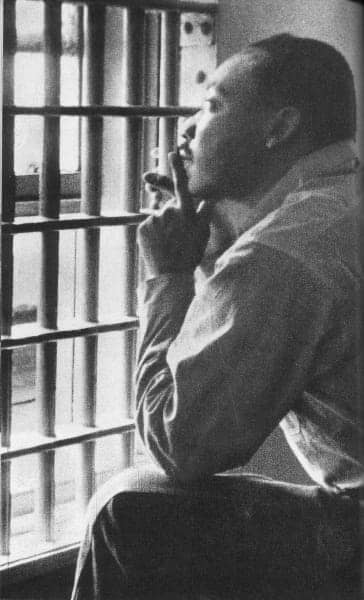
Martin Luther King, who himself was constantly being thrown in jail, is jailed in Birmingham in this iconic photo.

“For more than a decade, from the 1950s until the late 1960s, conservatives systematically and strategically linked opposition to civil rights legislation to calls for law and order, arguing that Martin Luther King Jr.’s philosophy of civil disobedience was a leading cause of crime. Civil rights protests were frequently depicted as criminal rather than political in nature, and federal courts were accused of being excessively lenient toward lawlessness, thereby contributing to the spread of crime. In the words of then Vice-President Richard Nixon, the increasing crime rate ‘can be traced to the spread of the corrosive doctrine that every citizen possesses an inherent right to decide for himself which laws to obey and when to obey them.’”

Can you expand on the birth of mass incarceration? When was this enacted? A few paragraphs down you talk about Barry Goldwater, but why is it that you talk about Nixon and Barry Goldwater when you talk about the birth of mass incarceration?

Professor Michelle: Well, you know that many people imagine that the explosion in our nation’s prison population is due to crime or crime rates. It’s just not true. Nothing can be further from the truth. In the past few decades, our nation’s prison population quintupled. Not doubled or tripled, quintupled. We’ve gone from a prison population of 300,000 to well over 2 million. And this has not been due to crime rates. Crime rates have fluctuated over the past few decades, gone up, gone down. Today, crime rates are actually at historic lows, but incarceration rates, especially Black incarceration rates and increasingly Latino incarceration rates, have soared.

So what explains this phenomenon of skyrocketing incarceration rates that are moving completely independently of crime and crime rates? Well it’s “The War on Drugs” and “The Get Tough Movement” – the wave of punitiveness that washed over the United States. And this wave of punitiveness was driven by a political strategy known as the Southern Strategy, a grand Republican Party strategy of using racially coded get-tough appeals to appeal to poor and working class whites, particularly in the South, who were anxious and resentful about the gains of African-Americans in the Civil Rights Movement. “The War on Drugs” and “The Get Tough Movement” was part of the backlash against the Civil Rights Movement.

You know, to be fair, we have to acknowledge that poor and working class whites really had their world rocked by the Civil Rights Movement. Wealthy whites could send their kids to private schools and give their kids all of the advantages wealth had to offer, but poor and working class whites were faced with a social demotion. It was their kids who might be bussed across town to go to a school that they believed was inferior. It was their kids and themselves who were suddenly forced to compete on equal terms for scarce jobs with a whole new group of people that they have been taught their whole lives were inferior to them.

And affirmative action programs gave many poor and working class whites, who themselves were struggling for survival the feeling that Black folks were now leap-frogging over them on their way to Harvard or Yale, into fancy jobs in corporate America. And this circumstance created an enormous amount of anxiety, fear and resentment among poor and working class whites, but it also created an enormous political opportunity.

Numerous historians and political scientists have now documented that media strategists and media consultants found that by using this “get tough” appeal, promising to crack down on a group not so subtly defined by race, could be enormously successful in persuading poor and working class whites to defect from the Democratic New Deal coalition and join the Republican Party in droves.

In the words of H.R. Haldeman, President Richard Nixon’s former chief of staff, he described his strategy: “The whole problem is really the Blacks. The key is to devise a system that recognizes this without appearing to.” Well, they did. “The War on Drugs” and “The Get Tough Movement,” this wave of punitiveness, has managed to birth a system of mass incarceration unprecedented in world history – one that has not been driven by crime rates but instead a form of political and racial opportunism that has benefitted a few. And many African-Americans have defended aspects of this system on the grounds that we do need to get tough on those violent offenders and poor communities of color.

But this drug war has never been focused on rooting out violent offenders or drug kingpins. Federal funding has flowed to state and local law enforcement agencies that boost the sheer numbers of folks into this system. It’s been a numbers game, and the result is today there are more African-Americans under correctional control – in prison or jail, on probation or parole – than were enslaved in 1850, a decade before the Civil War began.

M.O.I. JR: Wow. Can you say that one more time?

Professor Michelle: Yes. There are more African-American adults under correctional control today – in prison or jail, on probation or parole – than were enslaved in 1850, a decade before the Civil War began. In fact, in many urban areas today, the majority of working age African-American men have criminal records and are thus subject to legalized discrimination for the rest of their lives – forced to check that box on applications asking the dreaded question, have you ever been convicted of a felony.

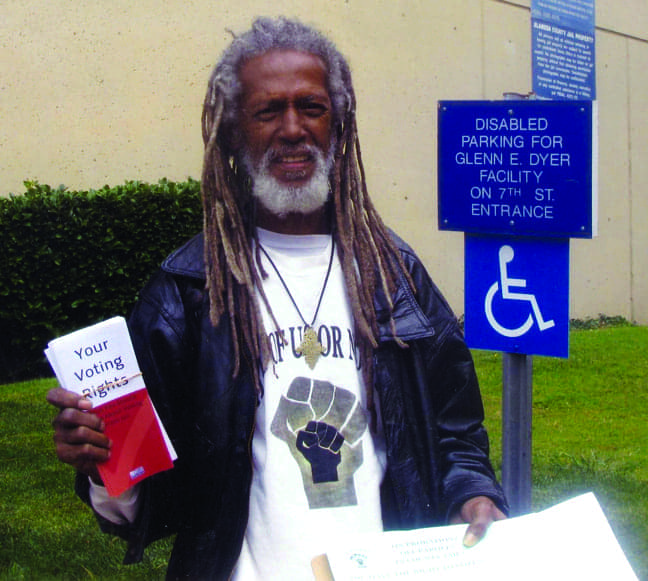
The denial of jobs and survival assistance like food stamps and public housing is compounded by the denial of voting rights to many returning prisoners. Elder Freeman of All of Us or None, an organization of former prisoners, hands out voting rights brochures to visitors at the county jail in Oakland.

People convicted of felonies can be barred from public housing, denied even food stamps to survive if they have been convicted of drug felonies. We have created a system in which it is difficult for people even to survive once they have been branded a felon.

M.O.I. JR: Let’s talk a little bit about Reagan. In your book – I’m quoting from page 48 – it says “Reagan portrayed the criminal as ‘a staring face, a face that belongs to a frightening reality of our time, the face of the human predator.’ Reagan’s racially coded rhetoric and his strategy proved extraordinarily effective, as 22 percent of all Democrats defected from the party to vote for Reagan. The defection rate shot up to 34 percent among those Democrats who believed civil rights leaders were pushing too fast.”

Can you speak to Ronald Reagan and the birth of “The War on Drugs”? Where did it come from? And as we listen to you talk, we see that this was an expansion on the policies of Nixon and Goldwater, but can you speak to Reagan and the part he played?

Professor Michelle: Yes. Well, Ronald Reagan officially declared the current drug war in 1982, at a time when drug crime was actually on the decline and not on the rise. Most people assume that “The War on Drugs” was declared in response to the emergence of crack cocaine and the media frenzy that followed, but that’s not true. At the time when President Ronald Reagan declared his drug war, drug crime was actually on the decline and not on the rise. It was before, not after, crack really began to ravage inner-city communities and become a media sensation.

President Richard Nixon, I should point out, was the first to coin the term, a war on drugs, but it was President Ronald Reagan who turned that rhetorical war into a literal one. And the reason he declared the drug war had little to do with overwhelming concern about drug abuse or drug addiction; instead, it was part of his effort to make good on campaign promises, to get tough in accordance with the Southern Strategy, get tough with a group of people defined not so subtly along racial lines. But I think it is important also to empathize that this is not just a fault of the Republican Party.

You know President Bill Clinton escalated the drug war far beyond what his Republican predecessors even dreamed possible. President Bill Clinton presided over the largest increase in Black imprisonment in United States history. And it was the Clinton administration that championed laws banning drug offenders, under federal laws, from food stamps for the rest of their lives, making it difficult for them to even get housing and public housing.

It was the Clinton administration that championed laws barring drug offenders from even federal financial aid for schooling. And to a large extent, it was the Clinton administration, desperate to win back those white swing voters, the folks that defected from the Democratic Party and the Civil Rights Movement, that is responsible for the basic architecture of this new caste system.

I spend a fair amount of time in the first chapter in my book showing how efforts to pit poor people of color against poor whites have triggered the rise of these caste-like systems over and over and over again. And even slavery, the all-Black system of slavery, can be traced to an attempt to divide white indentured servants from Black servants and slaves. Throughout our history, the same games have been played with great success of pitting poor whites against poor people of color, resulting in these vast new systems of racial and social control. So when building a movement to end mass incarceration, we have got to insure that we develop cross-racial, inter-racial unity among poor folks of all colors, because it has been these divide and conquer tactics that have worked so well in the past to birth new caste-like systems over and over again.

M.O.I. JR: Reading again from your book, on page 81, it says, “Harsh sentences encourage people to snitch. The number of snitches in drug cases has soared in recent years, partly because the government has tempted people to ‘cooperate’ with law enforcement by offering cash, putting them on payroll, and promising cuts of seized drug assets, but also because ratting out codefendants, friends, family, or acquaintances is often the only way to avoid a lengthy mandatory minimum sentence. In fact, under the federal sentencing guidelines, providing ‘substantial assistance’ is often the only way defendants can hope to obtain a sentence below the mandatory minimum.”

You go on to say, “The U.S. Sentencing Commission itself has noted that ‘the value of a mandatory minimum sentence lies not in its imposition, but in its value as a bargaining chip to be given away, in return for the resource saving plea from the defendant, to a more leniently sanctioned charge.’ Describing severe mandatory sentences as a bargaining chip is a major understatement, given its potential for extracting guilty pleas from people who are innocent of any crime.” Can you go on to describe both of those paragraphs that I read from your book? Can you go on to expand on them, so the listeners have a better understanding about what is going on with snitches in jail?

Professor Michelle: Yes. There was actually a very good article in the New York Times recently about the increased power of prosecutors today as a result of harsh mandatory minimum sentences, and how prosecutors are able to coerce people into pleading guilty, whether they may be guilty or not, by threatening them with these extremely harsh penalties.

And I told a number of stories of defendants who were first offered maybe two years for the alleged crime, and the defendant would say, “No, I’m taking it to trial because I’m innocent.” Then the prosecutor would come back and say, “OK, we’ll give you five years,” and the defendant would say, “No, no, I want to take it to trial.”

And then finally the prosecutor would come back with a 20-year mandatory minimum sentence and say, “You’re going to prison for 20 years if you try to take this thing to trial. You could roll your dice with the jury, or you could take the plea deal.” And how defendants would cave, understandably terrified of rolling their dice with a jury, whether they are innocent or guilty, accept guilty pleas convicting themselves and getting branded a felon for life.

And snitches have never played a larger role in law enforcement than they do today. Thanks largely to the war on drugs, we have people that are on the payroll, who are getting paid by law enforcement to snitch on their relatives, their neighbors, people in their community, feeding law enforcement information for pay.

Then on top of that, you have people facing these unbelievable mandatory minimum sentences, sometimes for minor offenses, and terrified that they might have to spend the rest of their life in prison if they don’t turn a family member in or turn a friend in. Under that kind of pressure, people will often provide information, and sometimes that information isn’t truthful. So terrified people are of spending the rest of their life in prison, or a decade in prison, that they succumb to the temptation to provide false information to the police to avoid prison time.

You know this has resulted in gross miscarriages of justice and really destroyed our communities, where families and relatives are turning on each other, not to provide information to law enforcement about serious crimes of great danger that may be facing the community but simply to turn folks in for petty crimes. Again, often the same types of crimes of drug possession or drug sales that go ignored on college campuses, go largely ignored in middle class white communities but our communities have been turned against each other. In many cases, whole communities find themselves trapped in this under-caste with family members cycling in and out of prison for life.

M.O.I. JR: We’ve talked a lot about the court system but your book expands beyond the court system, and talks about police and how this is a machine. It is not just the courts, but it is a whole political machine that is mass incarcerating the Black community and the Brown community.

On one part you talk about racial profiling, and the war that it has played in the “war on drugs.” Can you expand on police racial profiling Black people and how this aids their war against the Black community?

Professor Michelle: Yes. Over the past couple of decades, the U.S. Supreme Court has really eviscerated Fourth Amendment protections against unreasonable searches and seizures. The Supreme Court has given the police license to stop, interrogate, search just about anyone anywhere without a shred of evidence of criminal activity. The police no longer need reasonable suspicion or probable cause to stop someone, interrogate them on the street, frisk them, so long as they have what is called consent.

What’s consent? Consent is when a police officer walks up to a young man on the street, with one hand on his gun, and says, “Son, you turn around and put your hands in the air, so I can frisk you to see if you have anything on you.” And the kid goes “uh huh” and complies. That is considered consent. There’s no Fourth Amendment protection for that individual once he puts his arms up in the air and nods his head. The police have license to frisk him, search him without any evidence of any criminal activity.

Well, granting the police license to behave in that way, knowing full well that hardly anyone refuses consent to the police because they don’t feel that they actually have the power to refuse consent to the police. Knowing that virtually everyone complies, the Supreme Court has opened the door for rampant discrimination in police stops and searches.

You know the police don’t sweep college campuses, stopping and frisking kids on their way to class, pulling over kids in middle class white communities and asking to search their car for drugs. No, the police never behave that way on college campuses and in middle class white communities. They do it exclusively in poor communities of color.

But the court has made it virtually impossible to prove racial bias in the criminal system today, because the court has ruled in a series of cases beginning with McClesky v. Kemp and Armstrong v. United States that unless you can provide evidence of conscious, intentional bias, tantamount to an admission by a police officer or a prosecutor that they were acting with racial bias, you can’t even state a claim for race discrimination in the criminal justice system, no matter how overwhelming the statistical evidence might be or how severe the racial disparity is or might be.

This is an enormous problem because most police officers and prosecutors, like the rest of us, know better than to say, “Yeah, your honor, I stopped him because he was Black,” or “Yeah, I would have given him a better plea deal but he was Black or he was Latino.” Most law enforcement officials like the rest of us know better than to state our racial biases out loud, but more importantly so many of the stereotypes and biases that drive law enforcement decision-making are unconscious.

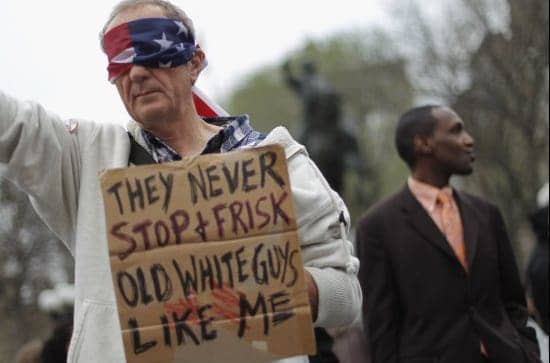
Most of the crowd at the March 21 Million Hoodie March in New York City were Black, and then there was this provocative “white guy.” – Photo: Mario Tama, Getty Images

People are not even fully aware of how biased they are when making decisions about who to stop and search or who they view as more likely to be a criminal. But by refusing to allow people to challenge patterns of racial bias for discriminatory stops, the Supreme Court has effectively immunized this system of mass incarceration from judicial scrutiny of racial bias, much in the same way that the Supreme Court once rallied to the defense of slavery and Jim Crow in their day.

M.O.I. JR: Can you talk a little bit about the Baldus Study? In your book on page 107, you say, “The study found that defendants charged with killing white victims received the death penalty 11 times more often than defendants charged with killing Black victims. Georgia prosecutors seem largely to blame for the disparity. They sought the death penalty in 70 percent of cases involving Black defendants and white victims, but only 19 percent of cases involving white defendants and Black victims.” Can you expand on the Baldus Study?

Professor Michelle: Yes. Well, you know, the Baldus Study showed definitively – and the results of that study have been replicated elsewhere – that who lives and who dies from the death penalty has more to do with the race of the victim than just about anything else.

You know, white lives are valued more by juries than Black lives, and so those who are put to death are those who kill white people, not those who kill Black people. And when Black people kill white people, they are most likely to be put to death.

And the Baldus Study was an incredibly comprehensive statistical study showing the incredibly powerful role that race was playing in determining who lives and who dies and who receives the death penalty in the criminal justice system in Georgia. And there were just mountains of statistical evidence – regression analysis controlling for all of these non-racial factors that could possibly explain the outcome – and the U.S. Supreme Court didn’t disagree with the data. It didn’t challenge or quarrel with the data.

In fact, the Supreme Court acknowledged the data seemed accurate but it said that no matter how severe the racial disparities might be, no matter how overwhelming the statistical evidence is, unless you can provide evidence of that conscious, intentional bias, find some prosecutor who is basically willing to admit, “Yeah, I sought the death penalty because he was Black,” you can’t even state a claim for racial bias in the criminal justice system today.

M.O.I. JR: Later on in the book you go on to say, “Practically from cradle to the grave, Black males in urban ghettos are treated like current or future criminals. One may learn to cope with the stigma of criminality but, like the stigma of race, the prison label is not something that a Black man in the ghetto can ever fully escape.

“For those newly released from prison, the pain is particularly acute. As Dorsey Nunn, an ex-offender and co-founder of All of Us or None, once put it, ‘The biggest hurdle that you got to get over when you walk out of those prison gates is shame.’ That shame, that stigma, that label, that thing you wear around your neck saying I’m a criminal is like a yoke around your neck, and it will drag you down and even kill you if you let it.” Can you go on to explain how after leaving prison, the stigma doesn’t leave Black males in particular?

Professor Michelle: Well, that’s right. It does not, and I think Dorsey Nunn put it very well. It is a stigma; it’s shame. It can drag you down and even kill you if you let it. That shame, that stigma follows you for life and it’s part of what leads so many people who are branded felons or criminals to try to pass, not just by lying to employers or housing officials by refusing to check the box but also by avoiding, denying, lying to friends and family members about their own criminal history or that of their loved ones.

There’s an excellent ethnographic study done in Washington, D.C., of neighborhoods hard hit by mass incarceration, neighborhoods where literally every house or every other apartment had a family member who is currently behind bars or who had been recently released from prison, neighborhoods where you would think that incarceration is so normal everybody would be talking about it all of the time, and to some extent that was true.

But even in these neighborhoods they couldn’t find one person, not one, who had fully come out to their friends, neighbors or loved ones, who had come out about their own criminal history or that of their loved ones. Children when asked by a relative, “Where’s your daddy? I haven’t seen your daddy for a while.” The child would say, “Oh, my daddy? I don’t know where my daddy is,” knowing full well that their father is behind bars. People when stopped by a neighbor on the street, who says, “Where have you been? I haven’t seen you for months? It’s been years? How are you doing?” the person would say, “You know, I’ve been here and there. I’ve been out of town. I gotta go.”

The shame and stigma associated with being branded a criminal or a felon is so severe that it has kept us silent and in denial, shaming and blaming one another rather than coming together to challenge this new system as we must. So I fully believe that one of the most important things that we can do is break the silence around the system and end the shaming and blaming of those who have been caught up in the system or who have loved ones behind bars.

I mean, the truth is that we are all criminals. We are all criminals. We are all sinners. We’ve all made mistakes. All of us have broken the law at some point in our lives. Maybe we drank under age or we experimented with drugs; I often say that if the worse thing that you have ever done is be 10 miles over the speed limit on the freeway, you have put yourself and others at more risk of harm than someone smoking marijuana in the privacy of their living room.

But there are people in the United States doing life sentences for first time drug offenses, so we’ve got to stop this “us versus them” mentality and begin to see that all of us made mistakes in our lives, all of us have violated the law at some point, but only some of us are being demonized and stigmatized and relegated to a second class status for life.

All of us have violated the law at some point, but only some of us are being demonized and stigmatized and relegated to a second class status for life.

M.O.I. JR: Let’s talk a little bit about the exclusion of Blacks from juries. There’s a section of your book on page 188 where you say, “Another clear parallel between mass incarceration and Jim Crow is the systematic exclusion of Blacks from juries. One hallmark of the Jim Crow era was all-white juries trying all Black defendants in the South. Although the exclusion of jurors on the basis of race has been illegal since 1880, as a practical matter, the removal of prospective Black jurors through race-based peremptory strikes was sanctioned by the Supreme Court until 1985, when the Court ruled in Batson v. Kentucky that racially biased strikes violate the equal protection clause of the 14th Amendment. Today defendants face a situation highly similar to the one that they faced a century ago.” Can you expand on that?

Professor Michelle: Yes. All-white juries have been having a roaring comeback in many parts of the country that are racially diverse. Why? Because once you’ve been branded a felon, you’re deemed ineligible for jury service for the rest of your life. And if you’ve ever had a “negative experience” with law enforcement, you could be struck from a jury for cause. Good luck finding many African-Americans, as well as many poor Latinos who have not yet had a negative experience with law enforcement that would justify their exclusion from a jury for cause. In this way, all-white juries have been having a roaring comeback in many parts of the country, and this has been completely under the radar – the ways in which African-Americans have been stripped of the right to serve on juries – yet again as a result of a discriminatory caste-like system.

M.O.I. JR: Later on in the book, you go on to say, “In the era of mass incarceration, what it means to be a criminal in our collective consciousness has become conflated with what it means to be Black. So the term ‘white criminal’ is confounding, while the term ‘Black criminal’ is nearly redundant.” Why did you say that?

Professor Michelle: I think it is important for people to really grasp how much criminality has become part of the way that the public views African-Americans. You know, when someone says Black criminal, it’s almost unnecessary to have that adjective before the word criminal because when people imagine criminals, they imagine Black folks.

In fact, there was a study done in the mid-1990s. It was a national survey, where they asked participants to close their eyes and to imagine for a moment a drug criminal. Ninety-five percent of the respondents pictured an African-American. Only 5 percent pictured someone of any other ethnic or racial group.

The idea of drug criminals and criminals generally being African-American is so deeply rooted in our collective sub-conscious that criminal and Black have become conflated, and it’s that conflation of Blackness and criminality that inspired the overwhelming punitiveness that has helped to give rise to mass incarceration.

M.O.I. JR: Where do we go from here?

Professor Michelle: Well, it’s my own view that nothing short of a major social movement has any hope of ending mass incarceration in America. And I find, when I travel around speaking to folks about the need for movement-building in the United States around mass incarceration, they often push back. They’re freaked out by the idea of having to build a movement. It sounds too big and too overwhelming.

If you doubt that such a movement is necessary, consider this: If we were able to get back to the rates of incarceration that we had in the 1970s, before the “war on drugs” and the “get tough” movement kicked off, we would have to release four out of five people who are in prison today. Four out of five!

More than a million people employed by the criminal justice system would lose their jobs. Private prison companies listed on the New York Stock Exchange would be forced to watch their profits vanish. This system is so deeply rooted in our social-political-economic structure that it’s not just going to fade away if we continue tinkering with it and working for mere reform.

No, it’s going to take a major upheaval, a dramatic shift in our public consciousness, if we ever hope to end this system of mass incarceration as a whole. So I believe we need to go back and pick up where Dr. King and Ella Baker and so many others left off and do the hard work of movement-building on behalf of poor people of all colors in the United States.

The former prisoners who compose All of Us or None gather in support of the San Francisco 8, former Black Panthers picked up on 30-year-old torture-induced charges of killing a white cop. Eventually, they beat the rap. – Photo: Scott Braley

And there are wonderful movement-building efforts already underway in California. All of Us or None and Critical Resistance have been working for years to build this movement, and we have got to build upon the work that they have begun – to build a movement that won’t just tinker with this system, won’t just reform it, but will bring the system of mass incarceration to an end and inspire a more compassionate, caring approach to poor people of color, one that honors basic human rights – rights to work, rights to shelter and to food.

I believe it has to be a human rights movement for education not incarceration and for jobs not jails – a human rights movement that opposes all forms of discrimination against people released from prison, discrimination that denies them basic human rights to work, to shelter and to food.

A great awakening has to begin, and we have got to stop shaming and blaming one another and embrace all of the members of our community including those labeled criminals, because it’s been the refusal and failure to recognize that dignity and humanity of all people that has been the sturdy foundation for all caste systems that have ever existed in America.

The People’s Minister of Information JR is associate editor of the Bay View, author of “Block Reportin’” and filmmaker of “Operation Small Axe” and “Block Reportin’ 101,” available, along with many more interviews, atwww.blockreportradio.com. He also hosts two weekly shows on KPFA 94.1 FM and kpfa.org: The Morning Mix every Wednesday, 8-9 a.m., and The Block Report every Friday night-Saturday morning, midnight-2 a.m. He can be reached at blockreportradio@gmail.com.

********

Readers: No doubt, as you probably have guess by now, Michelle Alexander deserves the title of Wonderful Woman of The World, for her dedication, persistence and commitment to ending mass incarceration.

Anything to say? Blog me.

Lastly, greed over a great story is surfacing from my “loyal”(?) readers. With all this back and forth about who owns what, that appears on my blog, let me reiterate that all material posted on my blog becomes the sole property of my blog. If you want to reserve any proprietary rights don’t post it to my blog. I will prominently display this caveat on my blog from now on to remind those who may have forgotten this notice.

Gratefully your blog host,

michelle

Aka BABE: We all know what this means by now :)

If you love my blog and my writes, please make a donation via PayPal, credit card, or e-check, please click the “Donate” button below. (Please only donations from those readers within the United States. – International readers please see my “Donate” page)

Or if you would like to send a check via snail mail, please make checks payable to “Michelle Moquin”, and send to:

Michelle Moquin PO Box 29235 San Francisco, Ca. 94129

Thank you for your loyal support!

All content on this site are property of Michelle Moquin © copyright 2008-2012

“Though she be but little, she be fierce.” – William Shakespeare Midsummer Night’s Dream 

" Politics, god, Life, News, Music, Family, Personal, Travel, Random, Photography, Religion, Aliens, Art, Entertainment, Food, Books, Thoughts, Media, Culture, Love, Sex, Poetry, Prose, Friends, Technology, Humor, Health, Writing, Events, Movies, Sports, Video, Christianity, Atheist, Blogging, History, Work, Education, Business, Fashion, Barack Obama, People, Internet, Relationships, Faith, Photos, Videos, Hillary Clinton, School, Reviews, God, TV, Philosophy, Fun, Science, Environment, Design, The Page, Rants, Pictures, Church, Blog, Nature, Marketing, Television, Democrats, Parenting, Miscellaneous, Current Events, Film, Spirituality, Obama, Musings, Home, Human Rights, Society, Comedy, Me, Random Thoughts, Research, Government, Election 2008, Baseball, Opinion, Recipes, Children, Iraq, Funny, Women, Economics, America, Misc, Commentary, John McCain, Reflections, All, Celebrities, Inspiration, Lifestyle, Theology, Linux, Kids, Games, World, India, Literature, China, Ramblings, Fitness, Money, Review, War, Articles, Economy, Journal, Quotes, NBA, Crime, Anime, Islam, 2008, Stories, Prayer, Diary, Jesus, Buddha, Muslim, Israel, Europe, Links, Marriage, Fiction, American Idol, Software, Leadership, Pop culture, Rants, Video Games, Republicans, Updates, Political, Football, Healing, Blogs, Shopping, USA, Class, Matrix, Course, Work, Web 2.0, My Life, Psychology, Gay, Happiness, Advertising, Field Hockey, Hip-hop, sex, fucking, ass, Soccer, sox"

Posted in Human Rights and Equality, Political Powwow, Wonderful Women Of The World | 13 Comments »

Flap Your Lips Friday

Posted by Michelle Moquin on 27th April 2012


Bookmark and Share

Good morning.

Over the years we’ve read stories here over on the horrific treatment of women in the Middle East. It hasn’t changed.  A must read.


Why Do They Hate Us?

The real war on women is in the Middle East.

BY MONA ELTAHAWY | MAY/JUNE 2012

In “Distant View of a Minaret,” the late and much-neglected Egyptian writer Alifa Rifaat begins her short story with a woman so unmoved by sex with her husband that as he focuses solely on his pleasure, she notices a spider web she must sweep off the ceiling and has time to ruminate on her husband’s repeated refusal to prolong intercourse until she too climaxes, “as though purposely to deprive her.” Just as her husband denies her an orgasm, the call to prayer interrupts his, and the man leaves. After washing up, she loses herself in prayer — so much more satisfying that she can’t wait until the next prayer — and looks out onto the street from her balcony. She interrupts her reverie to make coffee dutifully for her husband to drink after his nap. Taking it to their bedroom to pour it in front of him as he prefers, she notices he is dead. She instructs their son to go and get a doctor. “She returned to the living room and poured out the coffee for herself. She was surprised at how calm she was,” Rifaat writes.

In a crisp three-and-a-half pages, Rifaat lays out a trifecta of sex, death, and religion, a bulldozer that crushes denial and defensiveness to get at the pulsating heart of misogyny in the Middle East. There is no sugarcoating it. They don’t hate us because of our freedoms, as the tired, post-9/11 American cliché had it. We have no freedoms because they hate us, as this Arab woman so powerfully says.

Yes: They hate us. It must be said.

Some may ask why I’m bringing this up now, at a time when the region has risen up, fueled not by the usual hatred of America and Israel but by a common demand for freedom. After all, shouldn’t everyone get basic rights first, before women demand special treatment? And what does gender, or for that matter, sex, have to do with the Arab Spring? But I’m not talking about sex hidden away in dark corners and closed bedrooms. An entire political and economic system — one that treats half of humanity like animals — must be destroyed along with the other more obvious tyrannies choking off the region from its future. Until the rage shifts from the oppressors in our presidential palaces to the oppressors on our streets and in our homes, our revolution has not even begun.

So: Yes, women all over the world have problems; yes, the United States has yet to elect a female president; and yes, women continue to be objectified in many “Western” countries (I live in one of them). That’s where the conversation usually ends when you try to discuss why Arab societies hate women.

But let’s put aside what the United States does or doesn’t do to women. Name me an Arab country, and I’ll recite a litany of abuses fueled by a toxic mix of culture and religion that few seem willing or able to disentangle lest they blaspheme or offend. When more than 90 percent of ever-married women in Egypt — including my mother and all but one of her six sisters — have had their genitals cut in the name of modesty, then surely we must all blaspheme. When Egyptian women are subjected to humiliating “virginity tests” merely for speaking out, it’s no time for silence. When an article in the Egyptian criminal code says that if a woman has been beaten by her husband “with good intentions” no punitive damages can be obtained, then to hell with political correctness. And what, pray tell, are “good intentions”? They are legally deemed to include any beating that is “not severe” or “directed at the face.” What all this means is that when it comes to the status of women in the Middle East, it’s not better than you think. It’s much, much worse. Even after these “revolutions,” all is more or less considered well with the world as long as women are covered up, anchored to the home, denied the simple mobility of getting into their own cars, forced to get permission from men to travel, and unable to marry without a male guardian’s blessing — or divorce either.

Not a single Arab country ranks in the top 100 in the World Economic Forum’s Global Gender Gap Report, putting the region as a whole solidly at the planet’s rock bottom. Poor or rich, we all hate our women. Neighbors Saudi Arabia and Yemen, for instance, might be eons apart when it comes to GDP, but only four places separate them on the index, with the kingdom at 131 and Yemen coming in at 135 out of 135 countries. Morocco, often touted for its “progressive” family law (a 2005 report by Western “experts” called it “an example for Muslim countries aiming to integrate into modern society”), ranks 129; according to Morocco’s Ministry of Justice, 41,098 girls under age 18 were married there in 2010.

It’s easy to see why the lowest-ranked country is Yemen, where 55 percent of women are illiterate, 79 percent do not participate in the labor force, and just one woman serves in the 301-person parliament. Horrific news reports about 12-year-old girls dying in childbirthdo little to stem the tide of child marriage there. Instead, demonstrations in support of child marriage outstrip those against it, fueled by clerical declarations that opponents of state-sanctioned pedophilia are apostates because the Prophet Mohammed, according to them, married his second wife, Aisha, when she was a child.

But at least Yemeni women can drive. It surely hasn’t ended their litany of problems, but it symbolizes freedom — and nowhere does such symbolism resonate more than in Saudi Arabia, where child marriage is also practiced and women are perpetually minors regardless of their age or education. Saudi women far outnumber their male counterparts on university campuses but are reduced to watching men far less qualified control every aspect of their lives.

Yes, Saudi Arabia, the country where a gang-rape survivor was sentenced to jail for agreeing to get into a car with an unrelated male and needed a royal pardon; Saudi Arabia, where a woman who broke the ban on driving was sentenced to 10 lashes and again needed a royal pardon; Saudi Arabia, where women still can’t vote or run in elections, yet it’s considered “progress” that a royal decree promised to enfranchise them for almost completely symbolic local elections in — wait for it — 2015. So bad is it for women in Saudi Arabia that those tiny paternalistic pats on their backs are greeted with delight as the monarch behind them, King Abdullah, is hailed as a “reformer”  — even by those who ought to know better, such as Newsweek, which in 2010 named the king one of the top 11 most respected world leaders. You want to know how bad it is? The “reformer’s” answer to the revolutions popping up across the region was to numb his people with still more government handouts — especially for the Salafi zealots from whom the Saudi royal family inhales legitimacy. King Abdullah is 87. Just wait until you see the next in line, Prince Nayef, a man straight out of the Middle Ages. His misogyny and zealotry make King Abdullah look like Susan B. Anthony.

SO WHY DO THEY HATE US? Sex, or more precisely hymens, explains much.

“Why extremists always focus on women remains a mystery to me,” U.S. Secretary of State Hillary Clinton said recently. “But they all seem to. It doesn’t matter what country they’re in or what religion they claim. They want to control women.” (And yet Clinton represents an administration that openly supports many of those misogynistic despots.) Attempts to control by such regimes often stem from the suspicion that without it, a woman is just a few degrees short of sexual insatiability. Observe Yusuf al-Qaradawi, the popular cleric and longtime conservative TV host on Al Jazeera who developed a stunning penchant for the Arab Spring revolutions — once they were under way, that is — undoubtedly understanding that they would eliminate the tyrants who long tormented and oppressed both him and the Muslim Brotherhood movement from which he springs.

I could find you a host of crackpots sounding off on Woman the Insatiable Temptress, but I’m staying mainstream with Qaradawi, who commands a huge audience on and off the satellite channels. Although he says female genital mutilation (which he calls “circumcision,” a common euphemism that tries to put the practice on a par with male circumcision) is not “obligatory,” you will also find this priceless observation in one of his books: “I personally support this under the current circumstances in the modern world. Anyone who thinks that circumcision is the best way to protect his daughters should do it,” he wrote, adding, “The moderate opinion is in favor of practicing circumcision to reduce temptation.” So even among “moderates,” girls’ genitals are cut to ensure their desire is nipped in the bud — pun fully intended. Qaradawi has since issued a fatwa against female genital mutilation, but it comes as no surprise that when Egypt banned the practice in 2008, some Muslim Brotherhood legislators opposed the law. And some still do — including a prominent female parliamentarian, Azza al-Garf.

Yet it’s the men who can’t control themselves on the streets, where from Morocco to Yemen, sexual harassment is endemic and it’s for the men’s sake that so many women are encouraged to cover up. Cairo has a women-only subway car to protect us from wandering hands and worse; countless Saudi malls are for families only, barring single men from entry unless they produce a requisite female to accompany them.

We often hear how the Middle East’s failing economies have left many men unable to marry, and some even use that to explain rising levels of sexual harassment on the streets. In a 2008 survey by the Egyptian Center for Women’s Rights, more than 80 percent of Egyptian women said they’d experienced sexual harassment and more than 60 percent of men admitted to harassing women. Yet we never hear how a later marriage age affects women. Do women have sex drives or not? Apparently, the Arab jury is still out on the basics of human biology.

Enter that call to prayer and the sublimation through religion that Rifaat so brilliantly introduces in her story. Just as regime-appointed clerics lull the poor across the region with promises of justice — and nubile virgins — in the next world rather than a reckoning with the corruption and nepotism of the dictator in this life, so women are silenced by a deadly combination of men who hate them while also claiming to have God firmly on their side.

I turn again to Saudi Arabia, and not just because when I encountered the country at age 15 I was traumatized into feminism — there’s no other way to describe it — but because the kingdom is unabashed in its worship of a misogynistic God and never suffers any consequences for it, thanks to its double-whammy advantage of having oil and being home to Islam’s two holiest places, Mecca and Medina.

Then — the 1980s and 1990s — as now, clerics on Saudi TV were obsessed with women and their orifices, especially what came out of them. I’ll never forget hearing that if a baby boy urinated on you, you could go ahead and pray in the same clothes, yet if a baby girl peed on you, you had to change. What on Earth in the girl’s urine made you impure? I wondered.

Hatred of women.

How much does Saudi Arabia hate women? So much so that 15 girls died in a school fire in Mecca in 2002, after “morality police” barred them from fleeing the burning building — and kept firefighters from rescuing them — because the girls were not wearing headscarves and cloaks required in public. And nothing happened. No one was put on trial. Parents were silenced. The only concession to the horror was that girls’ education was quietly taken away by then-Crown Prince Abdullah from the Salafi zealots, who have nonetheless managed to retain their vise-like grip on the kingdom’s education system writ large.

This, however, is no mere Saudi phenomenon, no hateful curiosity in the rich, isolated desert. The Islamist hatred of women burns brightly across the region — now more than ever.

In Kuwait, where for years Islamists fought women’s enfranchisement, they hounded the four women who finally made it into parliament, demanding that the two who didn’t cover their hair wear hijabs. When the Kuwaiti parliament was dissolved this past December, an Islamist parliamentarian demanded the new house — devoid of a single female legislator — discuss his proposed “decent attire” law.

In Tunisia, long considered the closest thing to a beacon of tolerance in the region, women took a deep breath last fall after the Islamist Ennahda party won the largest share of votes in the country’s Constituent Assembly. Party leaders vowed to respect Tunisia’s 1956 Personal Status Code, which declared “the principle of equality between men and women” as citizens and banned polygamy. But female university professors and students have complained since then of assaults and intimidation by Islamists for not wearing hijabs, while many women’s rights activists wonder how talk of Islamic law will affect the actual law they will live under in post-revolution Tunisia.

In Libya, the first thing the head of the interim government, Mustafa Abdel Jalil, promised to do was to lift the late Libyan tyrant’s restrictions on polygamy. Lest you think of Muammar al-Qaddafi as a feminist of any kind, remember that under his rule girls and women who survived sexual assaults or were suspected of “moral crimes” were dumped into “social rehabilitation centers,” effective prisons from which they could not leave unless a man agreed to marry them or their families took them back.

Then there’s Egypt, where less than a month after President Hosni Mubarak stepped down, the military junta that replaced him, ostensibly to “protect the revolution,” inadvertently reminded us of the two revolutions we women need. After it cleared Tahrir Square of protesters, the military detained dozens of male and female activists. Tyrants oppress, beat, and torture all. We know. But these officers reserved “virginity tests” for female activists: rape disguised as a medical doctor inserting his fingers into their vaginal opening in search of hymens. (The doctor was sued and eventually acquitted in March.)

What hope can there be for women in the new Egyptian parliament, dominated as it is by men stuck in the seventh century? A quarter of those parliamentary seats are now held by Salafis, who believe that mimicking the original ways of the Prophet Mohammed is an appropriate prescription for modern life. Last fall, when fielding female candidates, Egypt’s Salafi Nour Party ran a flower in place of each woman’s face. Women are not to be seen or heard — even their voices are a temptation — so there they are in the Egyptian parliament, covered from head to toe in black and never uttering a word.

And we’re in the middle of a revolution in Egypt! It’s a revolution in which women have died, been beaten, shot at, and sexually assaulted fighting alongside men to rid our country of that uppercase Patriarch — Mubarak — yet so many lowercase patriarchs still oppress us. The Muslim Brotherhood, with almost half the total seats in our new revolutionary parliament, does not believe women (or Christians for that matter) can be president. The woman who heads the “women’s committee” of the Brotherhood’s political party said recently that women should not march or protest because it’s more “dignified” to let their husbands and brothers demonstrate for them.

The hatred of women goes deep in Egyptian society. Those of us who have marched and protested have had to navigate a minefield of sexual assaults by both the regime and its lackeys, and, sadly, at times by our fellow revolutionaries. On the November day I was sexually assaulted on Mohamed Mahmoud Street near Tahrir Square, by at least four Egyptian riot police, I was first groped by a man in the square itself. While we are eager to expose assaults by the regime, when we’re violated by our fellow civilians we immediately assume they’re agents of the regime or thugs because we don’t want to taint the revolution.

SO WHAT IS TO BE DONE?

First we stop pretending. Call out the hate for what it is. Resist cultural relativism and know that even in countries undergoing revolutions and uprisings, women will remain the cheapest bargaining chips. You — the outside world — will be told that it’s our “culture” and “religion” to do X, Y, or Z to women. Understand that whoever deemed it as such was never a woman. The Arab uprisings may have been sparked by an Arab man — Mohamed Bouazizi, the Tunisian street vendor who set himself on fire in desperation — but they will be finished by Arab women.

Amina Filali — the 16-year-old Moroccan girl who drank poison after she was forced to marry, and beaten by, her rapist — is our Bouazizi. Salwa el-Husseini, the first Egyptian woman to speak out against the “virginity tests“; Samira Ibrahim, the first one to sue; and Rasha Abdel Rahman, who testified alongside her — they are our Bouazizis. We must not wait for them to die to become so. Manal al-Sharif, who spent nine days in jail for breaking her country’s ban on women driving, is Saudi Arabia’s Bouazizi. She is a one-woman revolutionary force who pushes against an ocean of misogyny.

Our political revolutions will not succeed unless they are accompanied by revolutions of thought — social, sexual, and cultural revolutions that topple the Mubaraks in our minds as well as our bedrooms.

“Do you know why they subjected us to virginity tests?” Ibrahim asked me soon after we’d spent hours marching together to mark International Women’s Day in Cairo on March 8. “They want to silence us; they want to chase women back home. But we’re not going anywhere.”

We are more than our headscarves and our hymens. Listen to those of us fighting. Amplify the voices of the region and poke the hatred in its eye. There was a time when being an Islamist was the most vulnerable political position in Egypt and Tunisia. Understand that now it very well might be Woman. As it always has been.

******

Readers: It bothers me to no end when women write in telling us of their plight. But it doesn’t bother me when women write in telling us how much they hate their men, crying out for help. I can understand why they would feel that way. As stated above: “Yes: They hate us. It must be said.”

Women wouldn’t hate if men didn’t hate them first, if they didn’t have a reason to hate. Men do horrific things to women for no reason (not that there is ever a reason to hate like they do)…but just because they are women…because of their hate of women.

How could women not hate in return? The difference in hate, is that women hate men because of what men do, not because they are just men. Men express their hatred with violence, abuse, rape, murder. But many woman may feel their only recourse is their expression of hatred, their venting of hatred, when their hands and bodies are tied by their men…by laws controlling their every move. I can understand why women write to me asking for Madaline’s help.

Would you not if you were in their shoes?

Now it’s Friday. Blog me.

Peace & Love.

Lastly, greed over a great story is surfacing from my “loyal”(?) readers. With all this back and forth about who owns what, that appears on my blog, let me reiterate that all material posted on my blog becomes the sole property of my blog. If you want to reserve any proprietary rights don’t post it to my blog. I will prominently display this caveat on my blog from now on to remind those who may have forgotten this notice.

Gratefully your blog host,

michelle

Aka BABE: We all know what this means by now :)

If you love my blog and my writes, please make a donation via PayPal, credit card, or e-check, please click the “Donate” button below. (Please only donations from those readers within the United States. – International readers please see my “Donate” page)

Or if you would like to send a check via snail mail, please make checks payable to “Michelle Moquin”, and send to:

Michelle Moquin PO Box 29235 San Francisco, Ca. 94129

Thank you for your loyal support!

All content on this site are property of Michelle Moquin © copyright 2008-2012

“Though she be but little, she be fierce.” – William Shakespeare Midsummer Night’s Dream 

" Politics, god, Life, News, Music, Family, Personal, Travel, Random, Photography, Religion, Aliens, Art, Entertainment, Food, Books, Thoughts, Media, Culture, Love, Sex, Poetry, Prose, Friends, Technology, Humor, Health, Writing, Events, Movies, Sports, Video, Christianity, Atheist, Blogging, History, Work, Education, Business, Fashion, Barack Obama, People, Internet, Relationships, Faith, Photos, Videos, Hillary Clinton, School, Reviews, God, TV, Philosophy, Fun, Science, Environment, Design, The Page, Rants, Pictures, Church, Blog, Nature, Marketing, Television, Democrats, Parenting, Miscellaneous, Current Events, Film, Spirituality, Obama, Musings, Home, Human Rights, Society, Comedy, Me, Random Thoughts, Research, Government, Election 2008, Baseball, Opinion, Recipes, Children, Iraq, Funny, Women, Economics, America, Misc, Commentary, John McCain, Reflections, All, Celebrities, Inspiration, Lifestyle, Theology, Linux, Kids, Games, World, India, Literature, China, Ramblings, Fitness, Money, Review, War, Articles, Economy, Journal, Quotes, NBA, Crime, Anime, Islam, 2008, Stories, Prayer, Diary, Jesus, Buddha, Muslim, Israel, Europe, Links, Marriage, Fiction, American Idol, Software, Leadership, Pop culture, Rants, Video Games, Republicans, Updates, Political, Football, Healing, Blogs, Shopping, USA, Class, Matrix, Course, Work, Web 2.0, My Life, Psychology, Gay, Happiness, Advertising, Field Hockey, Hip-hop, sex, fucking, ass, Soccer, sox"

Posted in Health & Well Being, Human Rights and Equality, Love, Sex & Relationships | 49 Comments »